
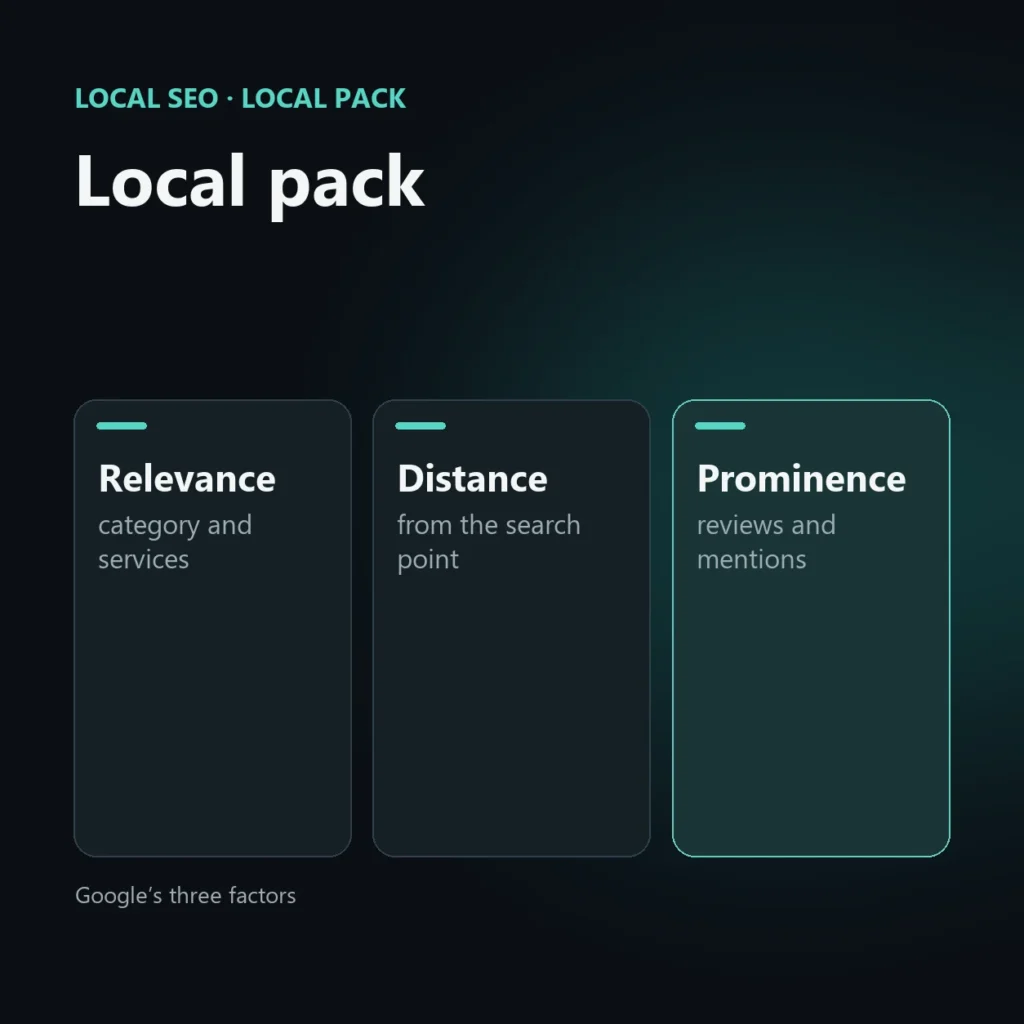
In the local pack, your competitors are the three listings Google shows on the map for a search with local intent, and they change from one point of the city to another. Analyzing them means understanding why Google picks them: based on relevance, distance and prominence, the three factors Google states for local ranking.
This guide is for businesses with premises open to the public or a real service area. It is part of the guide to online competitor analysis.
Why the local pack differs from regular SEO
In searches with local intent (“dentist near me”, “plumber Manchester”) Google shows a map with a few listings above the regular results. The result depends on where the searcher is: the same shop can appear a mile from its premises and vanish at three. So there is not one competitor: it changes by area.
The three factors Google states
- Relevance: how well the listing matches what is searched for.
- Distance: how far it is from the searcher’s location or from the area named in the search.
- Prominence: how well known the business is, based partly on reviews, links and mentions.
Of these, distance cannot be changed. You work on relevance and prominence.
How to analyze competitors
- Run the right searches. Take 5-10 local searches for your service and run them from several points in your area, with a phone or a service that simulates location.
- Note who appears in the three positions and how often, point by point.
- Open each listing and compare: primary and secondary categories, description, services, photos, hours, products, questions and answers, posts.
- Compare reviews: number, rating, frequency, owner replies, recurring words.
- Look at the linked website: the page for that area or service, the business details, consistency with the listing.
- Look at citations: which directories and local sites list the business, and with what details.
Tools
Manual search is enough to start. For a map of how visibility changes from point to point there are geographic grid tracking services, such as Local Falcon or BrightLocal: they show your rank across a grid of points around the premises. They are paid services and the results are simulations, useful for comparing over time, not for promising a position.
What to look for
| Signal | What it can tell you |
|---|---|
| Primary category different from yours | May be a relevance reason |
| Many more recent reviews | Prominence and ongoing activity |
| Services and products filled in | A more complete listing |
| A page dedicated to the area | Local on-page signal |
| Name with added keywords | Possible guideline violation: do not copy |
Mistakes to avoid
- Searching once from your home computer: the result depends on location.
- Copying a competitor’s name or improper tactics: risk of listing suspension.
- Thinking reviews alone are enough: they are a factor, not the only one.
- Ignoring the listing while working on the website, or the other way round.
Frequently asked questions
How do I see the local pack for another area?
By searching from a phone in the area, or with services that simulate location. Simulated results are indicative.
Can I beat a competitor closer to the center?
Distance matters, but it is not the only factor: relevance and prominence can compensate, and it depends on the search.
How many reviews do I need?
There is no number. Compare with competitors in your area and look at rating, recency and replies too.
Is it useful without premises?
Only with a real service area. Without premises or a service area the listing cannot be opened.
Who appears instead of you on the map?
I analyze the local pack competitors in your area and tell you what to change on your listing and website to win positions back.
Keep reading
SEO, GEO and AEO specialist
Related articles
 Local SEOBing Places for Business: Listing GuideOctober 30, 2026
 Local SEOGoogle’s playbook for local businesses: what it reveals about the algorithm’s prioritiesSeptember 24, 2026
 Local SEOLocal SEO is no longer just «optimize the listing»: the new geography of searchSeptember 24, 2026
Explore by topic