
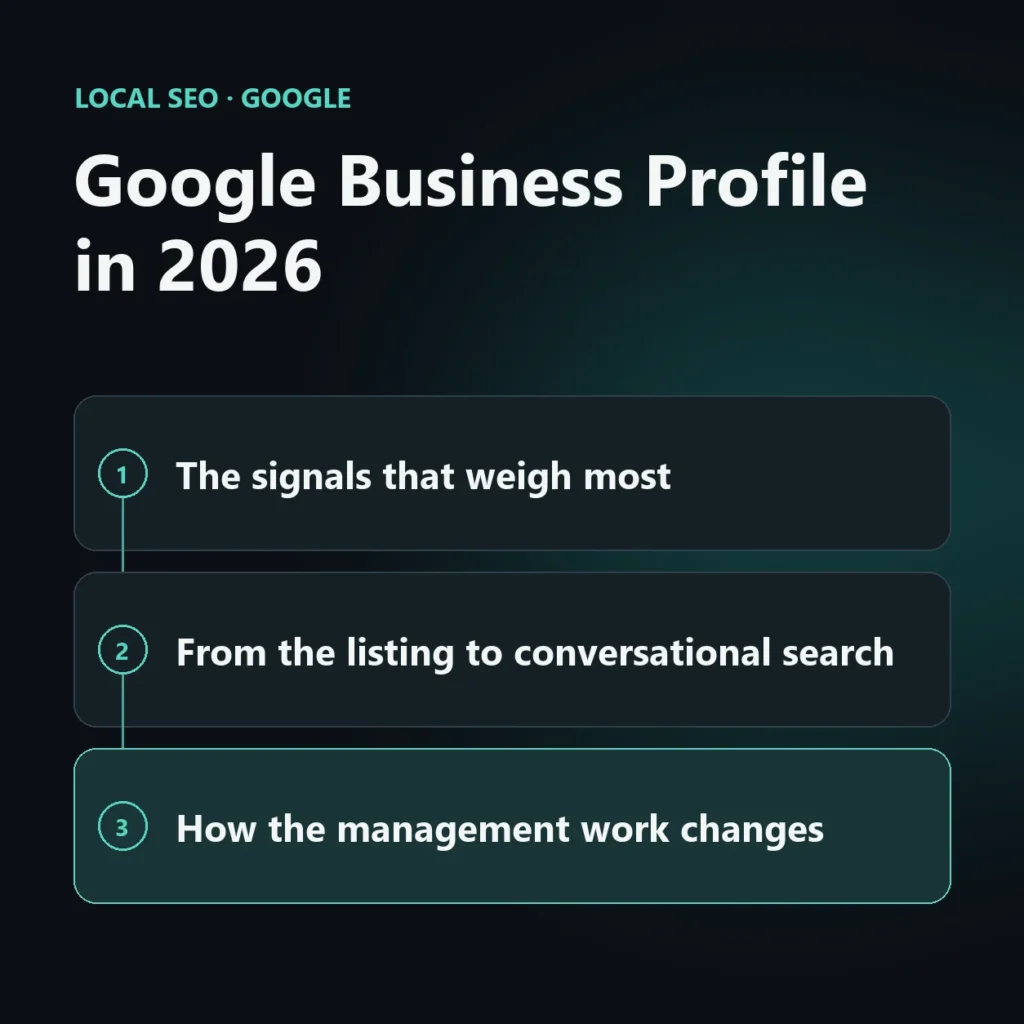
Google Business Profile in 2026 is the listing Google uses to represent a local business in searches, on maps and in answers generated by artificial intelligence. It is no longer just a list of opening hours, address and phone number: it has become an information node that feeds local search, rich results and the conversational systems users ask for advice on where to eat, get the car repaired or find a professional practice. For those running a local business, understanding what has changed in Google Business Profile 2026 means distinguishing between what has stayed stable — the centrality of the listing as a source of truth — and what instead requires a new approach, closer to structured data work than to simply filling in fields.
Google Business Profile 2026 is no longer a listing to fill in
For years the listing was treated like a form: you entered the information once and updated it rarely. In Google Business Profile 2026 this approach shows its limits, because the systems that read the listing are no longer satisfied with the main fields. Attributes, secondary categories, services, products, public questions and answers and multimedia content are interpreted as signals that must be consistent with each other. If a category says «restaurant» but the attributes don’t mention family-friendly options or accessibility, the listing communicates a blurred identity.
The practical consequence is that consistency across all fields matters more than completeness for its own sake. Better a few aligned, always up-to-date pieces of information than a listing full of contradictory details. This is particularly true for businesses with multiple locations, where each branch must have a distinct profile consistent with its own operating reality.
This is where the concept of local entity comes in. Google no longer reasons only on keywords, but on interconnected entities: the business, the neighborhood, the services, the reviews, the site’s content. Google Business Profile 2026 is one of the points where this network of entities takes shape, which is why it should be managed together with the rest of the digital presence and not in isolation.
Signals that weigh most in Google Business Profile 2026
Among the factors that have gained weight, reviews remain central but with a different nuance. It isn’t only the average that counts, but the relevance and richness of the text: reviews that mention specific services, products or detailed experiences help systems understand what the business really does. The owner’s replies, written with care and without repetitive formulas, contribute to the same effect.
Reviews and replies as content, not as passive reputation
Treating reviews as a mere reputation indicator is reductive. In Google Business Profile 2026 they represent a source of natural language that describes the business in customers’ own words. Replying specifically, citing the service or context mentioned, strengthens the link between the listing and real queries. Conversely, generic replies identical to each other add little.
The frequency of updates also plays a role. Publishing news, recent photos and periodic posts signals that the listing is alive. You don’t need a continuous flow: you need regularity and relevance to what the business actually offers in that period.
Attributes, services and structured data
Attributes and services have become a way to answer users’ precise questions. If someone looks for a business with certain characteristics, these fields make the difference. Linking with the site’s structured data — in particular with the LocalBusiness schema.org type — makes explicit what the listing declares, reducing ambiguity.
«A particular physical business or branch of an organization. Examples of LocalBusiness include a restaurant, a particular branch of a restaurant chain, a branch of a bank, a medical practice, a club, a bowling alley, etc.» — schema.org, type «LocalBusiness»
This definition remains the reference for aligning the listing with the site’s markup. If Google Business Profile 2026 describes a business with a specific location, the site should declare the same thing with the same data, with no divergence between the two sources.
From the listing to conversational search
One of the most relevant developments is the way local information is reused in answers generated by artificial intelligence. When a user asks for a recommendation in natural language, the systems draw on structured, consistent sources. Google Business Profile 2026 is one of these sources, but it only works if the information is clear and verifiable.
This changes the way you work on local SEO: it isn’t enough to optimize for a geographic keyword, you have to make the business understandable to a machine that has to describe it in one sentence. The more explicit and consistent the data, the more likely it is to be cited correctly in a synthesized answer.
The relationship with the site and the local pack
The listing doesn’t live alone. The information it provides must find confirmation on the site, in the service pages and in the structured data. This consistency is what allows a business to appear in the local pack, the block of results with a map that dominates many local searches. If the listing and the site tell different stories, the signals weaken each other.
Google Business Profile management therefore becomes an activity integrated with the work on the site, not a separate task handed to whoever only deals with the listing. Whoever manages the content and whoever updates the profile should speak the same language.
How the work of those who manage local businesses changes
The first change is cultural: Google Business Profile 2026 requires continuous oversight, not occasional interventions. Updating the listing once a year is no longer enough, because the systems reward fresh and consistent information. The second change is methodological: you need a clear process to collect, verify and publish information.
A reasonable approach provides for a regular review cycle: checking the main data, verifying attributes, updating photos, managing reviews and publishing relevant content. Consistency is worth more than intensity: small frequent updates produce better results than large sporadic interventions.
Finally, measurement matters. Not all available metrics are equally useful, but observing the trend of interactions — calls, direction requests, site visits — helps you understand whether the changes are having an effect. Google Business Profile 2026 offers more data than before, but it must be read with judgment.
| Aspect | Outdated approach | Approach in Google Business Profile 2026 |
|---|---|---|
| Data updates | Once a year | Regular, continuous cycle |
| Reviews | Only a reputation indicator | Source of language and relevance signals |
| Attributes and services | Optional fields | Elements that answer specific queries |
| Relationship with the site | Separate management | Consistency between the listing and structured data |
| Conversational search | Not considered | Citable source for generated answers |
Frequently asked questions about Google Business Profile 2026
Has Google Business Profile 2026 changed in its basic functions?
The main functions remain recognizable, but the weight given to consistency, attributes and regular updates has increased compared to the past.
Do I still need a site if I have a well-kept listing?
Yes: the listing and the site reinforce each other, and the information must match to be considered reliable.
How much does the frequency of updates matter?
Regularity matters more than quantity: periodic and relevant updates signal that the business is active.
Do reviews influence conversational search?
They can contribute, because the text of reviews describes the business in natural words that systems can interpret.
Is the site’s structured data still useful?
Yes, especially when it aligns the site with the listing and makes the type of business explicit, as in the case of LocalBusiness.
Can I manage multiple locations with the same approach?
Yes, but each location must be treated as a distinct entity, with its own data consistent with the reality of that branch.
Your Google profile stands still while your competitors climb
With 2026 here, your Google Business Profile is no longer enough to cover local searches: obsolete categories, outdated opening hours and unanswered reviews make your business slip off the map. It’s a concrete problem, visible every day in the contact requests that don’t arrive. I, with geo-seo.pro, step in right here: I reorganize the listing, align the information with the signals Google rewards and turn it into an active channel of customers. If you want to understand how I work on your listing, start here.
Keep reading
SEO, GEO and AEO specialist
Related articles
 Local SEOLocal Pack Competitor AnalysisOctober 30, 2026
 Local SEOBing Places for Business: Listing GuideOctober 30, 2026
 Local SEOGoogle’s playbook for local businesses: what it reveals about the algorithm’s prioritiesSeptember 24, 2026
Explore by topic