
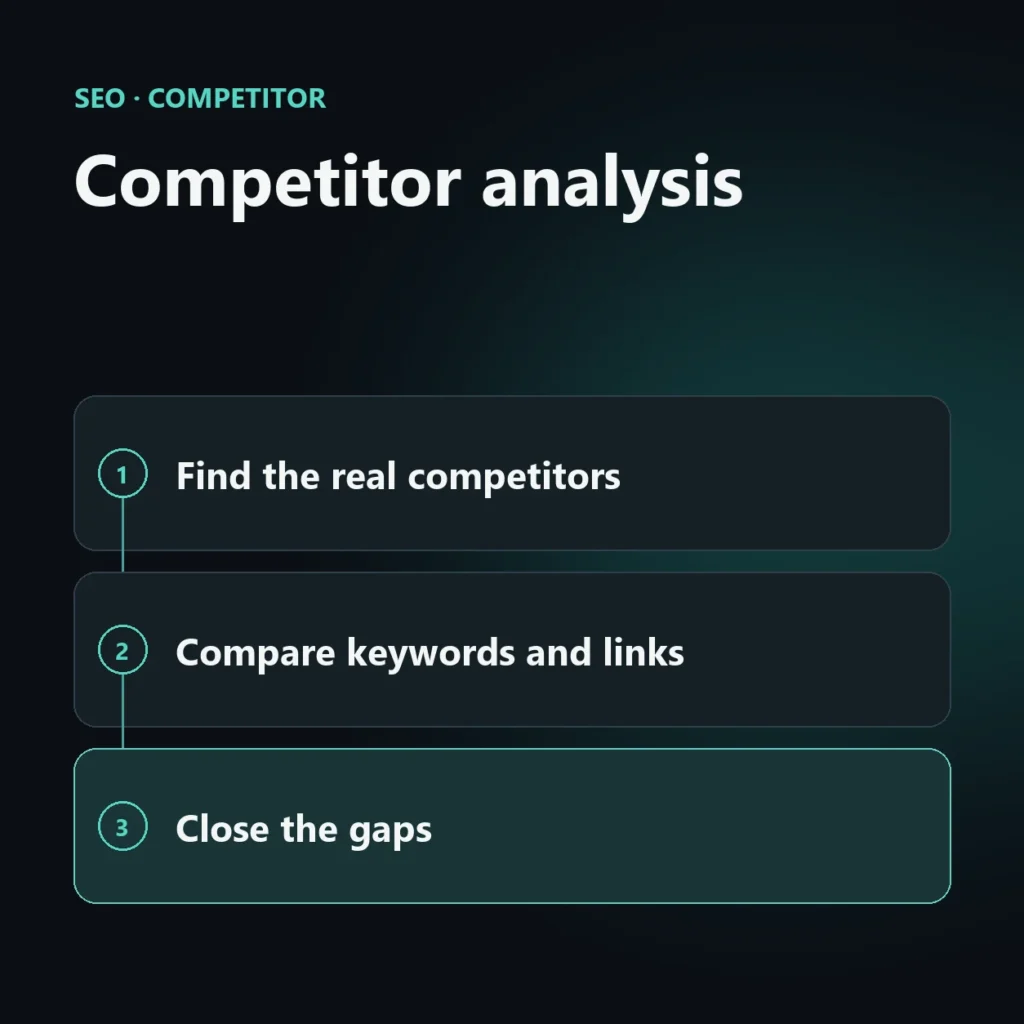
Online competitor analysis means working out who ranks ahead of you in search results, why they do, and what you can do to overtake them. It is not limited to looking at the competitors you already know: it starts from Google’s real results, because your SEO competitors are not always the ones in your industry.
This guide follows a five-step method, with free and paid tools, and says what to look at and what to ignore. It applies to any type of business.
Who your online competitors are (and why they are not who you think)
A commercial competitor sells what you sell. An SEO competitor is anyone who appears in the results for the searches you care about, even if they sell something else: a newspaper, a comparison portal, a blog, an online encyclopedia, a marketplace. For a single keyword they can be three different types of site.
The distinction matters because it changes strategy: against a direct competitor you work on offer and commercial pages, against a portal you work on informational content and authority.
Step 1: find the real competitors
- Start from your keywords. List 10-20 searches you would like to be found for. If you use Search Console, start from the queries that already bring you impressions.
- Search each one on Google in an incognito window and note the domains in the top ten. It is best to repeat the test over several days, because results change.
- Count the recurrences. The domains that appear in many searches are your main SEO competitors.
- Classify them: direct competitors, portals, publishers, marketplaces. You need it to know who you compete against and with what content.
Paid tools automate this step. Semrush, Ahrefs, Sistrix and SE Ranking have “organic competitors” or “competing domains” reports that compare the keywords two sites share. They work well, but they depend on each tool’s database and the chosen country: always check the results by hand on Google.
Step 2: compare keywords
Once you have three to five competitors, compare the keywords they rank for and you do not (sometimes called a “keyword gap”). What to look for:
- Keywords where they rank high and you do not appear: topics you have not covered.
- Keywords where you appear but lower: pages to strengthen, usually faster to improve.
- Keywords that bring them a lot of traffic with few pages: a sign of a profitable topic.
Free tool: Search Console shows your real queries, and comparing with a manual Google search shows where they beat you. Google Trends helps you see whether a topic is growing or declining. Paid tools (Semrush, Ahrefs, Sistrix, SE Ranking) allow direct site-to-site comparison.
Step 3: analyze the content
For the pages that rank above you, look by hand at:
- what type of page it is: guide, product page, service page, comparison, list;
- how long it is and how it is organized, with which headings and questions;
- whether it answers straight away or beats around the bush;
- what data, examples, images and sources it uses;
- when it was last updated.
The goal is not to copy, but to understand what Google considers useful for that search and where the competing page is weak. Old, generic content with no concrete examples is an opportunity.
Step 4: look at the links (backlinks)
Inbound links are one of the reasons one page beats another. Ahrefs, Semrush and Sistrix have reports showing the sites that link to a competitor and not to you (sometimes called a “backlink gap”). The aim is to understand what kinds of sources link to them: trade publications, directories, partners, mentions in articles. Not every link can be replicated and chasing quantity does not pay: what counts is whether there is a concrete reason for that site to cite you too.
Step 5: look at AI answers too
Today a competitor is also whoever is cited in the answers of Google AI, Copilot, ChatGPT and Perplexity. Ask the questions your site should answer and note which sources appear. Cited sources can differ from those on Google’s first page. Some paid tools are adding AI-answer visibility reports, but they are recent and the metrics are not yet standardized: use them as an indication, not an exact measure.
Tools: what each one does
| Tool | Useful for | Cost |
|---|---|---|
| Google (manual search) | Seeing real competitors, rich results, AI answers | Free |
| Search Console | Your real queries, pages and positions | Free |
| Google Trends | A topic’s trend over time | Free |
| Semrush, Ahrefs, Sistrix, SE Ranking | Comparing keywords and links between sites, traffic estimates | Paid, with trials or limited plans; check each site |
| Similarweb | Traffic estimates and where a site’s visitors come from | Limited free version and paid plans |
All data from paid tools are estimates: nobody except the site owner sees a competitor’s real traffic. They are for comparing orders of magnitude and trends, not for quoting exact numbers.
Mistakes to avoid
- Analyzing only the competitors you know. The ones that matter to Google may be others.
- Trusting an estimate as if it were data. Traffic estimates can be far off.
- Copying competitors’ content. You always lose against whoever published the same thing first.
- Chasing keywords irrelevant to your offer. Traffic that does not bring enquiries is no use.
- Doing the analysis only once. Results change: repeat it every three to six months.
What to do with it: a three-move plan
- Strengthen the pages that already rank but sit below competitors: they are the quickest to improve.
- Write the missing content that competitors have and you do not, if it is relevant to your services.
- Build authority where competitors are cited and you are not: mentions, partnerships, contributions to industry sites.
More on competitor analysis
- How to find your real SEO competitors
- Competitors in AI answers: who gets cited
- Backlink gap: analyzing competitor links
- Content gap analysis: what competitors write and you do not
- Local pack competitor analysis
- Google Ads competitor analysis
Frequently asked questions about online competitor analysis
How do I find my SEO competitors?
Search Google for the keywords you want to appear for and note the domains in the top ten. The ones that recur across several searches are your SEO competitors.
Do I need paid tools?
Not to start: Google, Search Console and a spreadsheet are enough. Paid tools save time and allow large-scale comparison, but their data are estimates.
Which tool is better, Semrush or Ahrefs?
It depends on what you need and the country: compare them with a trial on your industry, because databases and estimates differ. There is no answer valid for everyone.
Can I see a competitor’s real traffic?
No. Tools estimate traffic from rankings and search volume: they are indications, not measurements.
How often should I redo the analysis?
Usually every three to six months, or after a drop in rankings, an algorithm update or a new competitor entering.
Want to know who is ahead of you and why?
I identify your real competitors in search, compare keywords, content and links, and show you where to start to win positions back.

SEO, GEO and AEO specialist
Related articles
 SEOContent Gap Analysis: What Competitors Write and You Don’tOctober 30, 2026
 SEOBacklink Gap: Analyzing Competitor LinksOctober 30, 2026
 SEOHow to Find Your Real SEO CompetitorsOctober 30, 2026
Explore by topic