
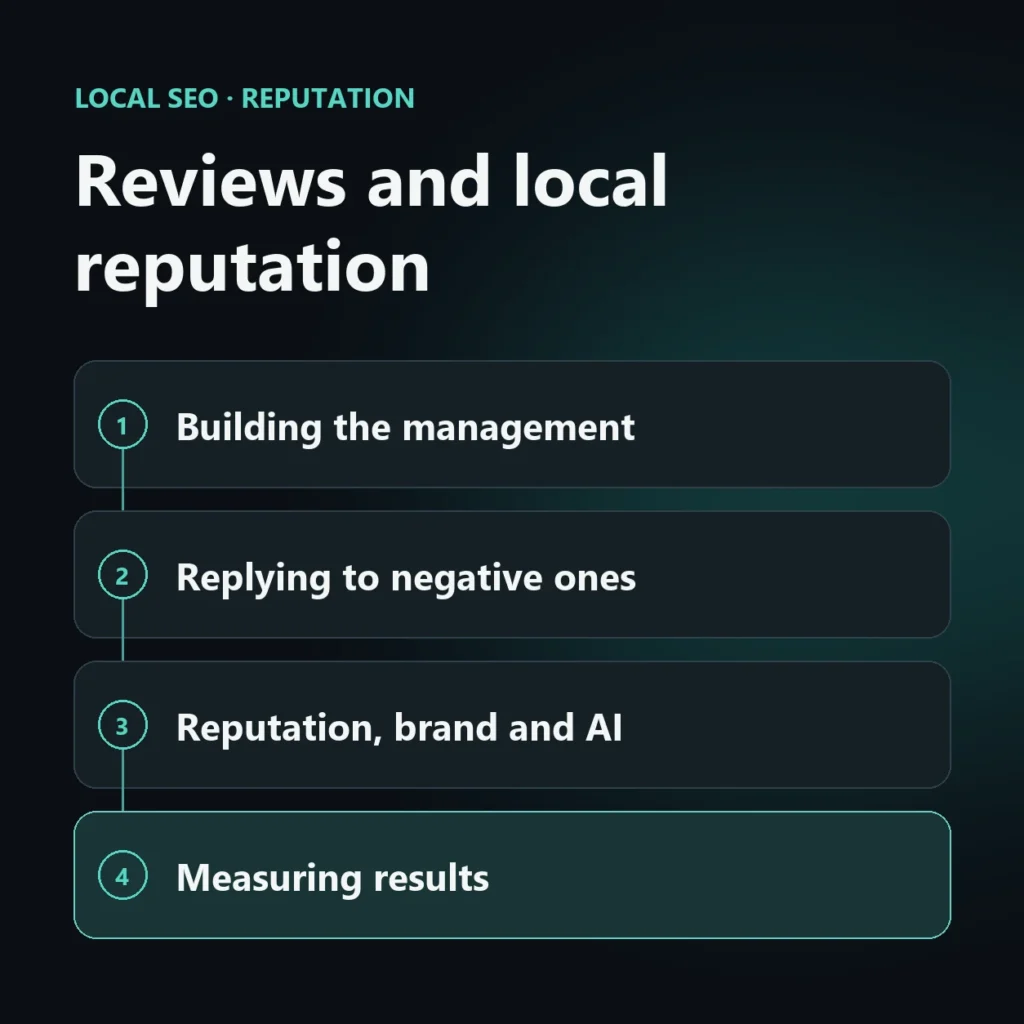
Local review management is the set of activities with which a business monitors, solicits and responds to customers’ opinions on review platforms, turning them into an asset of visibility and trust. It isn’t an operational detail to delegate at the end of the day: it is the point where reputation, buying behavior and local ranking meet. Those looking for a business near them read other people’s opinions before deciding, and the algorithms of search engines and generative artificial intelligence systems use those same signals to understand whom to trust. In this article we see why local review management has become a discipline of its own, how it integrates with SEO and GEO, and which practices really work.
Why reviews weigh more than any technical trick
Local algorithms, whether the Google map pack or the models that generate synthesized answers, are designed to return useful and reliable results. Reviews are one of the few signals that can’t be easily faked at scale: they tell real experiences, in natural language, and for this reason they are weighted. A business with many recent and detailed opinions transmits an idea of vitality and reliability that no on-page optimization can replicate alone.
This also applies to generative search. When an AI assistant answers a question like «what is the best dental practice in the area», it draws on sources it considers authoritative, and aggregated reviews are among them. Local review management therefore stops being a customer care activity and becomes a ranking lever: the more consistent and well-managed opinions, the greater the chance of being cited as a reference.
Then there is the halo effect. A profile with carefully tended reviews, timely replies and no episode left to fester attracts more clicks, more calls and more physical visits. And those user behaviors, in turn, strengthen the signals engines read. It is a self-reinforcing loop, positive or negative.
How to build effective local review management
The first rule is consistency. You don’t need a barrage of requests in a single week followed by months of silence: systems reward a regular flow. Asking for an opinion right after a positive interaction, with a simple channel and a non-intrusive message, is the cleanest way to feed the profile. The Google review management remains the heart of the work, because that is where most local purchase decisions are concentrated.
Reply, always, and with judgment
Every review deserves a reply, even the enthusiastic one. Thanking specifically, citing a detail of the service, shows that behind the profile there is an attentive person. On critical opinions the reply is even more important: you don’t argue to be right, you acknowledge the problem, explain what happened and propose a solution. Readers aren’t looking for perfection, they are looking for proof that the company knows how to handle problems.
Turning reviews into content
Opinions contain the words customers really use: service names, problems solved, neighborhoods, specific needs. Rereading them carefully is a concrete way to enrich descriptions, local pages and answers to frequently asked questions. In this sense local review management also feeds traditional SEO, because it suggests the real language of demand.
What to do when fake or aggressive reviews arrive
Sooner or later it happens. An unscrupulous competitor, a customer never served, a former employee: fake reviews exist and must be dealt with methodically, not instinctively. The first move is to document, then understand whether the content violates the platform’s guidelines. If the violation is evident, you proceed with the formal report; in parallel it is worth publishing a professional reply, because even those reading a fake review judge how the company reacts. On operating procedures I have collected a practical guide on how to report fake reviews, useful when you need to move fast without making mistakes.
The point is not to let a single episode define the profile. Mature local review management also includes a plan for unpleasant cases: who replies, in what tone, within what time, with what escalation. Having the procedure ready before it is needed makes the difference between contained damage and a crisis.
It is worth remembering that transparency pays. Don’t remove legitimate criticism, don’t buy opinions, don’t inflate numbers: these are shortcuts that algorithms and users sooner or later expose, with effects far costlier than the initial problem.
Local reputation, brand and artificial intelligence
Reviews don’t live in isolation: they are one piece of the overall brand reputation. What is said about a business on local platforms, on social media and in forums contributes to forming the image that engines and generative models have of that brand. A consistent and well-managed reputation makes it more likely that a business will be cited as a reliable source in automated answers.
This shifts the center of gravity of local review management: it is no longer enough to collect stars, you have to build a recognizable story. Positive sentiment, recurring themes, consistency between what the site promises and what customers say. This is where local SEO and GEO fuse, because both work on the same raw material: trust.
A business that replies, updates and cares for its profile sends a constant signal of activity. And recent activity is one of the factors local systems consider in deciding whom to show at the top.
| Approach to local review management | What it communicates | Effect on local visibility | Risk |
|---|---|---|---|
| Regular flow with timely replies | A living business, attentive to the customer | Strengthens ranking and trust | Low, requires consistency |
| Requests concentrated in a single wave | Artificial spike | Short, unstable benefit | Medium, suspected manipulation |
| Reviews bought or improperly incentivized | Inflated numbers | Possible initial boost | High, penalties and loss of trust |
| No replies, neglected profile | Indifference toward customers | Penalizes over time | High, reputation eroding |
The table clarifies one simple thing: local review management is not a one-off intervention, it is a process. And like every process, it yields results proportional to the consistency with which it is fed.
«97% of consumers read reviews for local businesses» — BrightLocal, “Local Consumer Review Survey”
This survey confirms what we see every day: almost everyone consults reviews before choosing a local business. It isn’t a secondary channel, it is the first filter of the decision. Ignoring it means letting others write our story.
Measuring results without chasing only stars
The average star rating is useful but insufficient. What counts is volume, freshness, the distribution of ratings and above all the content: which themes emerge, which objections come back, how customers react to the replies. Well-done local review management also tracks how many people reach the profile and then contact the company, because the review is a point of passage, not the finish line.
A good dashboard looks at a few indicators: new reviews in the period, average response time, share of reviews with a reply, evolution of the sentiment. From there you understand whether the work is paying off or whether you need to change approach. Measuring serves to correct, not to congratulate yourself.
Finally, integrating local review management with the rest of the digital strategy avoids scattered effort: the same keywords, the same messages, the same brand promise must be found on the site, in the profile and in replies to customers. When everything speaks the same language, engines and people perceive it.
Frequently asked questions about local review management
How long does it take to see results from reviews?
It depends on the starting point and on consistency: the first effects on trust and clicks are noticed as the flow becomes regular, while consolidating local ranking takes months of continuous activity.
Should I reply to positive reviews too?
Yes, always. A short, personalized reply shows attention and encourages other customers to leave their opinion.
Can I ask customers to leave a review?
You can and you should, as long as the request is neutral and offers no incentives in exchange for the rating: asking for an opinion is legitimate, buying one is not.
How do I react to a negative review?
Reply calmly, acknowledge the problem, explain what you did and propose a solution, without arguing or attacking whoever wrote it.
Do reviews also influence AI search?
Yes. Generative systems rely on sources they consider reliable, and a profile with consistent, well-managed opinions increases the likelihood of being cited.
Better a few excellent reviews or many average ones?
Balance counts: a credible volume that is steady over time is worth more than a few isolated perfect ratings, because it signals a business that is genuinely active.
When reviews don’t tell who you really are
It happens often: the business works well, customers are satisfied, and yet on Google there are few stars, old ratings or silence. Meanwhile a competitor with lower quality but more recent reviews appears before you on the map. Local reputation can’t be improvised: it must be built with a steady flow of requests, carefully written replies and consistent signals that algorithms read as reliability. It is exactly the work I do on geo-seo.pro, integrating reviews and local visibility into a single strategy.
Keep reading
 Local SEOLocal SEO is no longer just «optimize the listing»: the new geography of searchSeptember 24, 2026
 Local SEOGoogle Business Profile in 2026: what has changed for local businessesSeptember 24, 2026
 Local SEOReal photos vs stock: why local visual content matters more than you thinkSeptember 24, 2026
SEO, GEO and AEO specialist
Related articles
 Local SEOLocal Pack Competitor AnalysisOctober 30, 2026
 Local SEOBing Places for Business: Listing GuideOctober 30, 2026
 Local SEOGoogle’s playbook for local businesses: what it reveals about the algorithm’s prioritiesSeptember 24, 2026
Explore by topic