
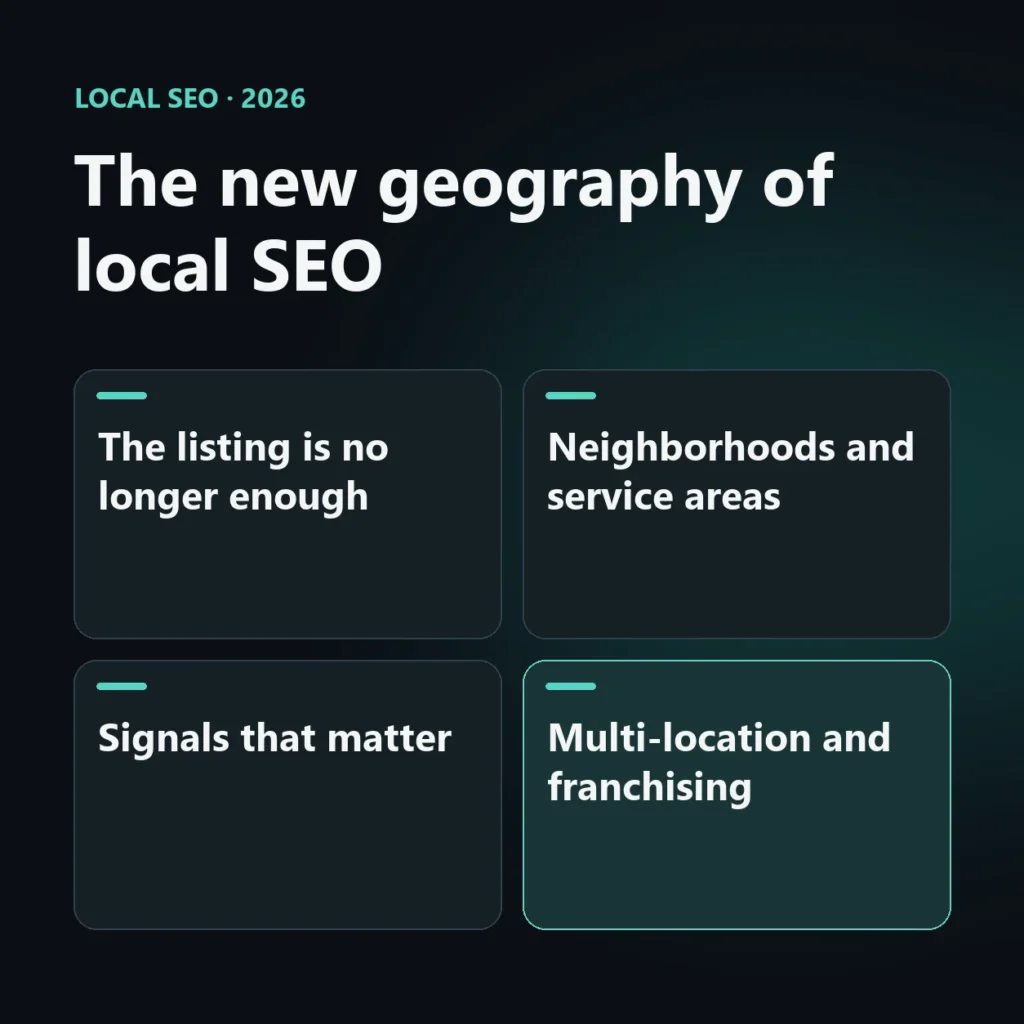
Local SEO 2026 no longer consists only of optimizing a Google Business Profile listing, but of covering a search geography that has fragmented into conversational queries, maps, voice assistants and generated results. For years, local business played out almost entirely on a single battlefield: the company’s profile on Google, with categories, hours, photos and reviews. Today that field remains central, but it is no longer enough, because users search in different ways, on different surfaces, with increasingly granular intents. Those who work on local SEO 2026 must rethink their model: not a list of one-off optimizations, but a geographic strategy distributed across multiple touchpoints.
Why the listing is no longer enough: search has moved
The first break with the past is in the very nature of the query. Users no longer type just «plumber Milan», but formulate requests like «who can come this afternoon in the Isola area to fix a leak». These are long, contextual, often voice queries, which engines must interpret by combining location, time, intent and availability. The local SEO 2026 starts right here: from understanding a geographic intent that is no longer just a city name.
This changes the way content is built. A page that merely repeats the city name in every paragraph no longer intercepts anything relevant. You need pages that answer concrete needs, tied to neighborhoods, specific services, usage situations. The Google listing remains the landing point, but the work of attraction shifts to the site’s pages and their ability to speak the language of real demand.
In parallel, local results have been enriched with generated elements: summaries, suggestions, synthesized answers. Users can get an answer without ever clicking on a listing. For this reason the local SEO 2026 must also think in AEO terms, that is, optimization for answers, not just for positions.
The new geography: neighborhoods, travel radii and micro-areas
The geography of local search no longer coincides with administrative boundaries. A user in Milan doesn’t think «Milan», they think of their neighborhood, their street, the travel time. Engines, for their part, increasingly reason in terms of real proximity and travel radii. This means a business can be very strong in a micro-area and almost invisible a few kilometers away.
Consequently, the work on local SEO 2026 requires a fine-grained mapping of the territory: not «the city», but the areas that generate demand and that the company can actually serve. For those who manage multiple points of sale, this approach becomes an information architecture problem, well described in the strategies of multi-location SEO, where each location must have its own coherent space without cannibalizing the others.
From boundaries to service areas
A recurring mistake is describing the service area as an endless list of municipalities, hoping to cover more queries. Engines recognize these lists as artificial and treat them with suspicion. Better a few real areas, told with content that explains their context: response times, peculiarities of the area, most requested services. It is a qualitative approach that the local SEO 2026 rewards over the old logic of blanket coverage.
The role of proximity in rankings
Proximity remains one of the strongest factors in local results, but it isn’t a factor you can «optimize» directly. You can however work on everything that goes with it: page relevance, profile authority, consistency of information. Those who excel at Google Maps ranking know that physical closeness opens the door, but it is the quality signals that keep the user in.
Signals that really matter in local SEO 2026
If the listing is no longer the only ground, which signals should you focus your energy on? The first is consistency. Name, address, phone number, categories and descriptions must match across site, profile, directories and structured data. Inconsistencies, even small ones, dilute the trust that engines attribute to a business.
The second signal is the depth of local content. A well-made service page with a territorial angle is worth more than ten generic pages. The local SEO 2026 requires content that demonstrates expertise on a specific area, not just the presence of a geographic keyword.
The third is user behavior: clicks, calls, direction requests, time on page. These are signals engines observe and that tell whether a business really satisfies those who find it. Working on the post-click experience, from the listing to the page, is by now an integral part of the strategy.
Reviews and localized social proof
Reviews remain a pillar, but their value grows when they are specific: they mention the service, the neighborhood, the problem solved. A detailed review enriches the profile and gives engines useful semantic material. In local SEO 2026, inviting customers to tell their experience concretely is more useful than chasing the raw number.
Structured data and clarity for machines
Structured data helps engines understand who you are, where you operate and what you offer. It isn’t a shortcut to ranking, but it reduces ambiguity. In a context where answers are generated automatically, being understandable to machines becomes a concrete competitive advantage.
Multi-location and franchising: geography becomes architecture
When locations multiply, search geography becomes a site architecture problem. Each point of sale has its own catchment area, its own queries, its own reviews. If pages overlap, the locations compete with each other and engines don’t know which to show. The franchise SEO guide insists on exactly this point: clear structure, distinct content, no duplication.
The local SEO 2026 for networks requires central direction and local execution. The brand defines guidelines, templates and standards; each location adds what makes it unique: staff, services, territory, testimonials. It is a delicate balance, but it is the only way to stay visible at scale without flattening out.
Another critical element is review management at network level. Replying in a uniform, impersonal way cancels the advantage of localization. Replies that mention the location, the service and the context strengthen the geographic signal and improve the perception of those who read.
Measuring local SEO beyond position
For years the king metric was the position on the map. Today it is a partial measure. The local SEO 2026 is evaluated on a set of indicators: visibility in the different areas, calls generated, direction requests, clicks to the site, conversions per location. This is data that tells the real impact, not just the ranking.
It is useful to segment metrics by area, because a citywide average hides enormous differences between neighborhoods. A location can grow in the suburbs and decline downtown, and without a granular reading the phenomenon remains invisible. Measurement thus becomes a decision-making tool, not just a reporting one.
| Approach | Main focus | Limit in the current context | Usefulness in local SEO 2026 |
|---|---|---|---|
| Optimized listing only | Google Business Profile | Doesn’t capture complex, conversational queries | Necessary but not sufficient foundation |
| City keywords | Repetition of the place name | Not very relevant for micro-areas and specific intents | Superseded by contextual content |
| Pages per location | Multi-location architecture | Risk of duplication if not differentiated | Essential for networks and franchises |
| Content for service areas | Micro-geography and intent | Requires real knowledge of the territory | High relevance and authority |
| Optimization for answers | AEO and structured data | Doesn’t replace local presence | Complementary and growing |
Frequently asked questions about local SEO 2026
Does local SEO 2026 still require the Google Business Profile listing?
Yes, it remains the indispensable starting point, but on its own it is no longer enough: it must be integrated with content on the site and a broader geographic strategy.
What is the difference between local SEO and AEO in a geographic context?
Local SEO aims to appear in geolocated results, AEO to be the answer selected by assistants and generated summaries.
Do I need a page for every neighborhood I cover?
Not automatically: you need pages only where there is real demand and distinctive content, otherwise you create harmful duplication.
How do I manage local SEO with multiple locations?
With a clear architecture, a dedicated page per location and differentiated content, avoiding overlap between catchment areas.
Do reviews still count in local ranking?
Yes, especially when they are specific and mention service and territory, because they enrich the profile with useful signals.
How do you measure local SEO success today?
Not only with map position, but with calls, direction requests, clicks and conversions segmented by area.
The search map has changed
Anyone looking for a service near them no longer finds a list of ten links: they find a map, a box, a synthesized answer. If your business doesn’t appear there, it doesn’t exist — and no traditional report will ever tell you. This is exactly what I work on: understanding how search geography is being rewritten for your sector and placing your presence where people really decide. It isn’t about adding a plugin, but about rethinking your local visibility the way it is searched today.
Keep reading
SEO, GEO and AEO specialist
Related articles
 Local SEOLocal Pack Competitor AnalysisOctober 30, 2026
 Local SEOBing Places for Business: Listing GuideOctober 30, 2026
 Local SEOGoogle’s playbook for local businesses: what it reveals about the algorithm’s prioritiesSeptember 24, 2026
Explore by topic