
Local SEO photos are authentic images, taken in the territory where a business operates, optimized for local and geographic search. It isn’t an aesthetic detail, but a signal that search engines and AI-based assistants use to understand where a company really is, what it does and how credible it is. In an ecosystem where answers are increasingly generated from verified sources, the right image can make the difference between being cited and disappearing. That is why it is worth thinking seriously about real photos versus stock images, and about how to build a visual asset base that works for local visibility.
Why local SEO photos matter more than it seems
When a user looks for a restaurant, a dental practice or a craftsman in their own city, they expect to see that place, not a generic image bought from a catalog. The match between what appears online and what physically exists is a trust factor, and trust is the fuel of local conversions. Stock images, however polished, tell a reality that belongs to no one: they are interchangeable and, precisely for this reason, forgettable.
Search engines, for their part, extract information from images in increasingly sophisticated ways. They analyze metadata, alt text, the page context and even recognizable elements within the shot. A well-built local SEO photo gives these systems consistent clues: a shop’s facade, a sign, a monument in the background, a street plate. These are all signals that strengthen the association between the business and a precise place.
Then there is the dimension of voice and conversational search. More and more people ask their assistant «what’s the best pizzeria near me» or «a plumber available in the area». In these scenarios, authentic visual content helps the platform choose which listing to show, because it contributes to that sense of proximity that no text alone can convey.
The weight of consistency between image and territory
An image that shows a recognizable context works like a signature. If your venue is on a characteristic street, if your workshop has a particular facade, if your team wears uniforms with the business name, all of this becomes precious material. Consistency between image and territory reduces ambiguity and helps algorithms place you in the right geographic area, a bit like what happens with the information that feeds the local pack.
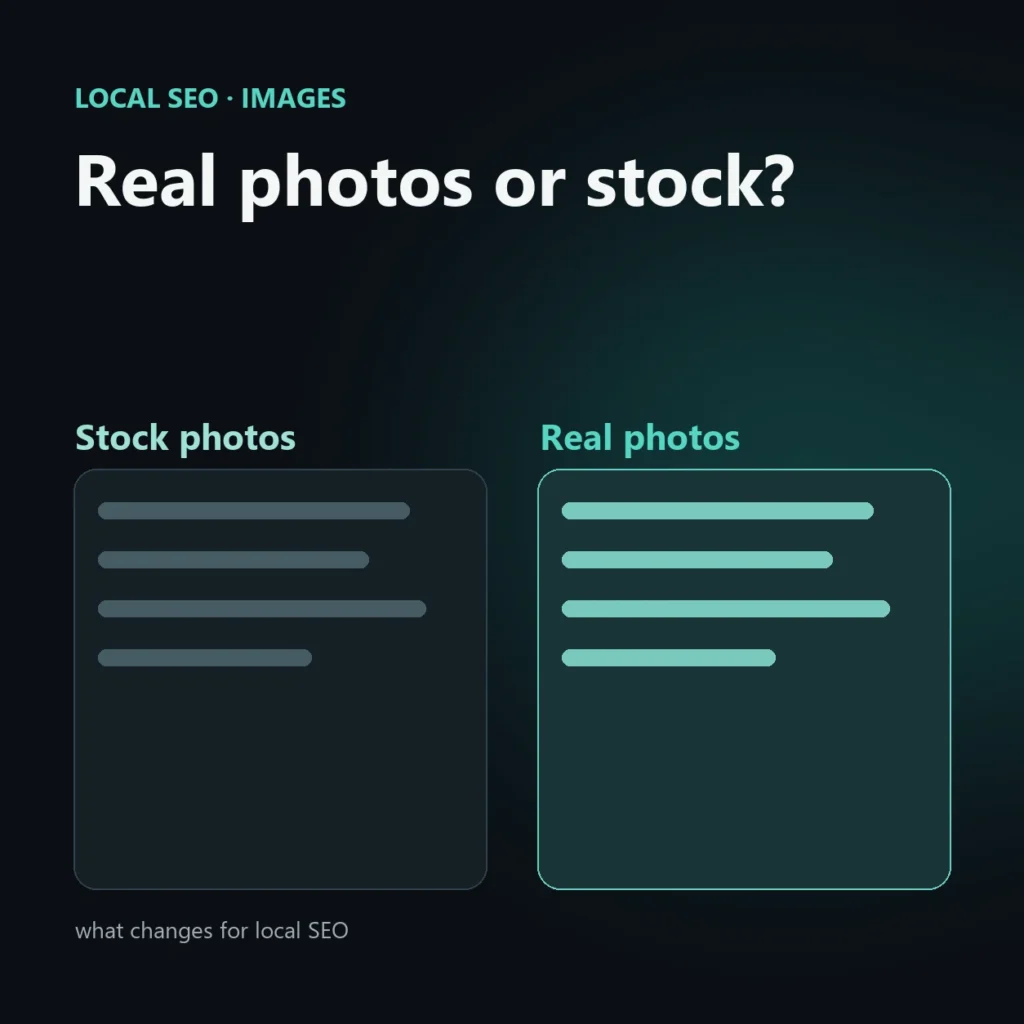
Real photos versus stock images: what really changes
Stock images have an obvious advantage: they are quick to find and often technically perfect. But perfection, in a local context, can work against you. A glossy smile in a sterile office says nothing about who you are, where you are and why they should choose you. Real photos, even with some imperfections, convey presence and authenticity, two elements users perceive immediately.
From the standpoint of indexing, original images tend to be unique: nobody else owns them, nobody else has already uploaded them. This makes them easier to associate with a single entity. Stock images, by contrast, circulate on thousands of sites and risk diluting the signal, because the same image points to a hundred different businesses in a hundred different cities.
There is also a question of durability. A stock photo ages and becomes anonymous; a real photo tells a story that evolves over time. Periodically updating the visual asset base with new shots keeps the site alive in the eyes of engines and users, and offers natural occasions to refresh texts, captions and descriptions.
Impact on trust and conversion rate
Those who visit a local site look for concrete reassurance. Seeing the owner’s face, the inside of the shop or a finished job creates a sense of familiarity that no generic image can replicate. Visual trust often translates into more qualified contacts, because the user arrives with realistic expectations about what they will find.
How to optimize local SEO photos without losing authenticity
Optimizing doesn’t mean turning a shot into an artifice. It means accompanying it with the right information. The file name, the alt text, the caption and the page context are all spaces where you can strengthen the link between image and location. Good alt text describes what is seen and adds the geographic reference naturally, without keyword accumulation.
Format and weight matter too. Images that are too heavy slow down loading and hurt the experience, especially on mobile, where much of local search happens. Compressing without losing perceived quality is a basic but often neglected practice. The same goes for dimensions: adapting images to the contexts in which they are shown avoids waste and improves rendering.
An often underrated aspect concerns consistency between the site’s images and those published elsewhere. If you upload the same photos to your business listing, on social media and on the site, you create a recognizable visual identity. This consistency helps users recognize you and systems link the different sources to a single entity. It is a principle that integrates well with a proper Google Business Profile management, where images play a central role in presenting the business.
Common mistakes to avoid with local images
One of the most frequent mistakes is uploading images with no description, letting the file name be a sequence of letters and numbers. Another is using stock photos of places that don’t exist or that belong to other cities, creating expectations you will disappoint at first contact. Misalignment between image and reality is one of the quickest ways to lose credibility, in the eyes of both users and algorithms.
The opposite excess should also be avoided: endless galleries of similar shots, with no hierarchy or selection. Better a few strong, well-contextualized images than a messy archive in which the user gets lost. The quality of the selection tells your level of care, a signal that also counts for brand perception.
Local SEO photos and content: integrated work
Images don’t live in isolation: they are part of a broader story. If you are working on content creation for your site, consider photos as chapters of a visual narrative. An article about a neighborhood, a services page, a product page: each can host shots that add context and value, not mere fillers.
This integrated approach also works well in the GEO dimension, the one tied to visibility in answers generated by artificial intelligence. Assistants tend to favor sources that show consistent, verifiable signals. A site with authentic images, well-structured texts and clear geographic references gives them more material on which to build a reliable answer. Entity and context thus become the two pillars on which local visibility rests.
It is worth remembering that images also contribute to accessibility. Accurate alt text allows those who can’t see the image to understand its content, and at the same time gives engines valuable information. It is a double benefit that rarely requires extra effort, just a little more attention at publishing time.
Measuring the effect of images on local traffic
To understand whether local SEO photos are working, look at the data carefully. Images can generate visits through image search, but also contribute indirectly to the ranking of the pages that host them. Compare the behavior of pages with original images and those with generic images: differences often emerge in time on page and in interactions.
Don’t expect immediate results. Work on images is cumulative: every authentic shot adds a piece to your business’s story and gradually strengthens its local presence. Consistency, more than intensity, is what produces lasting effects.
| Aspect | Real local photos | Stock images |
|---|---|---|
| Uniqueness | High, not replicated elsewhere | Low, shared across many sites |
| Geographic signal | Strong, tied to the territory | None or generic |
| Perceived trust | High, they show reality | Limited, perceived as generic |
| Impact on conversion | Favorable, they reduce uncertainty | Neutral or negative |
| Maintenance over time | Requires periodic updates | None, but they age |
Frequently asked questions about local SEO photos
Should stock photos always be avoided?
No, they can serve for neutral contexts such as icons or abstract backgrounds. But they should never replace the images that tell your business and your territory.
How many real photos does a local site need?
There is no fixed number: better a few meaningful, well-contextualized images than a scattered archive. The quality of the selection counts more than quantity.
Do local SEO photos also help image search?
Yes, because unique images with accurate alt text are more likely to be associated with a specific entity and location, increasing visibility in image searches.
Do I need a professional photographer for local photos?
It isn’t essential, but a careful shot helps. Good light and an orderly composition make a difference even with simple means.
How do I write the alt text of a local photo?
Describe what is seen and add the geographic reference naturally, avoiding keyword accumulation. A clear sentence is worth more than a list of terms.
Do real photos influence visibility in AI answers?
They help strengthen the consistency and authenticity signals that assistants use to choose sources. They are not the only factor, but they help build a credible profile.
Stock photos on your Google profile make you look like everyone else
You chose stock images to quickly fill your business listing, but now the profile looks like that of a hundred competitors and customers don’t recognize your business when they meet it on Maps. Real photos of the premises, team and products build trust and set you apart, but managing them well across formats, order and updates takes time and method. I take care of it: I manage your Google Business Profile with authentic images and a consistent listing, designed to get you found and chosen by those who are genuinely looking for your services in your area.
Keep reading

SEO, GEO and AEO specialist
Related articles
 Local SEOLocal Pack Competitor AnalysisOctober 30, 2026
 Local SEOBing Places for Business: Listing GuideOctober 30, 2026
 Local SEOGoogle’s playbook for local businesses: what it reveals about the algorithm’s prioritiesSeptember 24, 2026
Explore by topic