
Local SEO for multi-location businesses requires a dedicated page for each location, with unique content, a separate Google Business Profile listing per location and NAP (Name, Address, Phone) consistency across all online sources. Treating all locations as a single entity is the most common mistake.
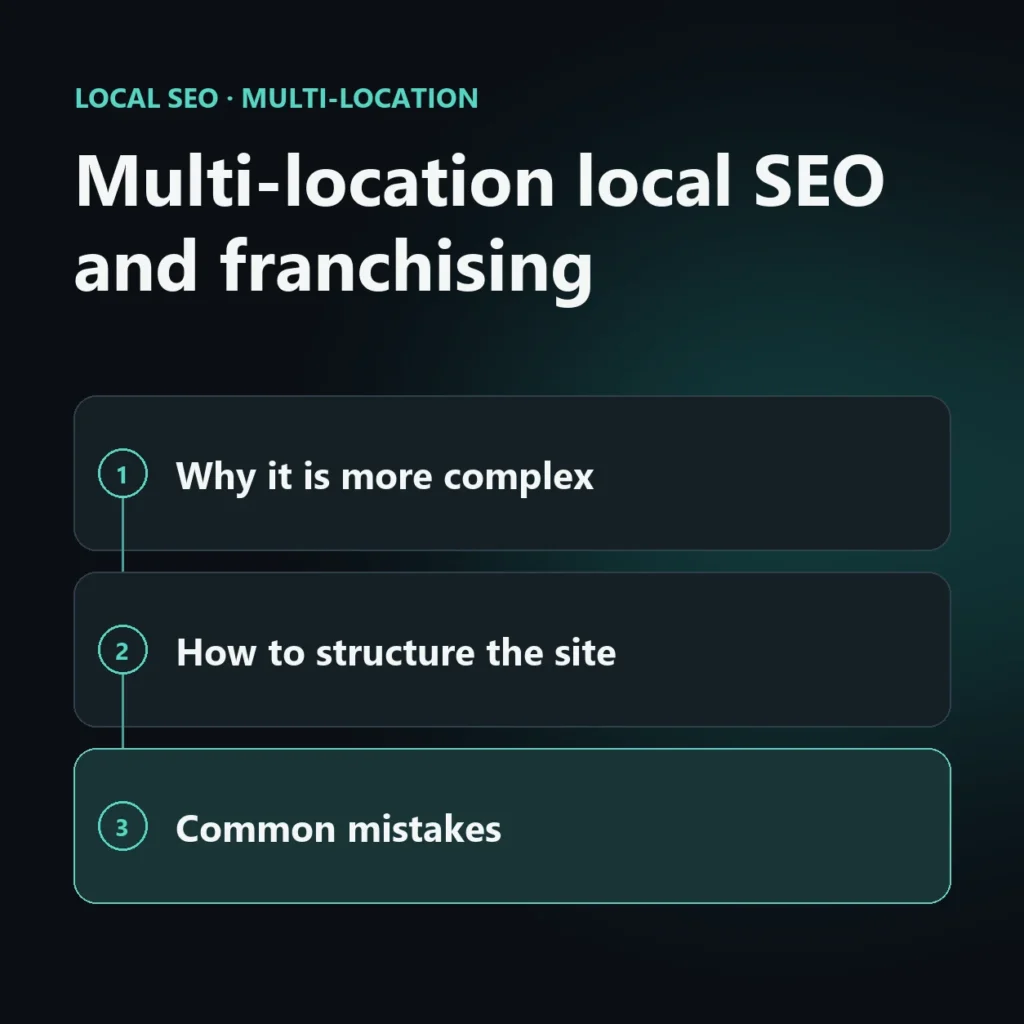
Why multi-location is more complex than standard local SEO
Each location competes for the same local searches but with a geographically different audience: “plumber Milan” and “plumber Turin” are distinct searches that require separate content and listings, not a single “About us” page listing the cities served.
How to structure the site for multi-location
One page per location
Each location must have a dedicated URL (e.g. /locations/milan/) with address, opening hours, local reviews and specific content — not text copied and pasted with only the city name changed, which Google can penalize as duplicate or low-value content.
One Google Business Profile listing per location
Every physical location needs its own Google Business Profile listing, verified individually, with the category, hours and photos specific to that location.
LocalBusiness schema markup for every location
The LocalBusiness structured markup must be implemented on every location page, not generically on the home page, to help Google match the right page to the geolocated search.
Common mistakes in multi-location local SEO
The most frequent are: inconsistent NAP across the site, Google Business Profile and local directories; duplicate content across location pages; and cannibalization, when two location pages end up competing for the same query instead of covering distinct areas. A dedicated multi-location SEO service structures the architecture to avoid these problems from the start.
Frequently asked questions about multi-location local SEO
Do I need a different page for each location even if the service is identical?
Yes, because Google evaluates geographic relevance: a generic page reduces the chances of appearing in specific local searches.
How do you avoid cannibalization between nearby locations?
By clearly defining the service area of each location and differentiating the content based on real local characteristics, not just the city name.
Is a subdomain for each location worth it?
Generally no: a subfolder (e.g. /locations/milan/) on the same domain consolidates SEO authority better than separate subdomains.
Keep reading
SEO, GEO and AEO specialist
Related articles
 Local SEOLocal Pack Competitor AnalysisOctober 30, 2026
 Local SEOBing Places for Business: Listing GuideOctober 30, 2026
 Local SEOGoogle’s playbook for local businesses: what it reveals about the algorithm’s prioritiesSeptember 24, 2026
Explore by topic