
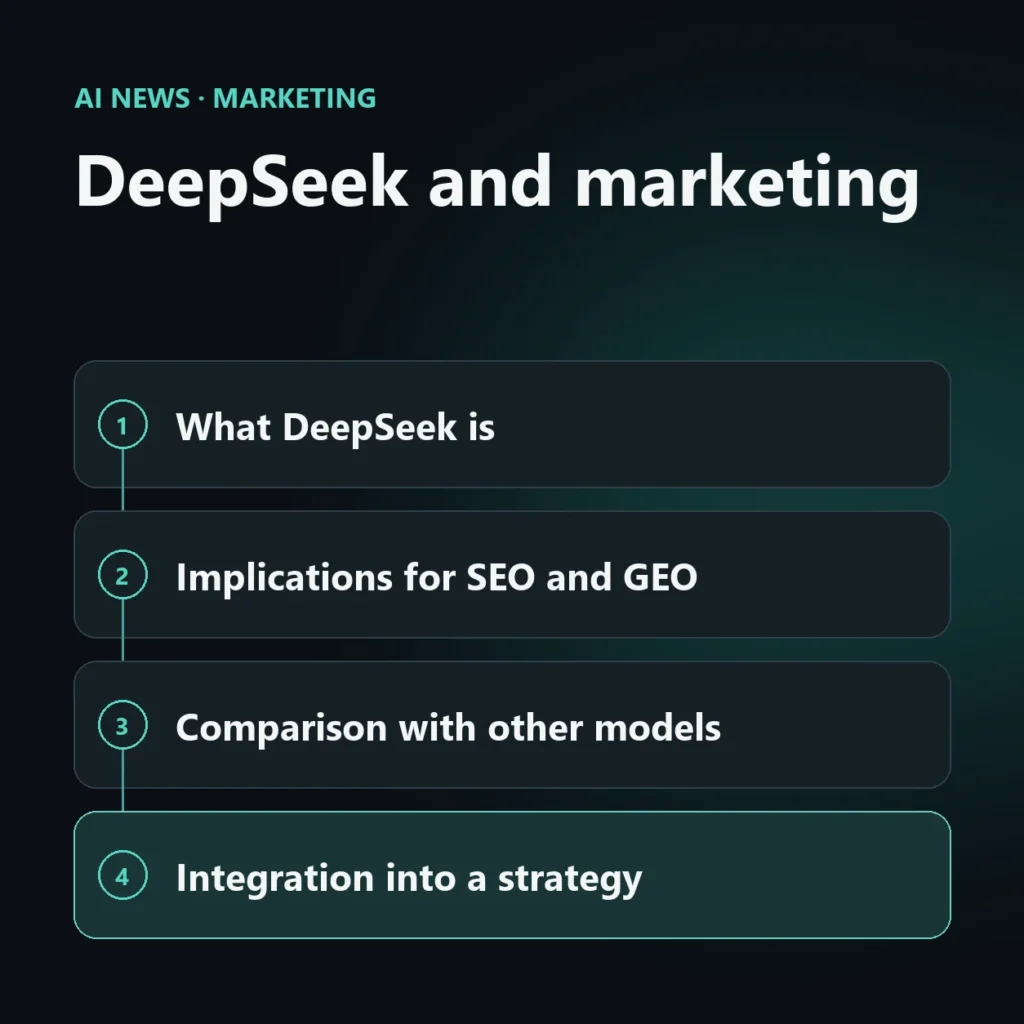
DeepSeek is a Chinese open-weight language model that is changing how companies evaluate costs, privacy and visibility strategies on generative search engines. In the daily debate on artificial intelligence and SEO, people almost always talk about OpenAI, Google or Anthropic, while DeepSeek stays at the margins of attention. Yet, for those working in marketing and organic search, ignoring it means missing an important piece in understanding how conversational assistants and answer engines are evolving. In this article we look at why DeepSeek marketing deserves more space in digital strategies, what implications it has for SEO and how to integrate it into a serious approach to generative visibility.
What DeepSeek is and why it is talked about so little
DeepSeek is a family of language models developed by DeepSeek-AI, a research lab based in China, which has made weights and technical documentation available under a relatively permissive license. The feature that sparked the interest of the technical community is the Mixture-of-Expertsarchitecture, which activates only a portion of the parameters for each token generated, reducing the computational cost compared with dense models of comparable size.
Despite the quality of the results, DeepSeek marketing has not yet gained the same visibility as its Western competitors. The reasons are several: communication is more research-oriented than product-oriented, the documentation is largely in technical English, and many agencies prefer to stay on tools already integrated into established workflows. This lower attention, however, does not reflect a lower potential impact, especially for those operating in contexts where cost control and model transparency really matter.
Another factor is cultural: the digital marketing ecosystem tends to chase the best-known names, neglecting innovations that come from outside the usual circuits. Yet it is precisely from these less-trodden areas that the dynamics destined to become standard often emerge.
Why DeepSeek marketing deserves more attention
The first reason is economic. The experts architecture makes it possible to achieve competitive performance with a lower infrastructure impact, which translates into lower inference costs for those who use it via API or host it themselves. For a company that generates content, analyzes queries or builds conversational assistants at scale, the cost difference becomes a concrete strategic advantage, not a technical detail.
The second reason concerns data sovereignty. Being able to run an open-weight model on your own infrastructure means reducing dependence on external providers and having greater control over information flows. In a context where AI regulation in Europe pushes toward greater transparency and accountability, this possibility is not a luxury but a compliance choice.
The third reason is SEO in nature. If DeepSeek powers assistants, plugins or answer engines, the content that cites it and is picked up by these systems gains weight. Understanding how the model selects sources helps to work better on citations in generative engines, which are becoming an increasingly relevant indicator for organic visibility.
Open-weight and control of the supply chain
The availability of the weights makes it possible to adapt the model to specific domains, such as legal, medical or technical, without having to retrain from scratch. For DeepSeek marketing this means being able to build tailor-made vertical tools, with a level of customization that closed models rarely allow.
Implications for SEO and Generative Engine Optimization
Traditional SEO is based on indexing, ranking and snippets. With the advent of generative engines, the game shifts to the ability to be cited within synthesized answers. DeepSeek, like other models, tends to favor clear, structured and authoritative sources: content with explicit definitions, verifiable data and consistent heading hierarchies is more likely to be picked up.
Adopting an approach of Generative Engine Optimization means working on these elements: answering questions directly, using natural language, citing primary sources and maintaining a clean semantic structure. DeepSeek marketing therefore becomes a testbed to understand whether our content is solid enough to be selected by a model that relies not on popularity signals but on consistency and relevance.
Another aspect concerns language. Chinese models have strong exposure to the Asian market, but the international versions handle Italian well too. This opens interesting scenarios for companies that want to cover multilingual niches without multiplying localization costs.
Content that models gladly cite
Models like DeepSeek reward content with verifiable claims, glossaries, FAQs and short definitions. Adding question-and-answer blocks, using comparison tables and citing original studies are all practices that increase the probability of being picked up in a generated answer.
«a strong Mixture-of-Experts (MoE) language model with 671B total parameters with 37B activated for each token» — DeepSeek-AI, “DeepSeek-V3 Technical Report”, arXiv 2412.19437
Comparison with the other models used in marketing
To get your bearings, it is useful to place DeepSeek next to the tools we already use every day. The table below summarizes the main differences from the point of view of those working on content, SEO and automation.
| Model | Openness of weights | Cost control | Suitable for sensitive data | Typical use in DeepSeek marketing |
|---|---|---|---|---|
| DeepSeek | Yes, open-weight | High, thanks to the MoE architecture | Yes, with self-hosting | Vertical assistants, query analysis, content at scale |
| Western closed models | No | Medium-low, depends on volumes | Limited, data passes through the provider | Rapid prototyping, ready-made integrations |
| Western open-weight models | Yes | Variable, requires technical skills | Yes, with adequate infrastructure | Research, experimentation, niche use cases |
| SEO-specialized models | Rarely | Medium | Depends on the vendor | Keyword analysis, technical audits, automated reports |
When to choose DeepSeek and when not to
DeepSeek is a sensible choice when you need high processing volumes, when data can’t leave the company infrastructure or when you want to build a vertical product. It is less suitable if you are looking for immediate integration with ready-made marketing tools, or if the team lacks the technical skills to manage deployment.
In many cases the best choice is hybrid: use closed models for prototyping and move to DeepSeek for production at scale, once the flows are validated. This combination reduces risks and maintains flexibility without tying the company to a single provider.
How to integrate DeepSeek into a DeepSeek marketing strategy
The first step is understanding where the model can bring value: drafting, summarizing documents, analyzing search queries, classifying content or building customer care assistants. You don’t need to replace everything, just identify the bottlenecks where cost per token or privacy are a problem.
The second step is adapting content. If we want DeepSeek to cite our site, we have to write to be understood by a model: short sentences, explicit definitions, data attributed to recognizable sources. DeepSeek marketing is not just technology, it is also editorial discipline.
The third step is measuring. Monitoring how many times our content is picked up in generated answers, by which models and in which contexts, lets you understand whether the strategy works. Without measurement, any talk of generative visibility remains theoretical.
Frequently asked questions about DeepSeek and marketing
Is DeepSeek free to use?
The model is available under an open license and can be run on your own, but infrastructure costs remain the responsibility of whoever hosts it. There are also API access options with pay-as-you-go plans.
Can DeepSeek marketing replace traditional SEO tools?
No, it complements them. DeepSeek helps with analysis, generation and summarization, but SEO also requires crawling, monitoring and technical skills that remain specific.
Is the data entered into DeepSeek safe?
It depends on how you use it. With self-hosting the data remains under company control; via third-party APIs the provider’s terms apply.
Does DeepSeek understand Italian well?
The most recent versions handle Italian adequately for most marketing tasks, although quality may vary depending on the domain.
How does it affect visibility in generative engines?
If the model is used to power assistants or answer engines, clear and well-structured content is more likely to be cited. This is the principle underlying Generative Engine Optimization.
Do I need a technical team to adopt it?
For basic use via API no, for self-deployment you need infrastructure and machine learning skills. Many companies choose a hybrid approach.
DeepSeek answers, but not about you
If you are reading this article on DeepSeek in digital marketing, you have probably already noticed the problem: when you ask an AI like DeepSeek for information about a sector, a product or a service like yours, the answers come from sources you never chose, while your brand stays out of the game. It isn’t a matter of missing content: it’s the structure with which the AI reads and cites sources that decides who gets named. I, with geo-seo.pro, work exactly on this, building the presence that generative engines intercept and report. If you want to understand how it works for your case, the starting point is here.
SEO, GEO and AEO specialist
Related articles
 AI NewsDeepSeek for SMEs: concrete opportunities and limits to knowSeptember 24, 2026
 AI NewsDeepSeek vs ChatGPT: implications for visibility and GEOSeptember 24, 2026
 AI NewsAI regulation in Europe (AI Act): what changes for companies and websitesSeptember 14, 2026
Explore by topic