
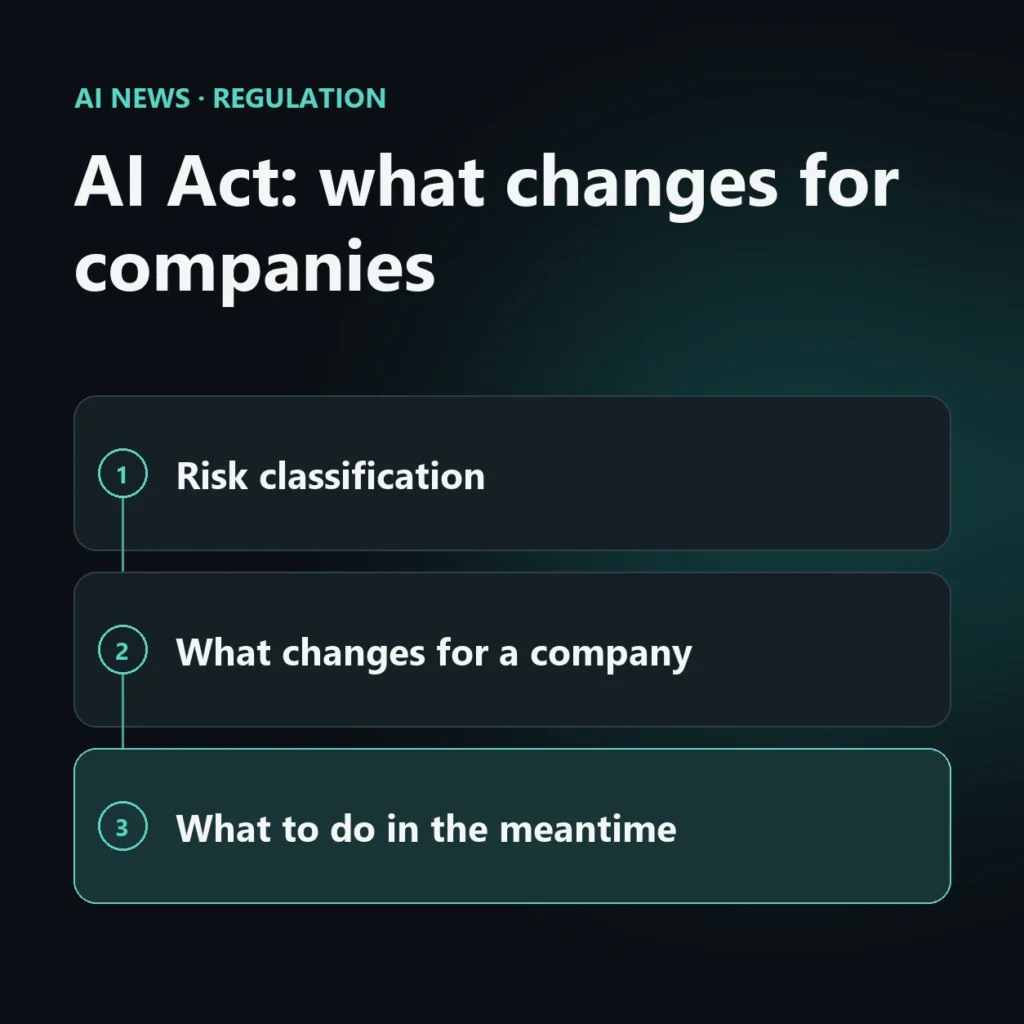
The AI Act is the European regulation that classifies artificial intelligence systems by level of risk, imposing increasing obligations as the risk to people’s rights grows. In force since 2024, it applies progressively in phases through 2027.
Risk classification in the AI Act
Unacceptable risk
Prohibited practices: subliminal manipulation systems, social scoring, real-time biometric identification in public spaces (with limited exceptions).
High risk
Systems used in sensitive areas (hiring, credit, healthcare): strict transparency, documentation and human oversight obligations.
Limited risk
Systems such as chatbots and AI-generated content: transparency obligation toward the user (e.g. stating that they are interacting with an AI).
Minimal risk
Most current AI applications (spam filters, video games): no specific obligations beyond the general regulations already in place.
What changes in practice for a company with a website
For most business websites that use AI in a standard way (support chatbots, content generation, product recommendations), the main obligations concern transparency: clearly informing the user when they are interacting with an automated system or when content (image, text, video) is generated or manipulated by AI.
Companies that develop or integrate AI systems classified as high risk must instead comply with much stricter requirements for documentation, risk management and human oversight, with penalties that can reach a significant percentage of global annual turnover for the most serious violations.
What to do in the meantime
Even for companies that don’t fall into the high-risk categories, it is good practice to start documenting where and how AI is used in their digital processes (content, customer service, marketing), both for regulatory compliance and because transparency about the use of AI is becoming a trust factor for users — a principle that also ties into a solid brand authority strategy.
Frequently asked questions about the AI Act
Does the AI Act apply only to European companies?
No, it applies to any provider or user of AI systems whose outputs are used in the European Union, regardless of the company’s registered office.
Does a simple chatbot on the site require specific compliance?
It generally falls under limited risk: the main obligation is to clearly inform the user that they are interacting with an automated system.
When do the AI Act obligations apply?
The regulation provides for progressive application over several years from its entry into force: it is advisable to check the updated timeline on official European Union sources, as the specific deadlines for each category of obligation may be subject to clarification.
Official source: European Commission, regulatory framework on artificial intelligence.
SEO, GEO and AEO specialist
Related articles
 AI NewsDeepSeek for SMEs: concrete opportunities and limits to knowSeptember 24, 2026
 AI NewsDeepSeek vs ChatGPT: implications for visibility and GEOSeptember 24, 2026
 AI NewsDeepSeek: why it deserves more attention in marketing and SEOSeptember 24, 2026
Explore by topic