
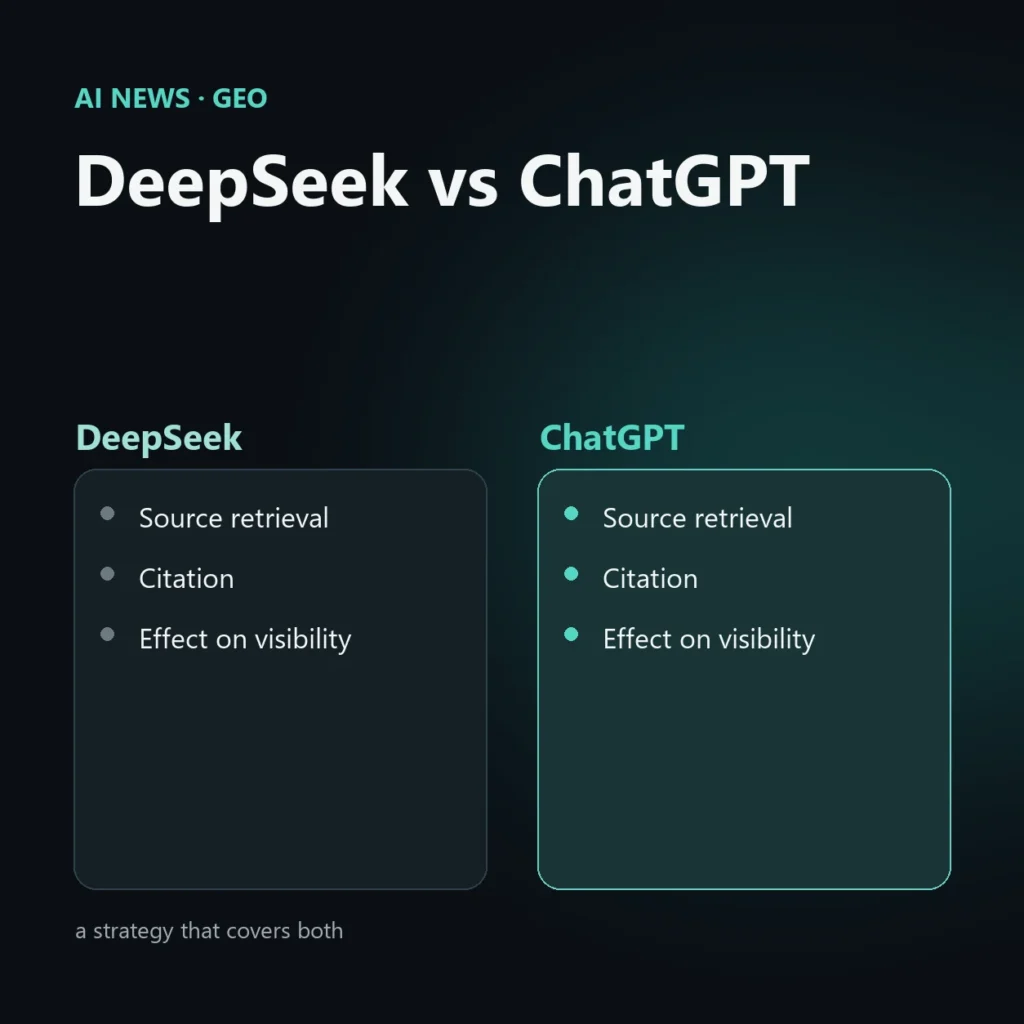
The DeepSeek vs ChatGPT comparison concerns two language models with different architectures, citation policies and ways of accessing sources, and these differences concretely change how a piece of content is retrieved, summarized and attributed in generative answers. For those working on digital visibility, the question is not which model is «better» in absolute terms, but how each one selects, weighs and reports information when a user asks a question. The DeepSeek vs ChatGPT topic is therefore central for those who deal with Generative Engine Optimization: understanding where the two systems diverge means understanding where your own content can be cited, ignored or misunderstood.
Why the DeepSeek vs ChatGPT comparison matters for visibility
ChatGPT, developed by OpenAI, is the generative model with the broadest and most established user base. DeepSeek is a Chinese open-weight model that has gained attention for its cost efficiency and for the release of its weights, as well as for rapid adoption in technical and development contexts. In terms of visibility, the difference that weighs most is not the quality of the generated text, but the way each system accesses up-to-date information and decides whether to cite a source.
ChatGPT integrates web search into its answers when the user or the system requests it, and tends to show links and references in an increasingly structured way. DeepSeek, in its most widespread configurations, relies to a greater extent on parametric knowledge and on its own retrieval mechanisms, with a transparency about sources that varies depending on the interface used. This means the same content may be picked up by one system and completely absent in the other.
For an agency or an SEO professional, the operational point is clear: there is no single optimization valid for all generative engines. The DeepSeek vs ChatGPT comparison should be read as an invitation to diversify strategies, instead of chasing a single model as if it were the only discovery channel.
How the two models retrieve and cite sources
The most relevant difference between the two systems lies in the relationship between generation and retrieval. ChatGPT, when it activates search, builds the answer from indexed pages and tends to return explicit references. DeepSeek often favors a more concise, self-contained answer, with citations that are less systematic and more dependent on the context of use. For those aiming to get mentioned, this changes the priorities.
What ChatGPT rewards
ChatGPT tends to value content with clear structure, direct answers and recognizable authority signals. The presence of passages that answer a question explicitly, with well-isolated data and definitions, increases the likelihood of being picked up. Those who have already worked onChatGPT optimization know that semantic clarity counts for more than keyword density.
What DeepSeek rewards
DeepSeek, with its open-weight nature, is often queried in environments where control over the model is greater. In these contexts source retrieval depends heavily on how the system is configured: an application that connects DeepSeek to an internal search engine behaves differently from direct use through the public interface. The consequence is that citation is not guaranteed by a universal format, but depends on the infrastructure around the model.
This makes the topic of citations in generative engines even more delicate: what works for one model may not be transferable to the other, and strategies must be tested separately.
Practical differences that affect the GEO strategy
On the operational level, the DeepSeek vs ChatGPT comparison translates into concrete choices about formats, languages and trust signals. The two models don’t have the same geographic distribution of users or the same querying habits, and this influences the type of content that makes sense to produce.
ChatGPT has a strong presence in Western markets and in everyday professional activities. DeepSeek has grown a lot in technical contexts and in geographic areas where access to Western services is more limited. For a multilingual or international site, ignoring this difference means losing coverage of a real pool of users who ask questions in a different way.
Language and cultural context
Content optimized only for Western English may prove less effective on DeepSeek, which often answers queries in Chinese or other languages with their own dynamics. Localization is not a detail: it is part of the generative visibility strategy.
Transparency and perceived reliability
Both models tend to favor sources that appear verifiable. The difference is in the degree of explicitness: ChatGPT more often shows the link, DeepSeek may integrate the information without making it traceable in the same way. For those who want to understand why ChatGPT doesn’t cite your site, the comparison with DeepSeek helps distinguish content problems from platform problems.
Comparison table: DeepSeek vs ChatGPT for visibility
| Aspect | ChatGPT | DeepSeek |
|---|---|---|
| Distribution model | Proprietary, broad global user base | Open-weight, strong in technical and localized contexts |
| Access to up-to-date sources | Integrated web search with frequent citations | Depends on configuration and interface |
| Citation transparency | Explicit references in most cases | Citations less systematic and variable |
| Content it rewards | Clear structure, direct answers, authority | Technical content, local context, well-isolated data |
| Impact on the GEO strategy | Semantic optimization and trust signals | Localization and infrastructure control |
How to set up a strategy that covers both models
A solid GEO strategy doesn’t choose between ChatGPT and DeepSeek: it treats them as distinct channels with partly overlapping requirements. The common base is clarity: content that answers real questions, with sharp definitions and well-separated passages, works better on any model.
The specific part concerns instead distribution and language. Producing localized versions, maintaining consistency across pages and cultivating authority signals helps cover the systems less oriented toward explicit citation too. Monitoring must be done model by model, because a mention on ChatGPT doesn’t imply a mention on DeepSeek, and vice versa.
Finally, it is worth testing the same queries on both systems and observing which sources get picked up. The DeepSeek vs ChatGPT comparison thus becomes an operational tool, not a technical curiosity: it serves to understand where your content enters the flow of answers and where it stays invisible.
Frequently asked questions about DeepSeek vs ChatGPT
Do DeepSeek and ChatGPT cite sources the same way?
No: ChatGPT shows explicit references more regularly, while DeepSeek cites more variably depending on the interface and configuration.
Does the DeepSeek vs ChatGPT comparison change SEO priorities?
Yes, because it pushes you to diversify: semantic clarity remains central, but localization and infrastructure control matter more for DeepSeek.
Is optimizing for a single generative model enough?
No, because user pools and source retrieval methods differ, and a mention on one model doesn’t guarantee visibility on the other.
Why does my site appear on ChatGPT but not on DeepSeek?
It often depends on language, local context or the way the system retrieves sources, not necessarily on the quality of the content.
Does DeepSeek’s open-weight nature help visibility?
It can help in technical contexts where the model is integrated into proprietary applications, but it is not an automatic guarantee of citation.
Which of the two models is more important for GEO today?
Both: ChatGPT has a broader reach, DeepSeek covers specific technical and geographic segments worth covering.
Your brand doesn’t appear in AI answers
If DeepSeek and ChatGPT answer your market’s questions without citing you, the visibility that matters moves elsewhere: ranking on Google is no longer enough, you need to be the source chosen by generative models. At geo-seo.pro I work exactly on this, with a Generative Engine Optimization path that makes your content readable, authoritative and citable by AI assistants, so that your name emerges when someone asks precisely what you offer.
SEO, GEO and AEO specialist
Related articles
 AI NewsDeepSeek for SMEs: concrete opportunities and limits to knowSeptember 24, 2026
 AI NewsDeepSeek: why it deserves more attention in marketing and SEOSeptember 24, 2026
 AI NewsAI regulation in Europe (AI Act): what changes for companies and websitesSeptember 14, 2026
Explore by topic