
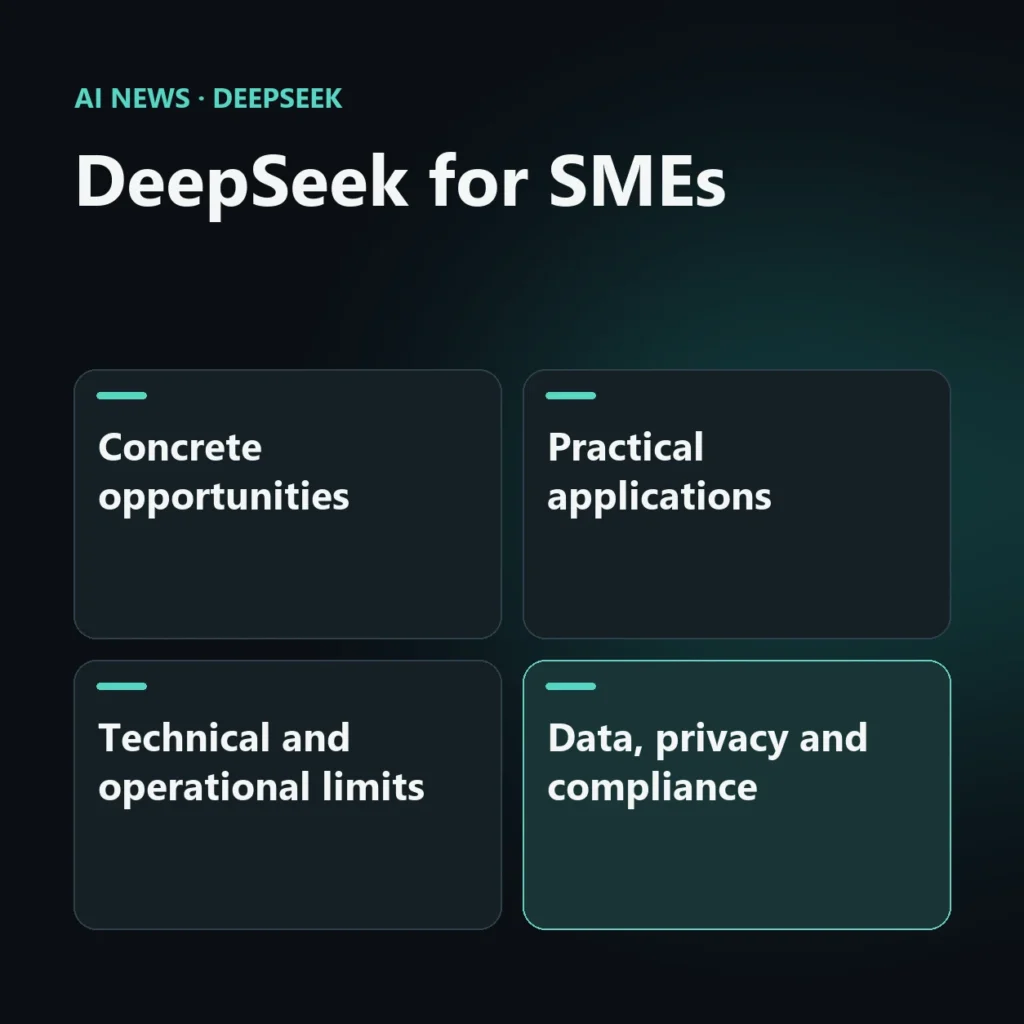
DeepSeek for SMEs is the use of a Chinese open-source language model, also accessible via API at low cost, to automate text and data analysis tasks within a small or medium-sized business. The interest stems from a mix of technological curiosity and economic pragmatism: many companies have heard of generative artificial intelligence but don’t want to commit right away to the big American providers, and see in DeepSeek a lighter entry point. Before adopting it, however, it is worth understanding what it can really do, where it stops and what implications it carries for data, compliance and digital strategy.
What makes DeepSeek interesting for an SME
DeepSeek is a language model developed by a Chinese laboratory, distributed largely under an open license and usable both through a conversational interface and through an API. For an SME this means two concrete things: the possibility of experimenting without binding contracts and the possibility of integrating text generation functionality into existing tools, such as a management system or a contact form. The cost of API access has historically been lower than many Western competitors, a factor that matters as usage volumes grow.
A second element of attraction is the transparency of the model: being partly open source, it can be studied, evaluated and in some cases run on your own infrastructure. This opens interesting scenarios for those with data confidentiality constraints. Also the topic of citations in generative engines becomes relevant: if company content is reworked by models like DeepSeek, brand visibility also depends on how these systems select and attribute sources.
It must be said that adopting DeepSeek for SMEs is not a neutral choice: it means inserting a non-European player into processes that may touch data of customers, suppliers or employees. Technical convenience must therefore be balanced with a governance assessment, which many small businesses tend to underestimate.
Practical applications: where DeepSeek for SMEs brings real value
Content and communication
The most immediate use case for an SME is producing text drafts: product descriptions, newsletters, social posts, replies to reviews, technical sheets. DeepSeek handles Italian well and keeps a consistent tone if given clear instructions and a few examples. The gain is not so much in the final quality, which still requires human review, as in the speed with which you reach a first editable version.
A second area is summarization: condensing long documents, extracting key points from meeting minutes, translating technical texts. Here the model offers concrete help to those who manage documentation without a dedicated department. Those working on web projects can combine these outputs with a website creation service that integrates generated and reviewed content in a structured way.
Data analysis and decision support
DeepSeek can be queried to interpret spreadsheets, spot anomalies in data series, translate natural language into queries. For an SME this means being able to ask questions like «which products had the sharpest drop in recent months» without writing complex formulas. The result must always be verified, but the time saved in the exploratory phase is significant.
First-level customer support is also among the possible applications: automatic replies to frequent questions, ticket classification, reply suggestions for operators. In all these cases DeepSeek for SMEs works better as a copilot than as a replacement, because errors in sensitive contexts carry a reputational cost.
Technical and operational limits to take into account
The first limit is the variability of answers. Like all generative models, DeepSeek can produce plausible but wrong statements, especially on up-to-date data or niche topics. In an SME without dedicated technical staff, this translates into a risk of publishing unverified content if there is no control process. You therefore need to define who reviews what, before automating any flow.
The second limit concerns integration. Connecting DeepSeek to a management system, a CRM or an e-commerce platform requires development skills that not all small businesses have in-house. The alternative is to rely on vendors, but this reduces the initial cost advantage. Maintenance must also be considered: models evolve, APIs change, and an integration left to itself tends to degrade.
The third limit is strategic in nature. Relying on a single model means depending on one provider for functions that have become critical. The most prudent SMEs maintain a certain portability, that is, the ability to change model without rewriting everything. A Google Ads consultant, for example, can help understand how generated content impacts campaigns and landing page quality, preventing automation from worsening performance.
Data, privacy and compliance: the most delicate point
DeepSeek is subject to Chinese law, which has different rules from the GDPR on data processing, retention and access. This doesn’t prevent use in Europe, but it calls for caution: don’t enter identifiable personal data, don’t upload confidential documents, prefer running the model locally when data is sensitive. For many SMEs the simplest solution is to use DeepSeek only on public content or on anonymized data.
A reasonable approach is to classify use cases by the sensitivity of the information involved. Activities on marketing texts, drafts and already-public materials are low-risk. Analyses on customer data, contracts or financial information instead require controlled infrastructure or locally run models. DeepSeek for SMEs can work in both scenarios, but with very different configurations and responsibilities.
The reputational aspect must also be considered: some customers or partners may not appreciate the use of tools of Chinese origin. It is not a technical problem, but a communication one, and it must be handled transparently in internal policies and externally when requested.
| Area of use | Suitable for DeepSeek | Attention required | Recommended alternative |
|---|---|---|---|
| Marketing content drafts | Yes, with human review | Low | Nothing in particular |
| First-level customer support | Yes, on frequent questions | Medium | Models with European hosting |
| Analysis of data with personal information | No, unless run locally | High | Self-hosted model |
| Integration into software products | Possible but complex | Medium-high | Dedicated technical assessment |
| Translation and summarization of internal documents | Depends on the content | Variable | Prior anonymization |
How to set up a DeepSeek project in an SME
The starting point is not the technology, but the process. It is best to identify a repetitive, measurable, low-risk activity, test it for a few weeks and assess whether the time saved justifies the investment. Only afterwards do you move on to more structured integrations. This approach avoids spending resources on projects that nobody then uses.
The second step is defining clear rules on what can and cannot be loaded into the model. An internal policy, even a short one, reduces the risk of mistakes by employees. The third step is training at least one person who knows how to write effective instructions and recognize unreliable outputs: the quality of results depends a lot on how the question is asked.
Finally, periodic monitoring should be planned. Models change, costs vary, business needs shift. A project based on DeepSeek for SMEs that works today may no longer be advantageous in a year, and you need the clarity to change course without having tied the entire operation to a single tool.
Frequently asked questions about DeepSeek for SMEs
Is DeepSeek free for an SME?
The conversational interface is accessible for free, while API use has a cost that depends on volumes. For occasional use the expense is modest, but it should be monitored if usage becomes continuous.
Can I use DeepSeek with my customers’ data?
In general it is not advisable, because the model is subject to Chinese law. For personal or confidential data it is better to run the model locally or anonymize the information before processing it.
Does DeepSeek replace an SEO consultant or a copywriter?
No, it works alongside them. It generates drafts and suggestions, but strategy, fact-checking and consistency with the brand’s positioning remain human activities.
Do I need technical staff to adopt it?
For basic use no, you only need to know how to write clear instructions. For integrations with management systems, CRMs or websites you need development skills or a specialized vendor.
Is DeepSeek reliable for content published online?
It can produce errors or outdated information, so any content meant for publication must always be re-read and verified before going online.
Is it better to bet only on DeepSeek or on several models?
For an SME it is more prudent not to depend on a single provider. Keeping the possibility of switching models reduces technical and contractual risk in the medium term.
Your SME doesn’t appear in DeepSeek’s answers
If a potential customer asks DeepSeek for a supplier in your area or sector, your company risks staying invisible: the AI cites few sources, and they aren’t the same ones you rank on Google. The problem isn’t the site, but how generative sources are selected. This is exactly what I work on, with a Generative Engine Optimization path designed for Italian SMEs: I understand how DeepSeek and the other generative engines choose sources and I build the content and signals that make you citable.
SEO, GEO and AEO specialist
Related articles
 AI NewsDeepSeek vs ChatGPT: implications for visibility and GEOSeptember 24, 2026
 AI NewsDeepSeek: why it deserves more attention in marketing and SEOSeptember 24, 2026
 AI NewsAI regulation in Europe (AI Act): what changes for companies and websitesSeptember 14, 2026
Explore by topic