
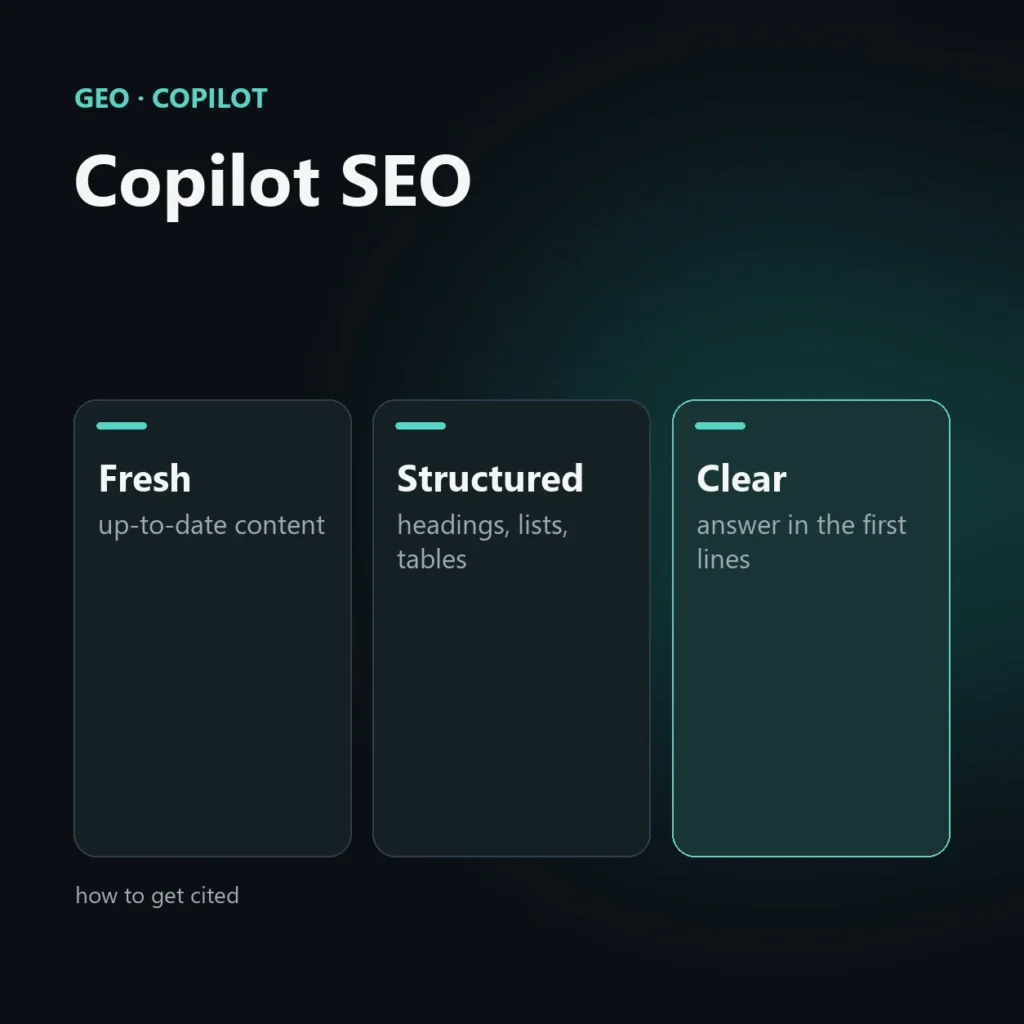
There is no trick to getting cited by Microsoft Copilot: you need pages that Bing has indexed, that answer a specific question clearly, and that are structured so an automated system can extract the answer. Microsoft has published guidance on how to write to be included in AI answers, and it is the best place to start. None of it guarantees a citation.
This article takes that guidance, organizes it, explains what it means in practice and shows how to check whether your site is being cited. It is part of the series on Bing SEO.
How Copilot builds its answers
Microsoft Copilot and Bing’s AI summaries do not answer out of thin air. They first search Bing’s index for pages relevant to the question, then use a language model to compose an answer and show the sources with links next to the text. For a site this means two things: if Bing has not indexed a page it cannot cite it, and if the page does not answer the question clearly it is less likely to be chosen.
What Microsoft says: fresh, authoritative, structured and clear content
In the post “Optimizing Your Content for Inclusion in AI Search Answers”, published on October 8, 2025, Microsoft Advertising sums up the target in four words: fresh, authoritative, structured and semantically clear content. The concrete guidance is:
- The SEO basics still apply. Crawlable pages, careful metadata, internal links and inbound links.
- Consistent title, H1 and description. The description should explain the value or outcome of the page, without forced keyword repetition.
- Descriptive headings. Every H2 and H3 should say where an idea starts and ends, not be a vague label like “Learn more”.
- Questions with short answers. A direct question followed by a clear, concise answer of one or two sentences, understandable even when pulled out of the rest of the text.
- Lists and tables for steps, comparisons and features.
- Structured data in JSON-LD that says what something is: product, review, FAQ, event.
- Semantic clarity. Write for user intent, replace vague terms with measurable facts, add context and use related terms.
What to avoid, again according to Microsoft
- long walls of text;
- hiding key answers in tabs or expandable menus;
- relying on PDF files for core information;
- putting important information only in images, without alt text or an HTML equivalent;
- overloaded sentences and decorative symbols;
- unanchored claims, such as “next-gen” without saying what is new.
The point about tabs and expandable menus deserves attention: FAQ sections that open with a click are very common, and Microsoft flags them as a risk when they hold the main answer. The text stays in the page code, but the practical rule is to put the important answer in the visible text and use the FAQs as an addition.
How to apply it to a page
- Start from the question. Pick a real question your customer asks, and write it as the title or a heading.
- Answer in the first lines, in one or two complete sentences that stand on their own.
- Develop below, with headings that reflect the sub-questions and with lists or tables where the content is a comparison or a procedure.
- Add facts and sources. Numbers, dates and verifiable references; where a figure is not public, say so.
- State who wrote it and update the page when the facts change.
- Add the relevant structured data, for example the FAQ.
- Announce the page with IndexNow when you publish or update it (see the guide to IndexNow).
How to check whether you are cited
Microsoft has added to Bing Webmaster Tools a report that counts your site’s citations in Copilot and Bing’s AI summaries, described in the guide to the AI Performance report. You can also run a manual test: ask Copilot the questions your site answers and see which sources it cites. Note the dates, because answers change over time.
The report does not give click data, and a citation does not guarantee a visit. It is a visibility signal, to be read together with real traffic (see the guide to measuring Bing traffic).
Local businesses: Bing Places too
For businesses with a location open to the public, Microsoft’s AI Performance announcement says to register with Bing Places for Business and keep the address, hours and contact details current. It is covered in the guide to Bing Places for Business.
What cannot be promised
No technique guarantees a citation. Microsoft does not publish the criteria it uses to choose sources, and answers change from one request to the next. Anyone who promises otherwise is guessing. What you control is the quality and clarity of the pages, and whether Bing has indexed them.
Frequently asked questions about Copilot and SEO
Do I need to rank first on Bing to be cited by Copilot?
No official data says so. Microsoft describes quality, authority, structure and clarity of the content as the criteria, not position.
Is JSON-LD enough to get cited?
No. Structured data helps describe the content, but it works together with a clear answer in the text and a page indexed by Bing.
Do FAQs help or not?
They help as an addition, with short, complete answers. Microsoft does advise against hiding the main answer in sections that open with a click: the key answer belongs in the visible text.
How do I know whether Copilot cites my site?
With the AI Performance report in Bing Webmaster Tools, which counts citations, and with manual tests: ask Copilot the questions your site answers and look at the sources.
Does being cited bring clicks?
Not necessarily. The report does not show clicks, and a citation is mostly visibility. Read it together with real traffic.
Does your site answer the questions customers ask AI?
I check which pages answer clearly, which ones Bing has indexed and where the structure stops an automated system from extracting the answer. Then I tell you what to rewrite first.
SEO, GEO and AEO specialist
Related articles
 GEOCompetitors in AI Answers: Who Gets CitedOctober 30, 2026
 GEOChatGPT and Bing: What We Actually KnowOctober 30, 2026
 GEOBing AI Performance Report: How to Read ItOctober 30, 2026
Explore by topic