
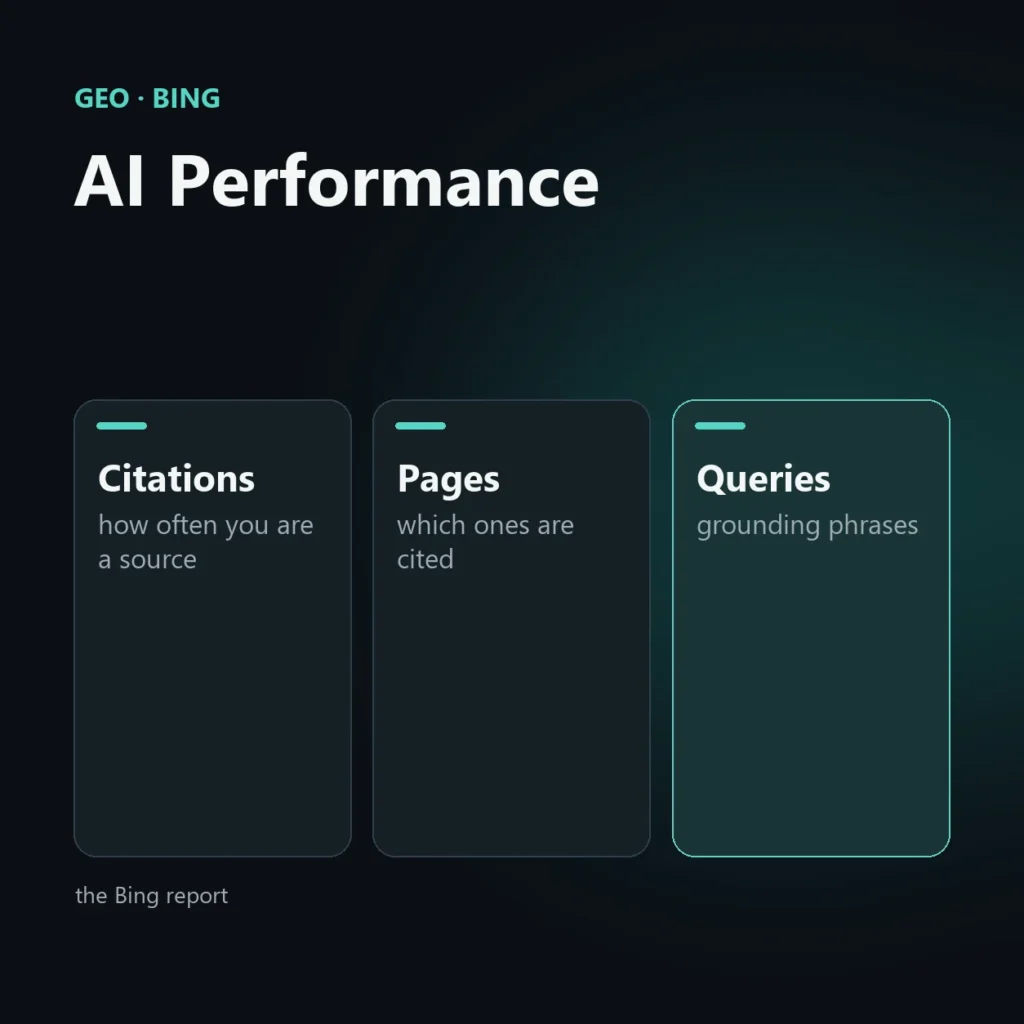
AI Performance is a report in Bing Webmaster Tools that counts how many times a site’s content is shown as a source in Microsoft’s AI-generated answers. It covers Microsoft Copilot, AI-generated summaries in Bing and select partner integrations. It has been in public preview since February 10, 2026, and it measures citations, not clicks or traffic.
This guide explains what the report contains, what it does not say and how to use it to decide what to improve. It is part of the series on Bing SEO.
What the report shows
According to Microsoft’s announcement, the dashboard has five parts:
- Total citations: how many times the site’s content was displayed as a source in AI answers during the chosen period. It does not indicate where it appears in the answer.
- Average cited pages: the average number of unique pages from the site cited per day over the selected range.
- Grounding queries: the key phrases the AI used when retrieving the site’s content. Microsoft states that they are a sample of overall citation activity.
- Page-level citations: how many times each URL was cited over the chosen range.
- Trend over time: a timeline of visibility across the supported AI experiences.
What grounding queries are
They are not the phrases users type. They are the expressions the system uses, behind the scenes, to look up information to put into the answer: generally shorter and more topical than the original question. Looking at them helps you understand which concepts your pages get associated with in answers, even if they do not match the keywords you usually work on.
What the report does not say
The limits stated by Microsoft matter if you want to avoid misreading the numbers:
- Citation data does not show ranking, authority or the role a page had in the answer. The page-level count tells you how often it is cited, not how important it is or where it appears.
- Grounding queries are a sample, and Microsoft says it will keep refining this metric.
- Data is aggregated across the supported AI experiences, so you cannot tell, for example, Copilot apart from a Bing summary.
- There is no click or visit data.
A citation, then, is a visibility signal, not a sale. To know whether it brings traffic you need to compare it with real visits (see the guide to measuring Bing traffic).
How to access it
The report is inside Bing Webmaster Tools, for verified sites. If you have not set the tool up yet, start from the guide to Bing Webmaster Tools. Since it is a preview, menu items and features may change.
How to use it: what Microsoft suggests
- Confirm which pages are already cited in AI answers.
- Find the content that is cited often and the indexed content that is cited rarely: those are the ones to improve.
- Go deeper on topics already cited for specific grounding queries, because that is where the site already has recognition.
- Improve structure with clear headings, tables and FAQ sections.
- Support claims with data, examples and sources.
- Keep content updated and use IndexNow to announce changes (see the guide to IndexNow).
- Stay consistent across text, images and video when they describe the same entities.
A practical monthly routine
- Note total citations and average cited pages, and compare them with the previous month.
- See which pages are growing and whether they have something in common: topic, structure, freshness.
- Read the grounding queries and ask whether the themes match the ones you want to be found for.
- Spot the important pages that do not appear and check their indexing on Bing.
- Compare with visits from Bing and Copilot in Analytics, to see whether visibility turns into clicks.
Mistakes to avoid
- Treating citations as traffic. They are two different measures.
- Chasing grounding queries as if they were keywords. They are a sample of what the system looked up, not a list of what users search.
- Drawing conclusions from a few days. The trend is read over weeks.
- Forgetting it is a preview. Measures and menu items may change.
Frequently asked questions about the AI Performance report
Is the AI Performance report available to everyone?
It has been in public preview in Bing Webmaster Tools since February 10, 2026. You need to have the site verified in the tool.
Does the report show clicks?
No. It shows citations, cited pages and grounding queries, but not clicks or visits.
What is the difference between citations and clicks?
A citation is a page appearing as a source in an answer; a click is the visit that follows. You can be cited without receiving visits.
Are grounding queries what users search?
No. They are the phrases the system uses to retrieve content, and Microsoft describes them as a sample of overall activity.
Can I tell whether Copilot or a Bing summary cited me?
No: the data is aggregated across the supported AI experiences.
Do AI answers cite your site?
Reading the report is easy, interpreting it is harder. I look at which pages are cited, for which topics and where they are missing, and tell you which content to strengthen first.
SEO, GEO and AEO specialist
Related articles
 GEOCompetitors in AI Answers: Who Gets CitedOctober 30, 2026
 GEOChatGPT and Bing: What We Actually KnowOctober 30, 2026
 GEOMicrosoft Copilot SEO: How to Get CitedOctober 30, 2026
Explore by topic