
Your real SEO competitors are the sites that appear in Google’s results for the searches you care about, not necessarily the companies that sell what you sell. Finding them takes a method: start from the searches, not from the list of competitors you already know.
This guide explains how to build the list in an hour, with free and paid tools. It is part of the guide to online competitor analysis.
Why a list of commercial competitors is not enough
An electrical contractor can be beaten, for “electrical installation quote”, by a quotes portal, a DIY blog and a company in another city. None of them is on the list the owner thinks of, but all of them hold the positions the owner would need.
The method in five steps
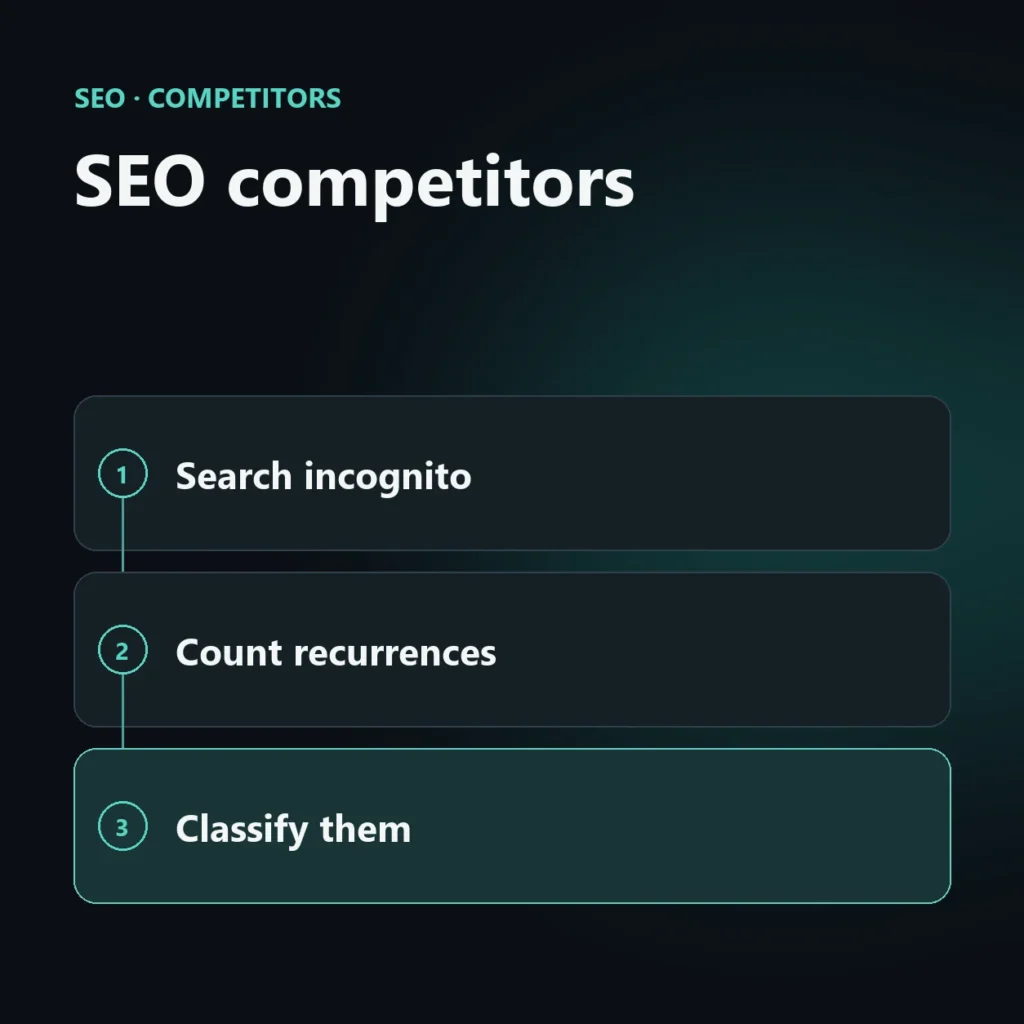
- Choose the searches. Take 10-20 searches that bring customers: for services, for products, for the questions that come before a purchase. If you have Search Console, start from the queries that already give you impressions, including those where you are on page two or three.
- Search cleanly. Use an incognito window, set the right country and language and, for local searches, the city. Results are personalized, so repeat the test on different days.
- Note the domains. For each search record the domains in the top ten in a spreadsheet: one row per search, one column per position.
- Count recurrences. A domain that appears in 8 searches out of 20 is a major SEO competitor. One that appears once usually is not.
- Classify them. Direct competitors, portals and comparison sites, publishers and blogs, encyclopedias, marketplaces, local sites. The type tells you what it takes to beat them.
How to read the result
| Type of competitor | How you compete |
|---|---|
| Direct competitor | Offer, commercial pages, reviews, prices, proof of reliability |
| Portal or comparison site | Better informational content, authority, presence where the portal cites you |
| Publisher or blog | More up-to-date and complete content, first-hand experience |
| Encyclopedia or institutional site | Often cannot be beaten: aim for more specific searches instead |
With paid tools
Semrush, Ahrefs, Sistrix and SE Ranking have reports that list the domains sharing the most keywords with yours. They save time and show competitors you would not have thought to look for. Two cautions: the data are estimates built on each tool’s own database, and the chosen country changes the result a lot. Always check at least the main searches by hand on Google.
With Search Console
Search Console does not show competitors, but it tells you which queries you appear for and at what position. Comparing that list with the manual search shows who is ahead of you on the searches where you already appear: those are the easiest to win back.
Mistakes to avoid
- Searching in a normal window, with browsing history affecting results.
- Using a single search: the picture changes from one keyword to another.
- Including searches that are too generic, where only big portals appear that you cannot beat.
- Forgetting language and country: a site can be a competitor in Italy and not in the UK.
Frequently asked questions
How many competitors should I analyze?
Three to five of the most recurring. More makes the work long without adding useful information.
Can I use only free tools?
Yes. Incognito Google, Search Console and a spreadsheet are enough for a solid analysis. Paid tools speed up and widen the comparison.
Do SEO competitors change over time?
Yes, because results change. Repeat the check every three to six months.
Does a portal count as a competitor?
Yes, if it holds the positions you want. Only how you compete changes: with content and authority, not with your offer.
Who is really ahead of you on Google?
I build the list of your real competitors on the searches that bring customers and tell you which ones are worth competing against.
SEO, GEO and AEO specialist
Related articles
 SEOContent Gap Analysis: What Competitors Write and You Don’tOctober 30, 2026
 SEOBacklink Gap: Analyzing Competitor LinksOctober 30, 2026
 SEOSEO Competitor Analysis: A Practical GuideOctober 30, 2026
Explore by topic