
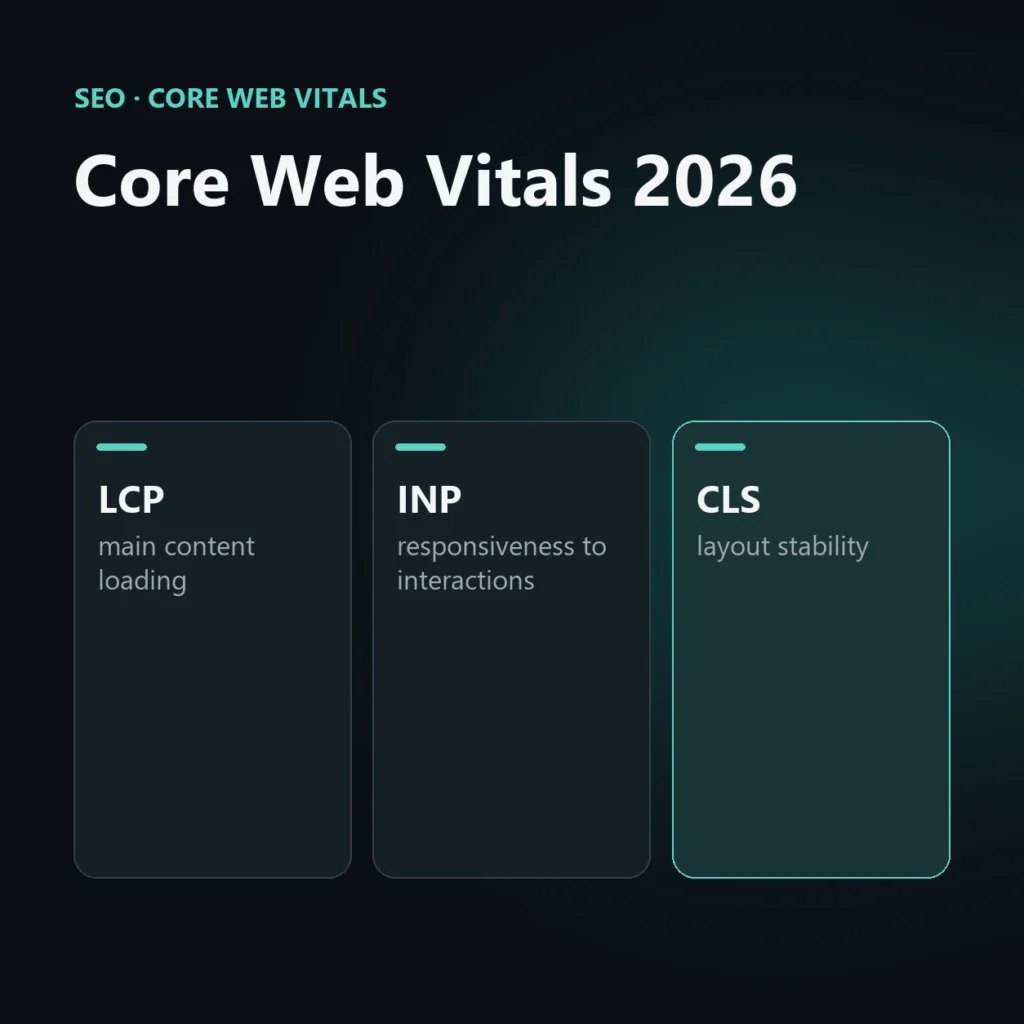
Core Web Vitals are three Google metrics that measure the loading speed (LCP), responsiveness (INP) and visual stability (CLS) of a web page. From a minor ranking signal, they have become a basic technical requirement: a slow or unstable site loses positions regardless of the quality of its content.
The three Core Web Vitals metrics explained
Google measures them both in the lab (Lighthouse) and on real user data (CrUX, the Chrome User Experience Report). Only real data counts for ranking.
LCP (Largest Contentful Paint)
Loading time of the main visible content. Good threshold: under 2.5 seconds.
INP (Interaction to Next Paint)
How quickly the site responds to a user’s click or tap. Good threshold: under 200 milliseconds. It replaced the old FID in 2024.
CLS (Cumulative Layout Shift)
How much the page “jumps” while loading (images without dimensions, banners that load late). Good threshold: under 0.1.
How to improve Core Web Vitals: practical steps
To improve LCP
Compress and serve images in next-gen formats (WebP, AVIF), enable server-side caching, reduce render-blocking resources (critical CSS and JavaScript) and use a CDN for static assets.
To improve INP
Reduce non-essential JavaScript executed at load, break long scripts into smaller tasks, and avoid heavy libraries when they aren’t needed.
To improve CLS
Always reserve space for images and videos with the width and heightattributes, avoid injecting dynamic content (banners, popups) above content that has already loaded, and preload fonts to avoid the so-called layout shift caused by font swapping.
Why it is no longer optional in 2026
With search increasingly mediated by generative engines and AI Overviews, crawlers favor technically solid pages even more: an unstable site risks not even being considered as a source. A technical SEO audit is the first step to understand where you are losing points.
Frequently asked questions about Core Web Vitals
Are Core Web Vitals a direct ranking factor?
Yes, they are part of Google’s Page Experience, although with less weight than the quality and relevance of the content.
How do I measure my site’s Core Web Vitals?
Through Google Search Console (the “Core Web Vitals” report), PageSpeed Insights or the “Web Vitals” Chrome extension.
What is the difference between lab data and real data?
Lab data (Lighthouse) is simulated and repeatable; real data (CrUX) reflects the actual conditions of visitors and is what is used for ranking.
For the official definition, see the Google Core Web Vitals documentation.



SEO, GEO and AEO specialist
Related articles
 SEOContent Gap Analysis: What Competitors Write and You Don’tOctober 30, 2026
 SEOBacklink Gap: Analyzing Competitor LinksOctober 30, 2026
 SEOHow to Find Your Real SEO CompetitorsOctober 30, 2026
Explore by topic