
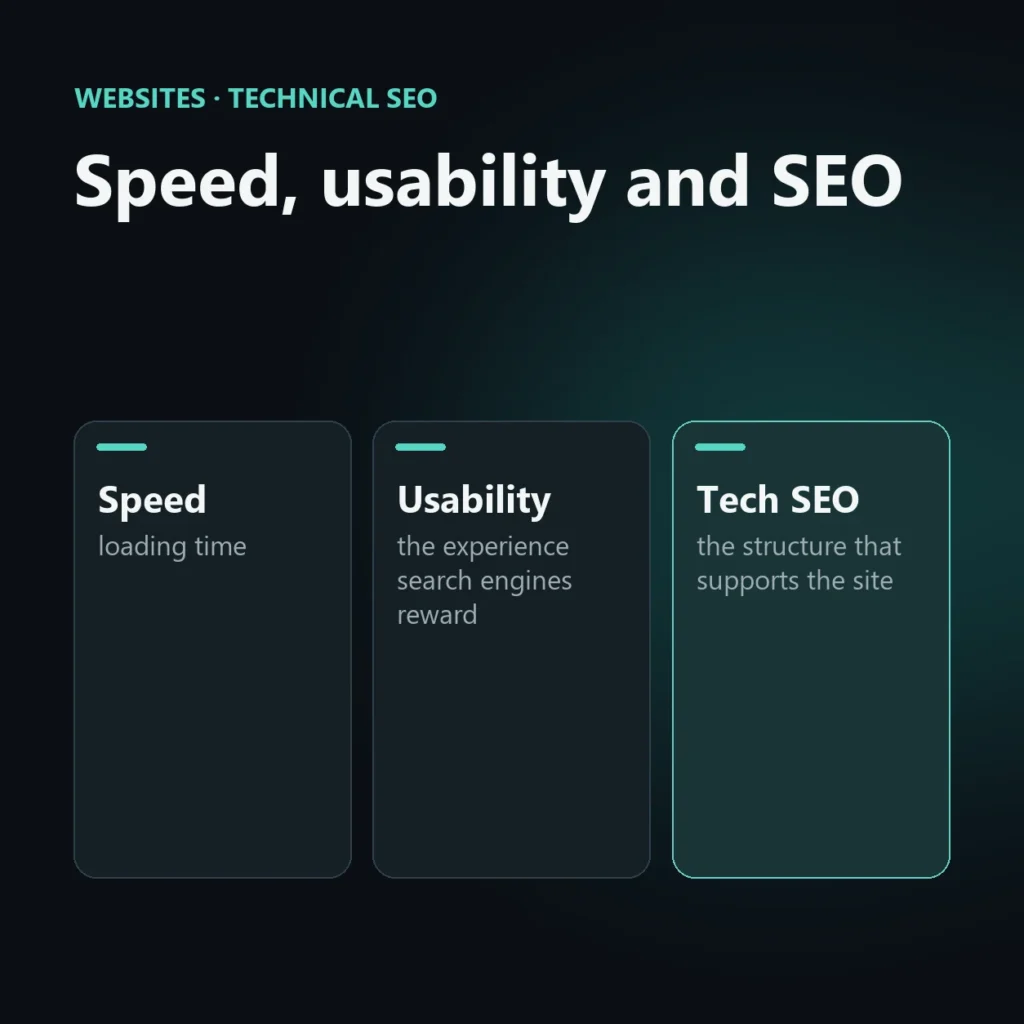
Speed, usability and SEO are the three technical pillars that determine whether a site is found, read and chosen by users and search engines. They are not separate areas to optimize at different times, but a single system: a slow site drives visitors away, a confusing interface disorients them, and a weak technical architecture prevents crawlers from understanding and valuing the content. When these three elements work together, the site speed for SEO stops being a mere technical parameter and becomes a concrete competitive advantage. In this article I analyze why no web project can ignore them and how to tackle them in an integrated way.
Why speed has become a decisive SEO factor
For years Google has been measuring the page loading experience through the Core Web Vitals, a set of metrics that describe how quickly a page shows its content, how stable it is during loading and how responsive it is to interactions. The site speed for SEO is therefore not an opinion, but a datum that search engines record and compare across similar pages. A site that loads in a reasonable time is more likely to be rewarded in ranking, while a slow site starts out at a disadvantage.
The point often overlooked is that speed isn’t only about the server. Resource weight, image handling, font loading, the presence of third-party scripts and cache configuration also matter. Every element adds or subtracts milliseconds, and the sum of these details makes the difference between a page that opens immediately and one that forces the user to wait. Working on performance and Core Web Vitals means intervening on all these fronts in a coordinated way.
It should be remembered that speed also impacts user behavior: long waiting times increase the likelihood of abandonment, reduce pages viewed per session and indirectly penalize the quality signals engines observe. Improving the site speed for SEO is therefore not just a technical operation, but a strategic choice that affects traffic, conversions and brand perception.
Usability: the experience engines reward
Usability describes how easy it is for a person to find their way around, read and act within a site. Clear navigation, consistent visual hierarchies, readable text and recognizable buttons reduce friction and keep attention high. For SEO this translates into longer sessions, fewer returns to the results page and a greater likelihood of interacting with the content, all signals that help strengthen the perceived authority of a page.
Usability must be designed together with the technical structure, not afterwards. A confusing menu or a poorly linear conversion path undermine even the work done on the site speed for SEO: the user reaches the page quickly, but doesn’t find what they’re looking for and leaves. Conversely, a well-designed interface amplifies the benefits of technical optimizations, because it turns good loading into an overall positive experience.
Accessibility also belongs in this discussion: adequate contrast, alt text, correct semantic structures and keyboard navigation make the site usable by a wider audience. An accessible and usable site is also a site that is easier for crawlers to interpret, since they read the page structure to understand what it is about and how it is organized.
Concrete signs of good usability
Some indicators help assess usability objectively: the clarity of headings, the consistency between link and destination, the presence of short paths to the main actions, the readability of text blocks. These are all elements measurable through tests with real users or behavioral analysis, and they should be monitored over time because usability is not a final state but a balance to maintain.
Technical SEO: the structure that supports everything else
Technical SEO comprises the set of configurations that allow search engines to crawl, interpret and index a site correctly. This area includes the management of robots.txt and sitemaps, the correct application of canonicals, URL structure, redirect handling and the consistency of structured data. Without a solid technical base, even the best content risks not being valued as it deserves.
site speed for SEO is closely intertwined with technical SEO: a slow site reduces the crawl budget available to crawlers, which end up visiting fewer pages in less time. Optimizing response times and reducing resource weight doesn’t only serve users, but also ensures that engines can explore the entire site regularly. It is one of the reasons why how to improve Core Web Vitals is a recurring question among those who manage web projects.
To this you add the maintenance dimension: security updates, error monitoring, performance checks over time. A neglected site accumulates problems that affect speed, indexing and user trust. Taking care of website maintenance and security is an integral part of a serious SEO strategy, not a separate activity.
Technical mistakes that weigh on ranking
Among the most common mistakes we find pages that return wrong status codes, duplicate content without canonicals, redirect chains that are too long and resources blocked by mistake. Each of these problems consumes crawl resources and confuses engines, reducing the overall effectiveness of the site. A periodic check makes it possible to spot and fix these issues before they become structural.
How the three pillars reinforce each other
Speed, usability and technical SEO are not three parallel tracks: they support each other. A fast page improves the experience, which in turn increases engagement; careful usability makes it easier for crawlers to scan the content; a correct technical structure ensures everything else is recognized and indexed. The site speed for SEO is the thread that connects these aspects, because it affects users and engines at the same time.
When one of the three pillars gives way, the others suffer. A technically flawless but slow site disappoints users; a fast but confusing site loses them along the way; a usable but poorly structured site isn’t found. The right approach is therefore integrated: you design thinking about performance, experience and architecture together, and you monitor over time to maintain the balance.
This applies in particular to projects aiming at visibility in generative engines and assisted answers, where technical quality and content clarity become even more decisive. A well-built site is easier to cite, to summarize and to recommend, both by users and by automated systems.
An integrated approach, not a compartmentalized one
Tackling the three pillars separately often leads to uncoordinated interventions: you optimize speed without considering navigation, you rewrite the interface without checking the technical impact. An integrated approach instead starts from an overall diagnosis and defines priorities that take all aspects into account, avoiding solving one problem by creating another.
| Pillar | What it measures | Impact on SEO | Typical priority |
|---|---|---|---|
| Speed | Loading times, visual stability, responsiveness | Ranking, crawl budget, abandonment | High, cross-cutting |
| Usability | Navigation, readability, conversion paths | Engagement, session duration, trust | High, ongoing |
| Technical SEO | Indexing, canonicals, structured data | Visibility, correct ranking | Fundamental |
| Maintenance | Updates, security, monitoring | Stability over time, prevention | Recurring |
As Google’s official documentation reminds us, these metrics are not optional for those who manage a site:
«Core Web Vitals are the subset of Web Vitals that apply to all web pages, should be measured by all site owners, and will be surfaced across all Google tools.» — web.dev (Google), “Web Vitals”
Frequently asked questions about site speed for SEO, usability and technical SEO
Does site speed really affect ranking?
Yes, speed is part of the metrics Google considers to assess page experience and indirectly affects user behavior as well, which in turn influences results.
What are Core Web Vitals in brief?
They are a set of metrics describing loading speed, visual stability and responsiveness to interactions, and they are measured on all pages of a site.
Is usability an SEO factor?
It is not a direct ranking factor, but it influences engagement signals and the ability of crawlers to correctly interpret the structure of pages.
How often should a site’s technical SEO be checked?
It is good practice to run periodic checks and continuous monitoring, especially after updates, structural changes or hosting changes.
Is optimizing only speed enough to improve SEO?
No: speed is an important pillar but it must be integrated with usability and technical SEO, because an isolated intervention doesn’t solve the overall issues.
Why does maintenance belong in the SEO strategy?
Because an updated and secure site maintains performance over time, avoids indexing errors and preserves the trust of users and engines.
Your site loses visits before it is even read
Has it ever happened that you open your site on mobile and see images appearing in jerks, content jumping from one part of the screen to another or the button you need to press not responding at the first tap? These are the classic symptoms of Core Web Vitals out of range, and they inflict the same experience on those arriving from your blog or your campaigns. Google measures them, weighs them in ranking and uses them to decide how much to show you. I start from the technical analysis of the real metrics, then I work on loading, visual stability and responsiveness, with work tailored to your stack and not to a generic checklist.



SEO, GEO and AEO specialist
Related articles
 Website CreationHacked WordPress site: anatomy of a real caseOctober 5, 2026
 Website CreationFrom site to funnel: how to design a path that convertsSeptember 24, 2026
 Website CreationNo-code, low-code and custom development: which approach should you choose for your company?September 24, 2026
Explore by topic