
The hidden cost of not being cited is the question your potential customers ask a generative engine and which someone else answers in your place. It isn’t a missed click, but an absence at a decision moment: when a user asks ChatGPT, Gemini or an answer engine who solves a problem, who offers a certain service or which approach is best to adopt, the model builds a concise answer citing some sources and ignoring others. If your company isn’t among those sources, the conversation happens anyway, but without you. This article analyzes why failing to be cited is a real cost, how it is measured and how to build visibility in generative engines in a structured way.
Why an answer you don’t give is a cost, not just a missed opportunity
In traditional search, lack of visibility produces a measurable effect: you don’t appear on the results page and the user chooses a competitor. In generative engines the mechanism is more insidious, because the answer is synthesized and presented as a ready-made conclusion. The user doesn’t see ten alternatives to choose from: they see one or a few sources deemed reliable. This means that visibility in answer systems is not an additional channel, but a new access point to the question.
The hidden cost works on three levels. The first is the direct loss of leads: those who aren’t cited receive no qualified traffic. The second is the loss of authority, because repeated absence suggests to the model, and to users, that your brand is not a reference source on that topic. The third is the cost of recovery: regaining a position in the set of cited sources takes more work than it would have taken to cover it in advance.
Unlike a paid campaign, which stops when you stop investing, visibility in generative engines tends to consolidate over time. Every citation increases the likelihood of being cited again, because models favor sources already recognized as consistent and reliable. Not covering this space means letting the advantage accumulate in favor of others.
How to build visibility in answer engines
Being cited doesn’t depend on luck nor on the authority of the domain alone. Generative engines select portions of content that answer a question directly, verifiably and in a well-structured way. visibility in answer engine systems is therefore built by working on the form and substance of the content, not just on keywords.
The first step is understanding which questions are asked and with what wording. Content that answers a real question, with a clear summary sentence at the start and a deeper dive right after, is much more likely to be extracted than a text that circles around the topic. The second step is structure: short paragraphs, explicit headings, verifiable data and claims. The third is consistency: if your site says different things on different pages, the model struggles to identify you as a reliable source.
An often underrated element is semantic markup. Explicitly declaring the type of content and the questions it answers helps automated systems interpret it correctly. In this sense, adopting a FAQ schema for AEO is not a technical detail in itself, but a way to make your expertise readable to whoever has to decide whether to cite you.
From classic SEO to GEO: what really changes
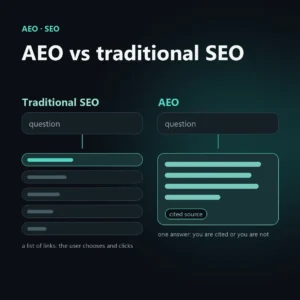
Classic SEO optimizes for ranking in a list of results. The Generative Engine Optimization optimizes for inclusion in a synthesized answer. The practical difference is that being on the first page is not enough: you have to be the source the model chooses to summarize. The visibility in generative engines rewards clarity, specificity and the ability to answer precise questions, more than the repetition of keywords.
This doesn’t make SEO useless, quite the opposite: it makes it a prerequisite. A technically healthy site with well-organized content is easier to interpret for generative systems too. But the qualitative leap lies in moving from «how do I rank» to «how do I become the answer».
The role of citations in generative engines
Citations are not all equal. A mention in an authoritative context weighs more than an isolated occurrence, and consistency across different sources strengthens the perception of reliability. Building citations in generative engines means working on the brand’s presence in sources that models consider relevant: well-structured owned content, consistent external mentions and verifiable data.
The key point is that citation is not an isolated event but a pattern. A model that finds your brand repeatedly associated with a certain topic will tend to cite it more often on that topic. The visibility in answer systems is therefore built with consistency, not with a single optimized piece of content.
Measuring visibility in generative engines: what to observe
One of the main obstacles is that generative engines don’t offer reports comparable to those of an advertising platform. The visibility in answer systems must therefore be measured with a mix of qualitative observation and indirect indicators. There is no single dashboard, but there are signals that, read together, tell you whether you are gaining or losing ground.
The first signal is presence in answers: by asking the main engines the key questions of your sector, you check whether and how you are cited. The second is traffic from reference sources: an increase in visits from contexts where you haven’t invested directly may indicate that you have become a cited source. The third is consistency of mentions: if your brand is repeatedly associated with the same concepts, you are building authority.
To set up this reading systematically you need a method, not improvisation. An AEO audit lets you capture the current state, identify the content that answers the relevant questions and understand where the visibility in generative engines is lacking.
The mistakes that wipe out visibility in answer engines
There are recurring mistakes that make a site invisible to generative systems. The first is vagueness: content that talks about the topic without answering a concrete question is rarely extracted. The second is fragmentation: information scattered across different pages, without a clear summary, forces the model to look elsewhere. The third is inconsistency between what you declare and what the rest of the web says about you.
A less obvious mistake is neglecting maintenance. Generative engines continuously update the sources they consider reliable: content that is dated or contradicted by more recent information loses ground. Keeping key content up to date is an integral part of the strategy for visibility in generative engines, not a side activity.
How much a citation is really worth: a comparison
To understand the impact of not being cited, it helps to compare the different scenarios a company can find itself in. The table below summarizes the differences between those who actively manage their visibility and those who neglect it.
| Scenario | Presence in answers | Effect on the brand | Cost over time |
|---|---|---|---|
| Active management | Recurring citations on key questions | Consolidated, recognizable authority | Investment that compounds |
| Partial presence | Occasional, unstructured citations | Inconsistent perception | Growing recovery cost |
| Total absence | No citations, answers given by others | Brand excluded from the comparison | Cumulative loss of opportunities |
| Contradictory presence | Citations with inconsistent information | Reliability called into question | Reputational damage to correct |
Reading the table clarifies one point: the biggest cost is not the single missed citation, but the cumulative effect. The visibility in answer systems behaves like reputational capital: it grows with consistency and depreciates with inertia.
Frequently asked questions about the cost of not being cited
What exactly does «not being cited» mean?
It means that a generative engine, answering a question in your sector, does not include your brand among the sources it uses or mentions in the synthesized answer.
Why is the cost called «hidden»?
Because it doesn’t appear in any report as a line of expense: it shows up as an absence of opportunities, so it is hard to quantify without a specific analysis.
Does visibility in generative engines replace traditional SEO?
No, it complements it. A technically solid and well-structured site remains the foundation on which the ability to be cited by answer systems is built.
How long does it take to get citations?
It depends on the competition on the topic and on the consistency of the content, but in general it is a progressive path, not an immediate result.
Is optimized content enough to be cited?
Content is necessary but not sufficient: the consistency of external mentions, the semantic structure and updating over time also matter.
How do I check whether I’m losing visibility?
By monitoring the answers of the main engines on the key questions of the sector and observing the trend of mentions and of traffic from reference sources.
Every question without your answer is a customer who doesn’t find you
When ChatGPT, Perplexity or AI Overviews answer a purchase question, they cite only some sources. If yours isn’t among them, the conversation closes without you: the prospect gets an answer, often a competitor’s, and doesn’t even know you existed. It isn’t a loss you can see in analytics, it’s a silence that accumulates. This is exactly what I work on: I make your content the source that generative engines choose to cite, with a structured and ongoing presence. The starting point is understanding where your voice is missing today.
SEO, GEO and AEO specialist
Related articles
 AEOFAQ, schema and conversational content: what really works for AEOSeptember 24, 2026
 AEOFeatured snippets, People Also Ask and AI answers: three different ways to win an answerSeptember 24, 2026
 AEOAEO: why answering well has become the new SEOSeptember 24, 2026
Explore by topic