
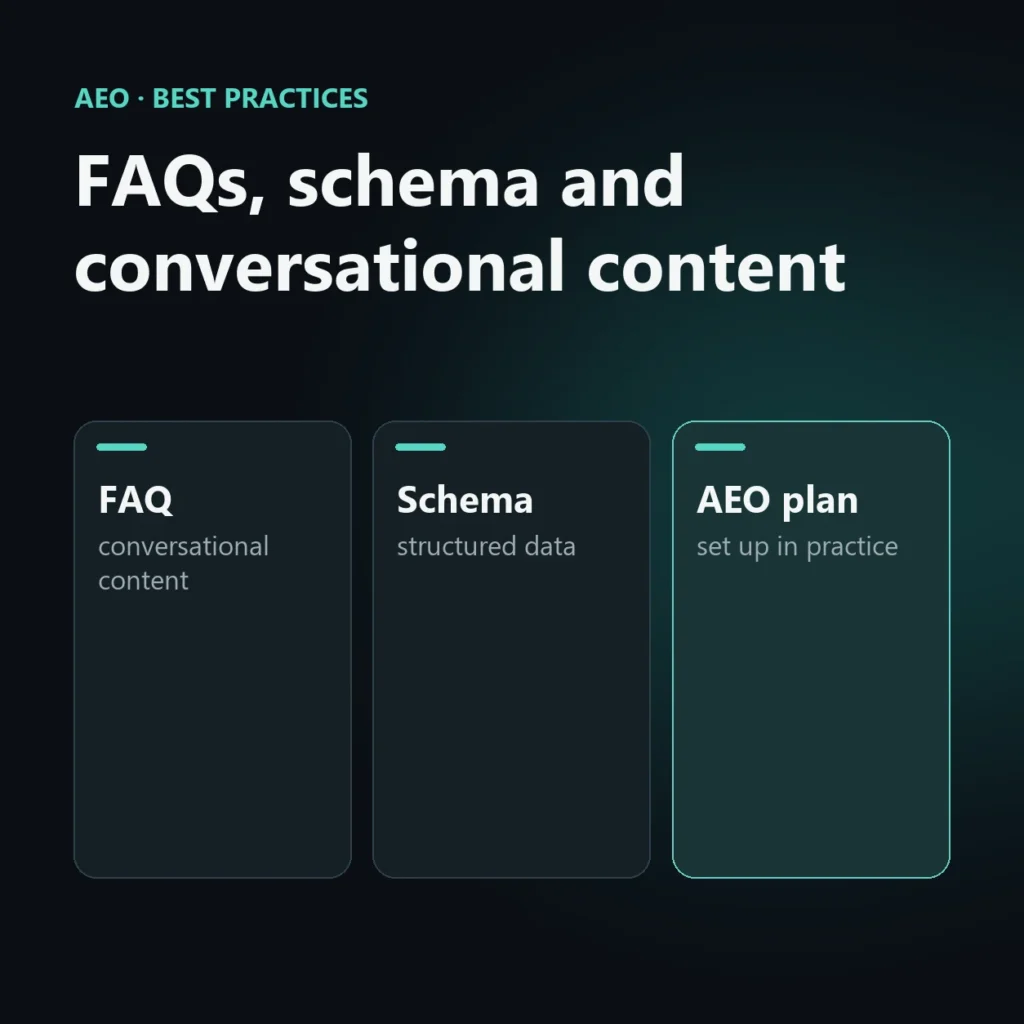
AEO, or Answer Engine Optimization, is the set of practices that makes a site’s content easily understandable, extractable and citable by answer engines and generative engines. Unlike classic SEO, which aims at ranking on a results page, AEO works on the ability of a system to answer a question using portions of reliable content. In this scenario, FAQs, structured data and conversational language become key tools, but not all of them work the same way. Some techniques considered winning until recently now carry a different weight, and understanding which AEO best practices are real is the starting point for not investing time in activities that produce no measurable effects.
Why AEO is different from traditional SEO
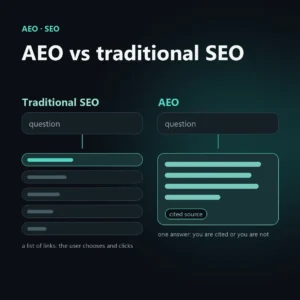
Traditional SEO thinks in terms of ranking: a page competes with others for a position, and the user clicks. AEO thinks in terms of extraction: a system reads, interprets and recomposes an answer, often without the user visiting the page. This changes the priorities. It isn’t enough to rank well, what matters is being understandable and citable as a source at the moment a generative engine builds its answer.
This shifts attention to three elements: the semantic clarity of the text, the technical structure that makes the relationships between question and answer explicit, and the consistency of authority signals. A page optimized only for keywords but written ambiguously will hardly be used as the basis for a generated answer. Conversely, well-structured content, even if less rich in keywords, is more likely to be selected.
AEO best practices, therefore, don’t replace SEO: they complement it with an extra level of care on the form of the content. Those who work on both fronts gain visibility both in classic results and in conversational answers, which today represent a growing share of search interactions.
FAQs and conversational content: what really works
FAQs remain a useful tool, but their role has changed. Until a few years ago the promise was simple: add FAQ schema and get an expanded rich result in the SERP. That is no longer the case. It is worth remembering what Google has stated on the matter.
«The FAQ rich result feature is no longer shown in Google Search results» — Google Search Central, FAQPage documentation (updated 2025)
This doesn’t mean FAQs are useless. It means their value has shifted: they are no longer bait for a visible snippet, but a semantic structure that helps systems recognize question-answer pairs. A generative engine that has to answer a specific question finds in a well-written FAQ section material that is already organized and ready for extraction. This is the core of AEO best practices applied to FAQs.
Conversational content, that is, written the way people speak, with explicit questions and direct answers, works better than purely descriptive text. Not because it is «nicer», but because it reduces ambiguity. An answer that starts with a clear statement and then expands is easier to isolate than a paragraph that gets to the point after three introductory sentences. Those who work onFAQ optimization know that the position of the answer within the block matters as much as the content itself.
Real questions, not invented ones
An FAQ works when it answers a question people really ask. Questions built at a desk to insert a keyword are recognizable and generate no value for either users or systems. AEO best practices suggest starting from real queries, from related searches, from recurring doubts collected in customer support or in comments. The relevance of the question determines the relevance of the answer.
A second element is granularity: one question, one answer. Merging several questions into a single block confuses extraction. Better six short, precise FAQs than two long, scattered ones.
Length and tone of the answer
Answers that are too long dilute the signal; those that are too short often lack context. A good practice is to start with a crisp sentence that resolves the doubt, then add one or two sentences of depth. This format is consistent with the way generative engines tend to extract and cite portions of text.
A conversational tone helps, but shouldn’t be confused with extreme informality. The register can be direct and understandable without losing technical precision. The goal is to be understood, not to simplify to the point of being vague.
Schema and structured data: what they are for today
structured data remain an important technical tool, but their role should be framed realistically. The FAQ schema for AEO no longer produces a visible rich result for most sites. Nonetheless, the markup retains value: it makes the relationship between question and answer explicit, helps systems tell content apart and contributes to a more orderly representation of the page.
This also applies to other schema types, such as Article, HowTo or BreadcrumbList. The logic is the same: providing readable metadata that reduces interpretive ambiguity. A generative engine that has to decide whether to trust a source benefits from structured signals consistent with the visible text.
The risk, however, is treating schema as a shortcut. Marking up as FAQ content that isn’t, or inserting markup that doesn’t match the text, brings no benefit and can be penalized. AEO best practices require consistency between what is declared in the markup and what the user reads on the page.
Useful schema, decorative schema
A schema is useful when it adds information: it identifies the author, clarifies the type of content, makes the relationships between entities explicit. It is decorative when it passively repeats what is already obvious from the text. Focusing on the former is one of the most underrated AEO best practices, because it requires thinking of the page as a set of entities and not just as a block of words.
Common mistakes and how to avoid them
The first mistake is chasing tactics that no longer have the expected effect. Expecting an FAQ rich result after adding schema is an expectation bound to disappoint. The second is writing content designed for engines and not for people: generative systems are trained on real text, and artificial text is recognizable.
The third mistake is inconsistency. If the page promises one thing in the title, another in the introduction and a third in the FAQs, no system will know which version to favor. Semantic consistency is a prerequisite, not a detail. The fourth is ignoring maintenance: outdated content loses reliability, and AEO best practices include periodic review as an ordinary activity.
A fifth, subtler mistake is focusing only on the text and neglecting the overall experience of the page. Speed, clarity of structure, absence of elements that disturb reading: these are factors that affect the perception of quality, even when they are not directly related to AEO.
| Element | Is it needed for the Google rich result? | Is it needed for AEO? | Operational priority |
|---|---|---|---|
| FAQPage schema | No, removed for most sites | Yes, as a semantic signal | Medium |
| FAQs written in conversational language | Indirectly | Yes, directly | High |
| Additional structured data (Article, HowTo) | Partially | Yes, for clarity of entities | Medium |
| Consistency between markup and visible text | Basic requirement | Yes, essential | High |
| Periodic content updates | Indirect | Yes, for reliability | High |
How to set up a concrete AEO plan
An AEO plan starts from analyzing your audience’s real questions, not from a list of keywords. You collect the recurring questions, group them by topic and turn them into clear blocks of content. At that point you decide where to place them: a dedicated FAQ section, an explanatory paragraph inside an article, or both.
The second step is writing. Direct answers, short sentences, no ambiguity. The third is markup: schema consistent with the text, without forcing. The fourth is verification: content is reviewed periodically, updated when information changes and kept consistent with the rest of the site. Applying these AEO best practices systematically requires method more than sophisticated tools.
Finally, measurement. There are no perfect metrics for AEO, but you can observe indirect signals: an increase in citations, presence in generated answers, changes in traffic from conversational queries. A realistic approach measures trends, not certainties.
Frequently asked questions about FAQs, schema and AEO
Is FAQ schema still useful after the removal of the rich result?
Yes, but not to get a visible snippet. It serves as a semantic signal that helps systems recognize question-answer pairs and interpret the page better.
How many FAQs should you put on a page?
There is no fixed number: quality is what counts. Better a few FAQs that answer real questions than many built only to insert keywords.
Does conversational language penalize traditional SEO?
No, if it stays clear and relevant. Understandable, well-structured text tends to work well for both SEO and AEO.
Is structured data enough on its own for AEO?
No. It is a useful technical support, but without clear and consistent content it produces no significant effects.
How do you measure the effectiveness of an AEO intervention?
By observing indirect signals: citations in generated answers, traffic from conversational queries, consistency of visibility over time.
How often should AEO-optimized content be updated?
There is no fixed deadline. It should be reviewed when the reference information changes or when new recurring questions emerge.
Your FAQs are no longer enough to get cited
You’ve written the frequently asked questions, you’ve published the schema, and yet answer engines keep drawing from elsewhere. The problem is almost always the same: content designed for the page, not for the conversation, with markup that doesn’t hold up under scrutiny. I start right here, from your real FAQs and from how they are read and cited, to put schema and wording back in order from an AEO perspective. It isn’t template work: it’s understanding which answer deserves to be extracted, and making it readable to whoever has to cite it.
SEO, GEO and AEO specialist
Related articles
 AEOThe hidden cost of not being cited: what an answer you don’t give is worthSeptember 24, 2026
 AEOFeatured snippets, People Also Ask and AI answers: three different ways to win an answerSeptember 24, 2026
 AEOAEO: why answering well has become the new SEOSeptember 24, 2026
Explore by topic