
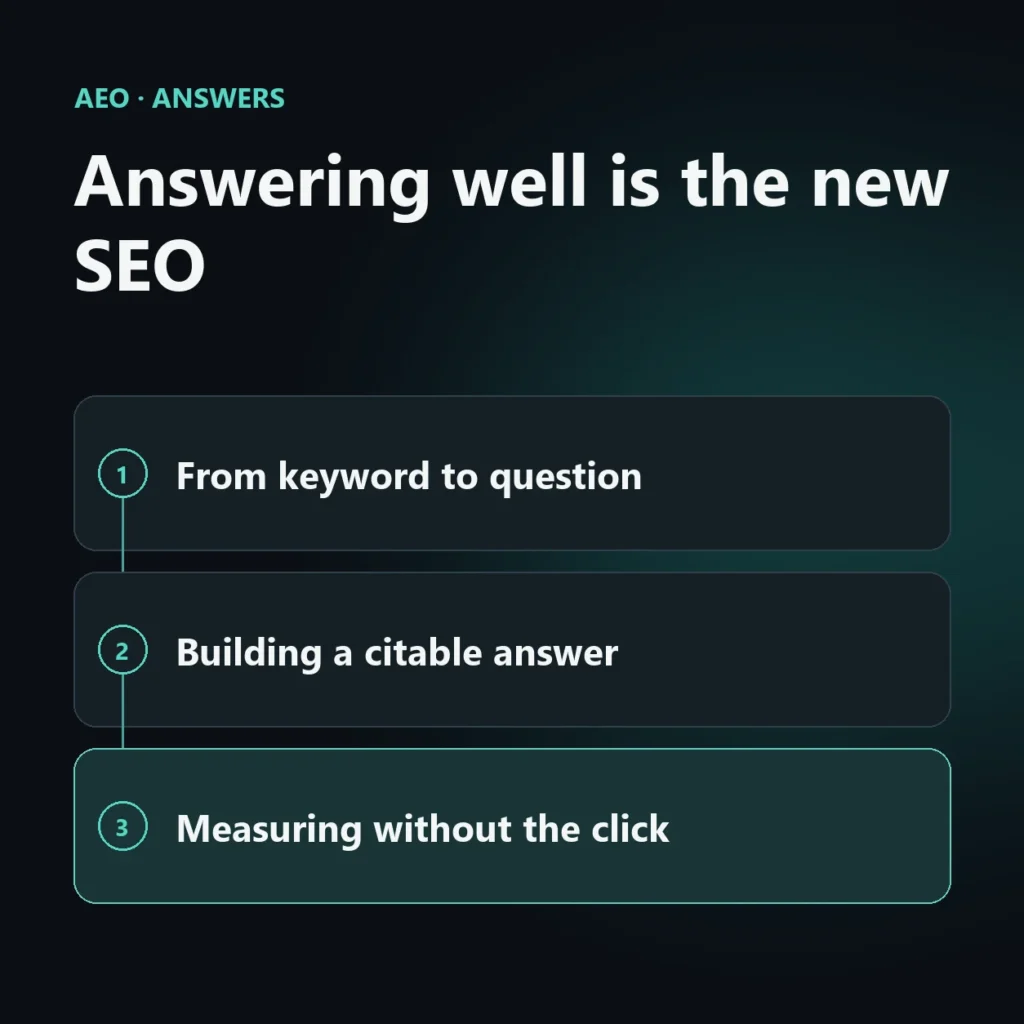
Answer engine optimization is the set of practices by which content is designed, written and structured to be selected and cited as a direct answer by artificial-intelligence-based engines and conversational assistants. If for twenty years SEO worked mainly to bring the user to a page, today the endpoint has shifted: more and more often the answer is consumed directly on the results page, inside a generated box, in a voice assistant or in a chat. This change of scenario doesn’t erase traditional SEO, but recomposes it around a different question: not “how do I rank”, but “how do I become the source that gets cited”. Answer engine optimization is born exactly from this, and for many companies it is becoming the new playing field.
Why answering well is the new SEO
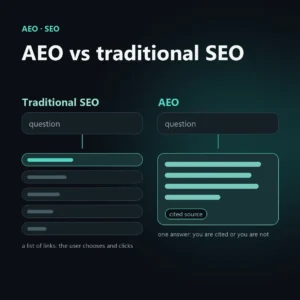
The classic search engine returned a list of links and left the user the job of choosing, comparing, synthesizing. Answer engines do the work for them: they read the sources, extract the relevant passages, recompose them into a short answer and cite a few sources. The result is that visibility is no longer measured only in rankings, but in presences inside answers. A piece of content can rank first and never appear in the generated summary, because it isn’t clear enough, isn’t structured enough or doesn’t answer the question directly. This is where answer engine optimization comes in: instead of optimizing for a keyword, you optimize for a question and its answer. This doesn’t mean writing thin or fragmented texts. It means making the link between question and answer explicit, putting the conclusion at the top, using consistent terminology and not leaving the engine to deduce the meaning of a paragraph. The difference between content that gets cited and content that gets ignored, in most cases, lies not in the authority of the domain but in the clarity with which the answer is worded. There is also a knock-on effect on the whole funnel. If an assistant cites your content as a source, that citation works as a recommendation: the user arrives already convinced, with less need to be persuaded. That is why answer engine optimization is not a technical exercise for its own sake, but a way to capture high-intent questions at a time when competition on the results page is increasingly compressed.
How to build an answer that gets selected
The first principle is the direct answer. Every section should open with a sentence that resolves the question implicit in the heading, and only then go deeper. Answer engines reward self-sufficient passages, that is, blocks of text that remain understandable when extracted from context. A paragraph that starts with «as we said above» or that depends on the previous paragraph to make sense is a hard paragraph to cite.
Structure, not decoration
The heading hierarchy is not an aesthetic detail: it is the map the engine uses to understand what a section is about. Clear headings that contain the question or the key concept help both human reading and automatic extraction. In the same way, short, isolated definitions work better than definitions diluted across three paragraphs. If you are explaining a concept, give the concept a sentence recognizable as a definition.
Structured data and semantic markup
Well-written text is the foundation, but structured signals help the engine interpret the role of each block. In this sense, implementing a FAQ schema for AEO lets you state explicitly which questions the content addresses and which answers it provides. It is not a shortcut: it is a way to reduce ambiguity and increase the chances that the content is read as a reliable source on that specific topic. It must be said honestly: structured data doesn’t guarantee citation, just as good formatting doesn’t guarantee ranking. They are necessary but not sufficient conditions. What makes the difference is the consistency between what you promise in the title, what you declare in the markup and what you write in the text. When these three levels say the same thing, the content becomes easy to interpret and therefore easier to reuse.
From keyword to question: what changes in editorial work
Editorial work for answer engine optimization starts from collecting real questions, not from a list of keywords. Questions are found in related searches, in autosuggestions, in conversations with customers, in support sections, in comments. A well-formulated question is worth more than ten generic keywords, because it indicates a precise need and a precise moment in the buying journey. Once collected, questions should be grouped by intent and assigned to different pages, avoiding answering the same thing on five competing URLs. Cannibalization, already a problem in classic SEO, is even more so here: if two pages give slightly different answers to the same question, the engine is less certain about which to cite. Better one page that answers well and completely, with internal sections dedicated to each sub-question.
The role of voice search and natural language
Queries spoken aloud tend to be longer, more conversational and phrased as complete sentences. This brings the way you write for voice search very close to the way you write for answer engines: in both cases it pays to use the user’s language, not internal jargon. If a customer asks «how much does it cost to redo a roof», a page that only talks about «coverings and waterproofing membranes» risks never meeting that question. This doesn’t mean lowering the technical level, but pairing it. Good content for answer engine optimization uses the precise term and, right after, the common phrasing people use to look for that thing. It is a double registration that serves both the expert and the first-time reader, and widens the occasions in which the content can be selected.
Measuring results when the answer isn’t a click
The classic measurement model — position, clicks, impressions — remains useful but doesn’t tell the whole story. When an answer is generated and cited, the user may not click at all, and yet have come into contact with the brand. In these cases we talk about zero-click, a phenomenon that shifts value from the visit to the mention. Measuring only sessions therefore risks making work that is actually succeeding on another level look like it’s declining. You need a broader dashboard: brand mentions in generated answers, presence in summaries for reference queries, trends in direct searches for the name, quality of the remaining traffic. One fewer click but a more informed user is often worth more than one more click and a confused user. Answer engine optimization works precisely on this second type of value, which is less immediate to see but more solid over time. A reasonable approach is to treat visibility in answers as a trend indicator, not a surgical metric. You observe the patterns: which topics get cited, which don’t, which pages are preferred, which are ignored. From there you understand where to strengthen clarity and where the answer is simply missing.
| Approach | Main goal | Unit of work | Success signal |
|---|---|---|---|
| Classic SEO | Ranking in the results | Keyword | Position and clicks |
| Answer engine optimization | Being cited as a source | Question | Presence in the generated answer |
| GEO (generative engine optimization) | Being included in generative models | Entity and topic | Mentions and entity consistency |
| Supporting content | Reducing interpretive ambiguity | Block of text | Extractability of the passage |
Common mistakes and how to avoid them
The first mistake is treating answer engine optimization as a formatting technique. Adding an FAQ section at the bottom of an article that doesn’t really answer anything produces no results. Markup amplifies content that is already clear, it doesn’t create its clarity. If the answer isn’t there, no structured data invents it. The second mistake is chasing every possible question, diluting the content. A text that tries to answer twenty different questions ends up not answering any of them well. Better a focused piece of content, with dedicated sub-sections, than an encyclopedic and superficial one. Depth on one topic almost always beats breadth across ten. The third mistake is ignoring entity consistency. If the brand is described in different ways on the site, profiles and directories, the engine struggles to build a stable picture. Answer engine optimization is not only a matter of individual pages: it is also a matter of how the whole site tells who you are and what you do.
Frequently asked questions about answer engine optimization
What is the difference between SEO and answer engine optimization?
SEO aims to rank a page in the list of results, while answer engine optimization aims to get the content selected as the direct answer. The two activities overlap, but the unit of work changes: keyword on one side, question on the other.
Does answer engine optimization replace traditional SEO?
No, it complements it. A good SEO base remains necessary to be indexed and considered reliable, while answer engine optimization adds the layer of clarity and structure needed to be cited.
Is structured data enough to be cited?
It isn’t enough on its own. It helps the engine interpret the content, but the main condition remains having a clear, complete and well-worded answer in the text.
How long does it take to see results?
It depends on the sector, the competition and the starting quality of the content. In general you think in months, not weeks, and the first signals are seen on the most specific questions.
Does it apply to small businesses too?
Yes, often with greater advantages. In local niches and very specific questions competition is lower and a well-made answer can emerge more easily.
How do you measure the success of an AEO strategy?
By observing mentions and citations in generated answers, trends in brand searches and the quality of the remaining traffic, rather than the number of clicks alone.
The content that never gets cited
You publish carefully crafted articles, but when someone asks an AI assistant the question about your sector, your name doesn’t appear among the sources. The problem isn’t the quality of the texts: it’s that they aren’t structured to be understood and selected by answer engines. I work on exactly this, with an Answer Engine Optimization approach that starts from your audience’s real questions and builds content designed to be cited, not just read. If you want to understand how to set up the work on your site, the starting point is here.
SEO, GEO and AEO specialist
Related articles
 AEOFAQ, schema and conversational content: what really works for AEOSeptember 24, 2026
 AEOThe hidden cost of not being cited: what an answer you don’t give is worthSeptember 24, 2026
 AEOFeatured snippets, People Also Ask and AI answers: three different ways to win an answerSeptember 24, 2026
Explore by topic