
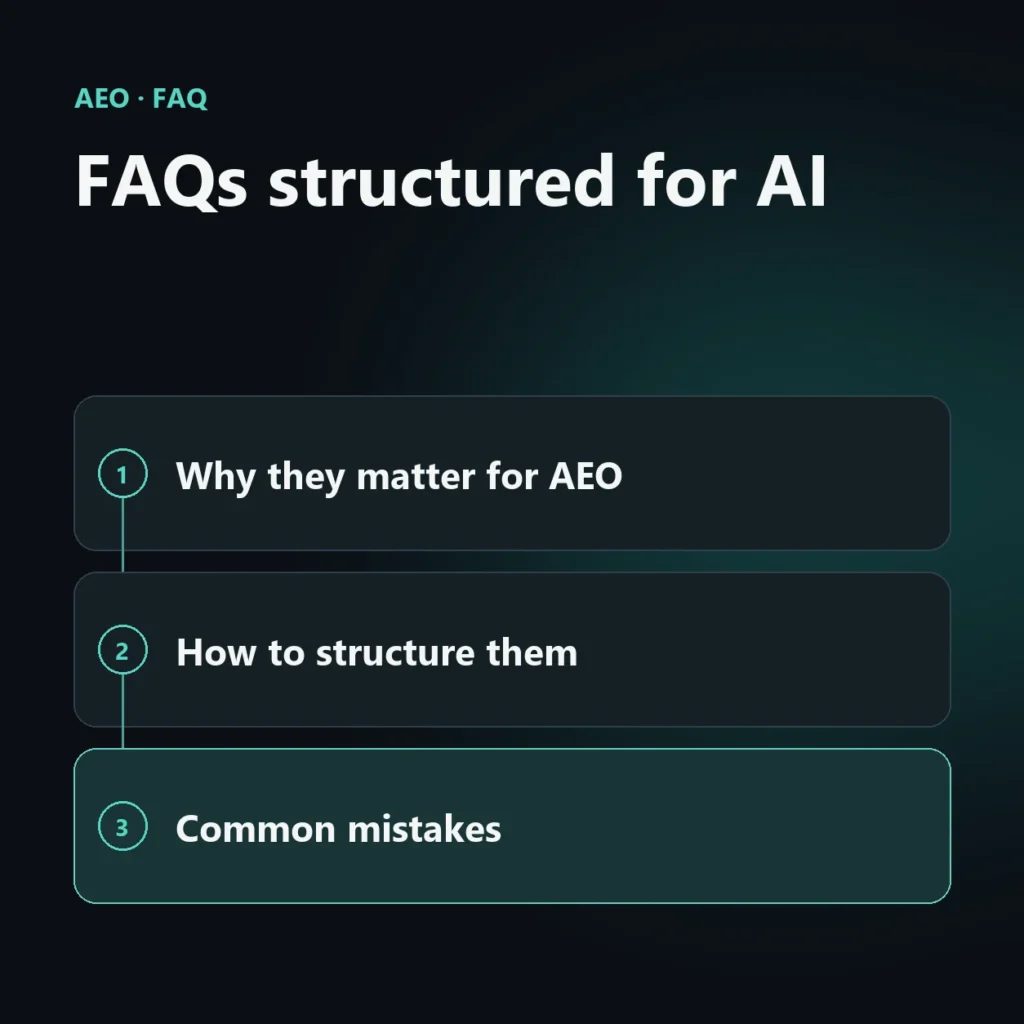
A site’s FAQs are read by AI only if they are marked up with FAQPage structured data and written in a self-sufficient question-and-answer format: every answer must make sense even when extracted from the context of the page, because that is exactly how it will be shown by Google and by assistants.
Why FAQs matter for AEO
Frequently asked questions are the easiest content format for an answer engine to extract: they are already in question-and-answer form, the native format in which users query ChatGPT, Google AI Overviews or a voice assistant.
How to structure an FAQ so AI can read it
One question, one complete answer
Every answer must stand on its own: avoid phrases like “as explained above” or references that require reading the rest of the page.
Questions written the way users really search
Use the natural language of real queries (“how much does it cost”, “how do you do it”, “what is the difference”) instead of technical or promotional wording.
Marking up with FAQPage schema
Without the FAQPage markup from Schema.org, Google can still read FAQs but less reliably. Structured data makes the question-answer relationship explicit.
Short but not generic answers
The ideal length is 40–80 words: long enough to be complete, short enough to be read aloud by a voice assistant.
Common mistakes in SEO FAQs
The first mistake is copying the same FAQs across several pages of the site, creating duplicate content. The second is writing promotional answers instead of informative ones — an AI answer engine tends to discard content that looks like advertising rather than neutral information. An FAQ optimization service works exactly on this balance.
Frequently asked questions about FAQs for AI
How many FAQs do you need per page?
There is no fixed number: better 4–6 relevant, well-written FAQs than 15 generic, repetitive ones.
Should FAQs be duplicated across several pages?
No, each page should have FAQs specific to its own topic to avoid cannibalization and duplicate content.
Does FAQPage markup guarantee appearing on Google?
No, it is a necessary but not sufficient condition: Google still decides whether and when to show the visual enhancement in the SERP.
SEO, GEO and AEO specialist
Related articles
 AEOFAQ, schema and conversational content: what really works for AEOSeptember 24, 2026
 AEOThe hidden cost of not being cited: what an answer you don’t give is worthSeptember 24, 2026
 AEOFeatured snippets, People Also Ask and AI answers: three different ways to win an answerSeptember 24, 2026
Explore by topic