
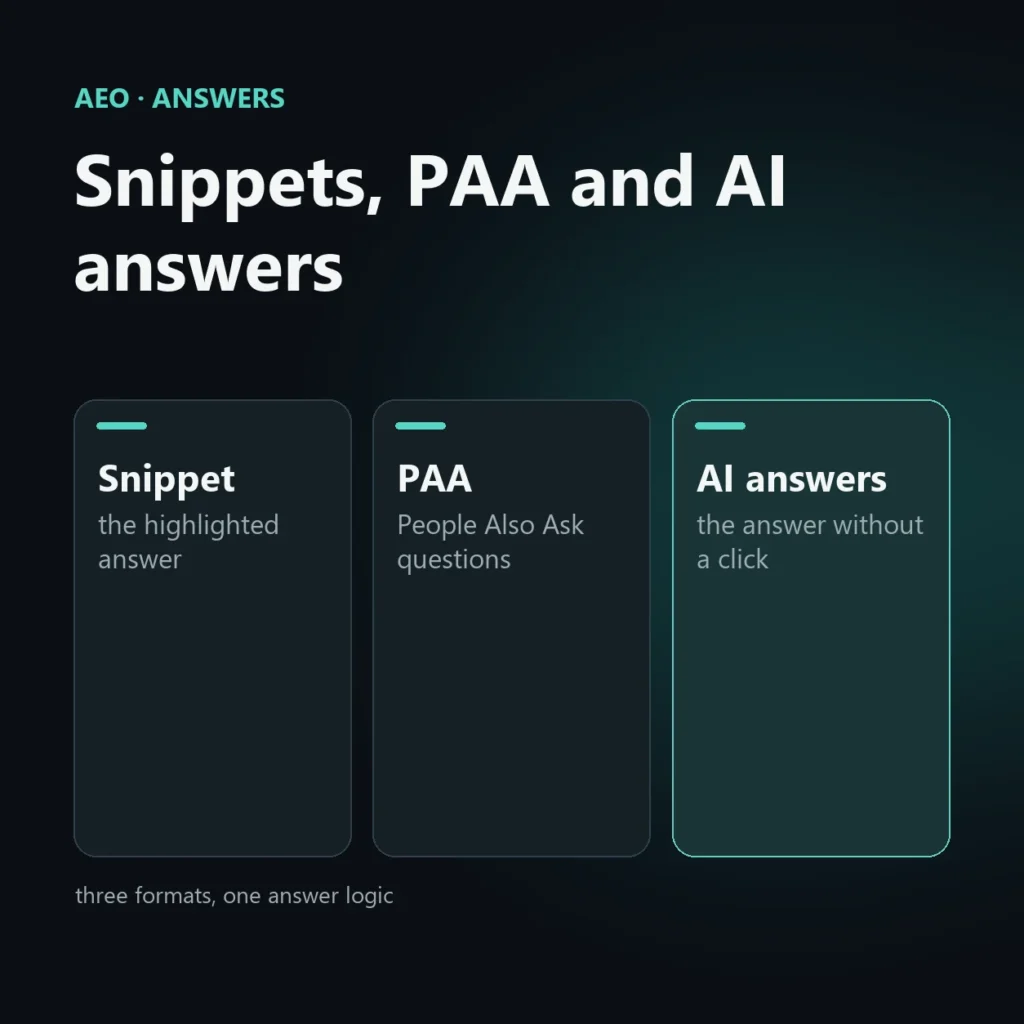
Featured snippet optimization is the structure and content work that lets a page win Google’s highlighted answer, the box that appears above the organic results. Around that box, however, an ecosystem of formats has been built over the years that answer the same user question in different ways: People Also Ask, and the answers generated by artificial intelligence in results and conversational engines. Understanding where they overlap and where they diverge is now the premise for a visibility strategy that doesn’t depend on a single format.
What a featured snippet really is
Google Search Central describes it as a special box in which the usual order of the result is reversed: first the descriptive text, then the title and URL. It is a simple definition that hides an important consequence: the snippet is not a separate result, it is an extraction from a page that Google considers the best suited to answer. This means you don’t “create” a snippet from nothing, you make a page extractable.
Featured snippet optimization starts exactly here: it isn’t about adding a tag or a magic markup, but about organizing the content so that a single portion of text or a table answers a question completely and self-sufficiently. The format can be a paragraph, a list, a table or a video, and the choice depends on the intent of the query.
It is worth remembering that the snippet doesn’t replace the work on rich snippet optimization, which concerns structured data and enhanced results: they are two distinct levels, often confused, but both contribute to how the page is represented in the SERP.
People Also Ask: the answer becomes a door
People Also Ask are blocks of related questions that Google shows below or next to the main results. Their peculiarity is that they are expandable: by clicking a question, the user sees a short answer and the block regenerates with new questions. For those working on visibility, this makes them interesting because a single page can appear in multiple PAAs at once, even without occupying position zero.
Why they matter more than they seem
PAAs capture the exploratory phase of search. The user hasn’t yet formulated the final question and is building their own path. Appearing in that block means entering the conversation before it closes on a competitor. Featured snippet optimization, in this sense, is not just a question of position: it is also a question of covering side questions.
The most effective way to cover PAAs is to build content sections that answer specific questions in language close to the way people ask them. Headings in question form, short and autonomous answers, no references to previous paragraphs: these are the same principles that apply to the snippet, applied to a different format.
AI answers: the answer without a click
Answers generated by artificial intelligence in search results and conversational engines are the third way to win an answer. Here the text isn’t extracted from a page, but synthesized from multiple sources. The consequence is twofold: on one hand the risk of zero-click increases, on the other it becomes crucial to be one of the sources cited or used in the synthesis.
What changes for featured snippet optimization
If AI answers are built on multiple sources, the clarity and verifiability of the content become a competitive advantage. Short sentences, attributable data, logical structure and terminological consistency help a model recognize and reuse a statement. It is a ground on which snippet optimization for AEO largely overlaps with classic SEO practices, with greater emphasis on precision of language.
Content that answers directly, without ambiguity and with a clear hierarchy of information is more likely to be cited both in a snippet and in a generated answer. The difference is that the snippet rewards synthesis, while AI answers reward synthesis backed by verifiable context.
«Featured snippets are special boxes where the format of a regular search result is reversed, showing the descriptive snippet first.» — Google Search Central, “Featured snippets”
Three formats, one answer logic
Placed side by side, featured snippets, People Also Ask and AI answers seem like three separate worlds. In reality they all respond to the same need: giving the user an immediate answer before they have to open a page. The selection mechanism changes, the degree of control the publisher has over the result changes, but the substance stays the same.
Those who work on how the featured snippet works know that position zero isn’t a permanent prize: it can be lost and regained, and it often passes from one page to another of the same site. The same applies to PAAs and to citations in AI answers: they are fluid positions that require maintenance.
One approach for three channels
Featured snippet optimization thus becomes the core of a broader strategy: writing autonomous answers, structuring them in a recognizable way, covering related questions and keeping the content up to date. These are practices that reinforce each other and that reduce dependence on a single format.
A cross-cutting element is the consistency between title, question and answer. If the title promises one thing and the next paragraph says another, no algorithm will choose that portion as an answer. Clarity is not a matter of style, it is a technical requirement.
A second element is granularity: short, thematically closed sections are easier to extract than long, all-encompassing blocks. This doesn’t mean fragmenting the content, but organizing it into complete units of meaning.
| Format | How it is selected | What it rewards | Degree of control |
|---|---|---|---|
| Featured snippet | Extraction from a single page deemed most relevant | Synthesis, structure, match with intent | Medium: it can be encouraged, not guaranteed |
| People Also Ask | Selection of related questions and their short answers | Coverage of side questions | Medium: depends on the relevance of the sections |
| AI answers | Synthesis generated from multiple sources | Clarity, verifiability, authority | Low: you influence the citation, not the text |
| Classic organic result | Ranking based on relevance and authority | Overall quality of the page | High: depends on ranking |
Recurring mistakes in featured snippet optimization
The first mistake is treating the snippet as a goal in itself, disconnected from the rest of the page. Those who chase only the highlighted box risk producing artificial content, with forced definitions and paragraphs constructed artificially for extraction. It rarely works and worsens the experience for readers.
The second mistake is ignoring alternative formats. Focusing only on the snippet means leaving PAAs and AI answers uncovered, which often reach the same audience at different points in the journey. A strategy that covers all three fronts is more resilient.
The role of updating
Featured answers change over time, and a page that holds position zero today can lose it without any intervention. Monitoring and updating content is an integral part of featured snippet optimization, not a side activity. Stagnant content is content that loses ground, especially when user demand evolves.
The choice of sources and references also matters: citing verifiable data and linking to authoritative sources strengthens the page’s credibility in the eyes of both algorithms and generative models.
Frequently asked questions about featured snippets, PAAs and AI answers
What is the difference between a featured snippet and People Also Ask?
The snippet is a single highlighted answer extracted from a page, while People Also Ask are blocks of related questions with short, expandable and regenerable answers.
Can you optimize a page for an AI-generated answer?
Not directly, because the text is synthesized from multiple sources. You can however increase the likelihood of being cited by working on the clarity, structure and verifiability of the content.
Does featured snippet optimization require structured data?
It isn’t a requirement for the snippet, which is based on content extraction. Structured data serves mainly for rich results and other enhanced formats.
How long does a position zero last?
It has no defined duration: it can change with algorithm updates, competing content and the evolution of the query. It must be monitored and maintained over time.
Do PAAs bring real traffic?
Yes, although to a variable extent. They capture the exploratory phase of search and can bring qualified visits, especially if the answer opens up a deeper dive.
Do AI answers reduce the value of the snippet?
No, but they shift attention to the need to be a recognized source. The snippet remains a relevant format, but it is no longer the only way to win an answer.
When the featured snippet goes to a competitor
You have the best content, yet the answer at the top of the SERP and the People Also Ask block stay occupied by others. You don’t win those positions with classic optimization: you need answer structure, paragraph format and signals that generative engines read to choose the source to cite. It is exactly the ground on which I work with geo-seo.pro: I analyze the contested queries, reorganize content to win snippets and PAAs and cover the answers your competitors are capturing in your place.
SEO, GEO and AEO specialist
Related articles
 AEOFAQ, schema and conversational content: what really works for AEOSeptember 24, 2026
 AEOThe hidden cost of not being cited: what an answer you don’t give is worthSeptember 24, 2026
 AEOAEO: why answering well has become the new SEOSeptember 24, 2026
Explore by topic