
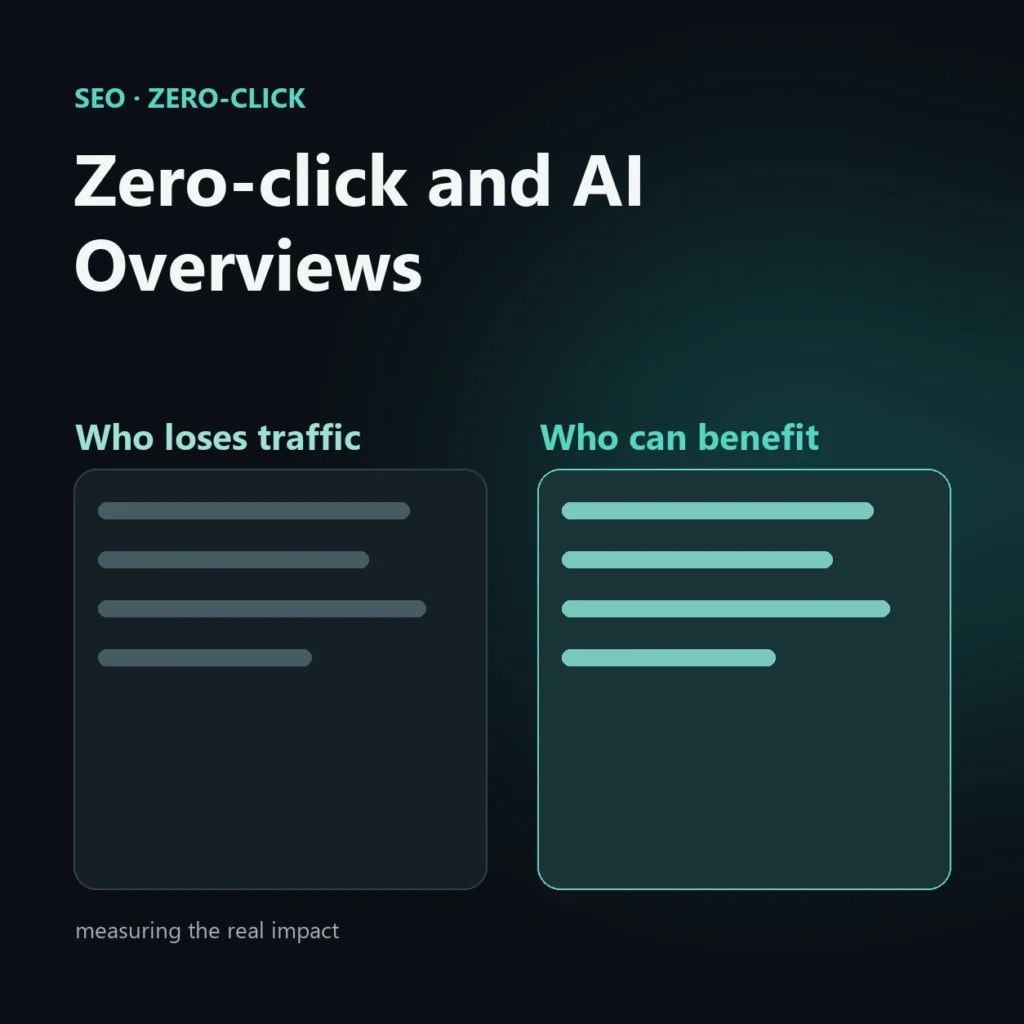
Zero-click search is search that ends directly on the results page, without the user clicking any link. A phenomenon that didn’t begin with artificial intelligence, but that AI Overviews have made far more visible and, for many publishers, far more problematic. In recent years the SERP has turned into a kind of self-sufficient answer: snippets, information panels, generated answers and conversational summaries cover a growing share of search intents. The question every content manager and every SEO asks is simple: who really loses the traffic when nobody clicks anymore? The answer is less obvious than it seems, because the loss is not uniform and doesn’t hit everyone in the same way.
What changes with zero-click search and AI Overviews
Zero-click search is not an anomaly, it is the natural evolution of an engine that wants to satisfy the user as quickly as possible. Google has shown direct answers for simple informational queries for years, and AI Overviews extend this principle to more complex questions, generating a concise summary built from several sources. Someone searching “how does photosynthesis work” or “difference between fixed and variable rate” often gets what they need without leaving the results page.
The central point is that visibility no longer coincides with the click. A site can appear as a cited source in a generated summary and still record a drop in organic sessions. This disconnect between presence and traffic is the real novelty of the period, and it particularly affects informational, encyclopedic and low-commercial-intent content. To understand the phenomenon it helps to start from how AI Overviews work, because the source selection mechanism determines who gets cited and who disappears.
AI Overviews don’t fish at random: they favor clear, well-structured pages with direct and authoritative answers. This means zero-click search doesn’t penalize everyone in the same way, but redistributes value. Some sites lose clicks but gain citations; others lose both.
The paradox of visibility without traffic
Being cited in a generated summary is a signal of authority, but it doesn’t always translate into visits. It is the paradox many publishers are experiencing: brand awareness grows, measurable traffic falls. The practical consequence is that traditional metrics are no longer enough to tell the real performance of a piece of content. You need to integrate impression, citation and mention data with session data.
Who really loses the traffic
The traffic loss from zero-click search is not democratic. It mainly hits those who built their model on generic informational content that is easy to summarize and lacks a strong identity. An article that merely explains a concept in a neutral way is the ideal candidate to be absorbed into a summary, because it offers nothing the user can’t get directly from the SERP.
Sites that depend on highly competitive head queries with purely informational intent also lose ground. If the answer is already on the results page, the click becomes superfluous. Conversely, those who work on transactional intents, experiential content or specific niches keep an advantage, because their offer can’t be replicated in a few generated lines.
Another group at risk is publishers who have never invested in editorial differentiation. When content is interchangeable, the algorithm has no reason to send the user elsewhere. Zero-click search, in this sense, works as a filter: it rewards those who add something and penalizes those who repeat.
The most exposed sectors
Some areas are structurally more vulnerable: introductory guides, definitions, basic tutorials, first-level medical and financial content. These are all areas where the user looks for a quick answer and where the generated summary may be enough. Sectors with a strong local, commercial or hands-on component remain better protected, because they require an action or a trust that the SERP can’t replace.
Who can benefit from zero-click search
Not everyone loses. Brands with a recognizable voice gain from zero-click search because being cited in a summary strengthens the perception of authority. If the site’s name appears as a source, the user remembers it and may come back later, perhaps with a direct search. It is a branding effect that session metrics don’t capture.
Content that requires depth, context or practical application also benefits. An operational guide, a case study, an analysis with proprietary data can’t be summarized in a paragraph. The harder content is to summarize, the more it stays attractive for the click. This is the main lever to work on today.
A third advantaged group is sites that cover conversational and niche queries, where AI Overviews cite few selected sources. Being among those sources, even without an immediate click, builds authority over time. In this scenario a technical SEO audit becomes useful to check that the site’s structure lets engines extract and cite the content correctly.
The value of citations as a new metric
Citations in generated answers are becoming a metric in their own right. They don’t replace traffic, but complement it: content that is heavily cited and rarely clicked tells a different story from content that is ignored altogether. Monitoring how many times your domain appears as a source in a Google AI Overview helps you understand whether the problem is one of visibility or of click conversion.
How to measure the real impact and what to do
Measuring the impact of zero-click search requires a change of perspective. Impressions can grow while clicks fall, and this doesn’t automatically mean the content is performing worse. You need to distinguish between informational-intent and action-intent queries, and read the two groups separately.
On the operational side, the countermeasures are few but clear. Structure content with direct answers at the top of the page, use proprietary data, add elements of real experience and focus on formats the SERP can’t replicate. The strategy is not to fight zero-click search, but to make it less relevant to your audience, by offering something that goes beyond the flat answer.
An effective approach combines optimization for generative engines with attention to conversion. Being cited isn’t enough: you have to give the user a concrete reason to dig deeper. The content that wins is the one that shows its value in the SERP without exhausting it.
| Content type | Exposure to zero-click search | Effect on traffic | Recommended strategy |
|---|---|---|---|
| Definitions and introductory guides | High | Drop in clicks | Focus on depth and practical cases |
| Transactional content | Low | Stable traffic | Strengthen trust and conversion |
| Analyses with proprietary data | Medium | Resilient traffic | Make the most of the uniqueness of the data |
| Local and experiential queries | Low | Growing traffic | Own the local context |
| Conversational niche content | Medium | Frequent citations | Monitor mentions as a metric |
Frequently asked questions about zero-click search and AI Overviews
Does zero-click search always cost you traffic?
No, not for everyone. Those who offer content that is hard to summarize or with strong transactional intent keep, and sometimes increase, their visits.
Do AI Overviews cite only big sites?
Not necessarily. They favor clarity, authority and structure, so even well-optimized niche sites can be cited.
How do I know if I am losing traffic to zero-click search?
By comparing impressions and clicks on informational queries and checking how many times the domain appears as a source in generated summaries.
Is it worth blocking content from generative engines?
It is rarely a good idea. Giving up citations reduces future visibility without guaranteeing more clicks.
Does zero-click search also affect commercial queries?
Much less. Action queries require a visit to the site, so they remain less exposed to generated summaries.
What is the first thing to do to defend yourself?
Make your content less replicable, adding proprietary data, direct experience and deep dives that the SERP can’t summarize.
When AI Overviews answer in your place
Zero-click searches and Google’s AI Overviews are changing how people find businesses: more and more users get the answer directly on the results page, without ever clicking the site that inspired that answer. If your organic traffic falls while queries grow, the problem isn’t the quality of your content but how it is read by generative engines. I work on exactly this: I make your content citable and recognizable by AI.
SEO, GEO and AEO specialist
Related articles
 SEOContent Gap Analysis: What Competitors Write and You Don’tOctober 30, 2026
 SEOBacklink Gap: Analyzing Competitor LinksOctober 30, 2026
 SEOHow to Find Your Real SEO CompetitorsOctober 30, 2026
Explore by topic