
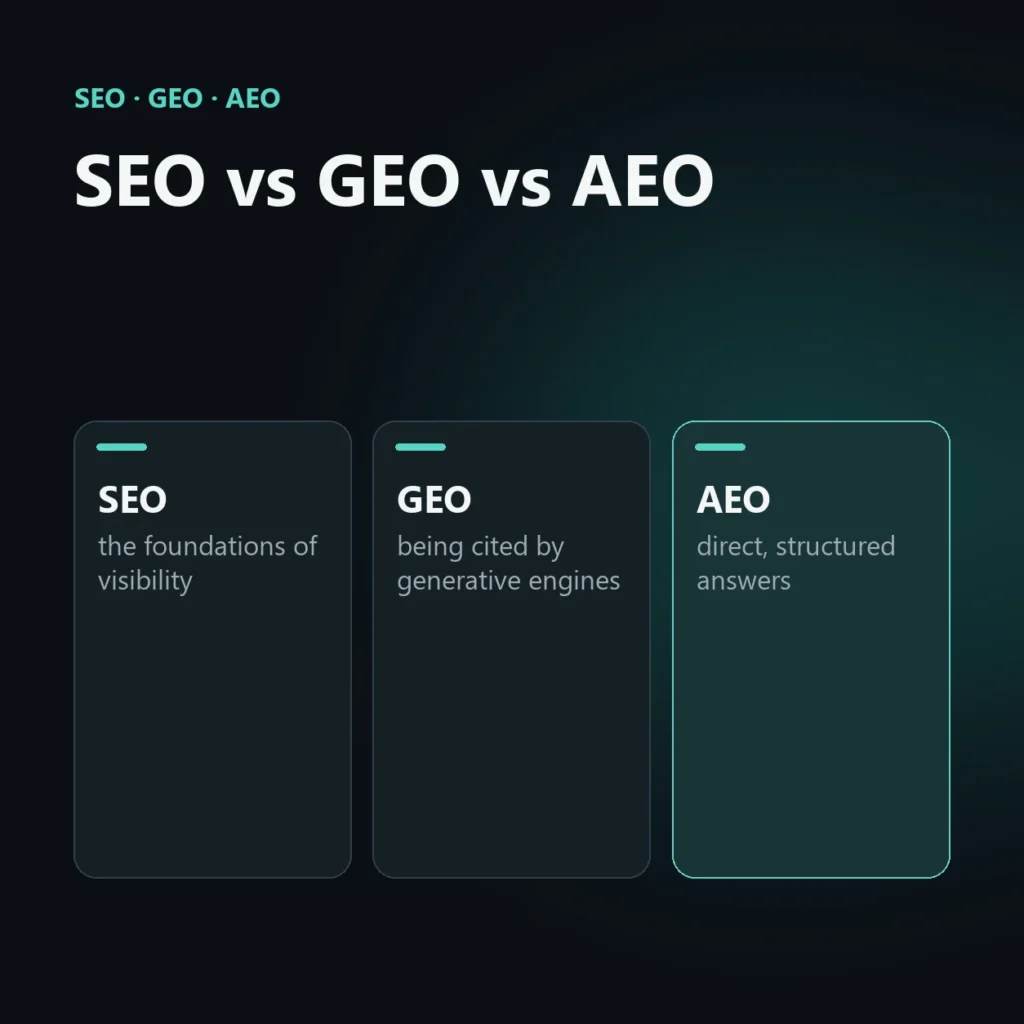
The SEO GEO AEO difference concerns three distinct but complementary disciplines: SEO optimizes ranking on traditional search engines, GEO works to be cited and synthesized by generative engines, AEO builds direct, structured answers for answer engines. Anyone working in digital visibility today faces an ecosystem in which Google remains central but is no longer the only access point to information. Conversational assistants, engines based on language models and answers generated in real time are changing how people find companies, products and services. Understanding the SEO GEO AEO difference is not a theoretical exercise: it means deciding where to invest resources, which skills to build in-house and how to measure results. In this article I analyze what really changes for a company, with concrete examples and a summary table.
SEO: the foundations of organic visibility
SEO — Search Engine Optimization — is the most established discipline. Its goal is to improve a site’s position on the results pages of traditional search engines, such as Google or Bing, when a user types a text query. SEO work is organized on several fronts: technical optimization, content, link building and user experience.
According to the definition on Wikipedia, SEO is:
«the computer science and graph theory discipline that includes the analysis of updates and traffic fluctuations in search engines and all those activities aimed at improving crawling, indexing and ranking» — Wikipedia (Italian), entry “Ottimizzazione per i motori di ricerca”
This definition highlights an often overlooked aspect: SEO is not just writing content, but also data analysis, understanding algorithms and managing the technical structure of the site. A technical SEO audit remains the starting point for any strategy, because without a solid base no optimization produces lasting results.
For a company, SEO continues to be the most predictable and measurable organic acquisition channel. However, user behavior is changing: more and more people ask complex questions and expect concise answers, not a list of links. This is where GEO and AEO come in.
GEO: being cited by generative engines
Generative Engine Optimization is the discipline that aims to make a brand, a piece of content or a source appear within answers generated by AI-based systems. Tools such as Google’s AI answers, Perplexity, ChatGPT with browsing or other conversational assistants don’t show ten blue links: they synthesize information from multiple sources and present it in a single text.
The SEO GEO AEO difference becomes evident right here. In SEO the goal is to climb the ranking. In GEO the goal is to be selected as a reliable source by the generative model, which cites or summarizes the content. This requires well-structured, verifiable content with explicit sources, up-to-date data and recognizable authority in your sector.
What makes content “citable” by a generative engine
Language models favor clear texts with precise statements and a logical structure. Short sentences, explicit definitions, topical paragraphs and the presence of recognizable entities (company names, products, technical concepts) increase the likelihood of being picked up. Consistency between content and metadata, the presence of structured markup and the domain’s reputation also play a role.
For a company this means rethinking content not only around keywords, but around the questions the content answers. An article that clearly defines a concept and links it to authoritative sources is more likely to be cited than a vague or promotional text.
AEO: direct, structured answers
Answer Engine Optimization focuses on the ability to provide immediate, structured answers to specific questions. Answer engines — from Google’s featured snippets to voice assistants, up to AI-based answer engines — reward content that resolves a doubt directly.
AEO works a lot on formats such as FAQs, definitions, numbered steps (even if I don’t use them here, in practice they are effective), comparison tables and short answers. The goal is to occupy the answer space before the user clicks on a traditional result. In many cases the answer is consumed directly on the results page or in the assistant’s interface.
The difference between AEO and GEO in practice
Although they are often confused, AEO and GEO have different nuances. AEO is more oriented to the structure of the answer: question, short answer, deep dive. GEO is more oriented to synthesis and citation: the generative model has to choose your content among many. In practice, good AEO work also makes GEO easier, because it provides clear, well-organized material that models can reuse.
For a company, investing in AEO also means improving the user experience: clearer content, shorter response times, less need for complex navigation. It is an advantage that shows up both on traditional engines and on conversational assistants.
Comparison table: SEO, GEO and AEO side by side
| Dimension | SEO | GEO | AEO |
|---|---|---|---|
| Main goal | Ranking in the SERPs | Citation in generative answers | Direct, structured answer |
| Typical channels | Google, Bing | AI Overviews, Perplexity, ChatGPT | Featured snippets, voice search |
| Key metrics | Rankings, organic traffic | Citations, mentions, share of voice | Presence in answers, zero-click |
| Skills required | Technical, content, links | Authority, clarity, sources | Structure, FAQs, markup |
| Time horizon | Medium-long | Medium | Short-medium |
The SEO GEO AEO difference for a company: what really changes
For a company the question is not “which discipline to choose”, but “how to integrate them”. The SEO GEO AEO difference translates into a different allocation of resources and a different reading of the results. SEO remains the foundation: without indexing and quality content, neither GEO nor AEO works. GEO adds the layer of authority and clarity needed to be cited. AEO optimizes the form to capture immediate answers.
An integrated approach requires content designed to be read by people and interpreted by machines. This means abandoning the logic of keyword density for its own sake and adopting more explicit writing, with definitions, examples and sources. It also means monitoring new indicators: not only position and clicks, but also how many times the brand is mentioned in an AI answer, in what tone and in what context.
Common mistakes when the three disciplines are confused
Many companies treat GEO and AEO as simple extensions of SEO, applying the same tactics. That is a mistake. Aggressive link building techniques, for example, have little impact on being cited by a generative engine, which mainly evaluates the consistency and reliability of the content. Likewise, filling a page with FAQs without real answers doesn’t improve AEO: answer engines penalize superficial content.
Another mistake is measuring everything with the same metrics. Organic traffic doesn’t capture generative citations, and citations don’t always generate clicks. You need a different dashboard, one that includes visibility, authority and presence in answers, not just sessions and direct conversions.
Frequently asked questions about SEO, GEO and AEO
What is the main difference between SEO and GEO?
SEO aims to rank a page in traditional search results, while GEO aims to get the content cited within answers generated by artificial intelligence.
Are AEO and GEO the same thing?
No. AEO optimizes the structure of direct answers, GEO works on the ability to be selected and synthesized by a generative engine.
Is SEO still useful with the advent of AI?
Yes, it remains the foundation: without indexing, quality content and technical authority, neither GEO nor AEO produces stable results.
How do you measure the success of a GEO strategy?
You look at citations, brand mentions in AI answers, share of voice and the consistency of the context in which the content is picked up.
Which content works best for AEO?
Clear definitions, well-structured FAQs, comparison tables and short answers to specific questions.
Does a company have to choose between SEO, GEO and AEO?
No, the three disciplines are complementary: SEO builds the foundations, GEO and AEO extend visibility to the new answer channels.
Three disciplines, one strategy to hold together
If your Google ranking improves but your content isn’t cited in the answers generated by AI assistants, the problem isn’t how hard you work: it’s that SEO, GEO and AEO are treated as separate activities, often handed to different people who don’t talk to each other. The result is visibility that grows on one side and is lost on the other, with resources invested twice on the same priorities. I start from a single analysis of queries, content and authoritative sources, then build a plan in which the three disciplines support each other instead of overlapping. You can find the full path here.
SEO, GEO and AEO specialist
Related articles
 SEOContent Gap Analysis: What Competitors Write and You Don’tOctober 30, 2026
 SEOBacklink Gap: Analyzing Competitor LinksOctober 30, 2026
 SEOHow to Find Your Real SEO CompetitorsOctober 30, 2026
Explore by topic