
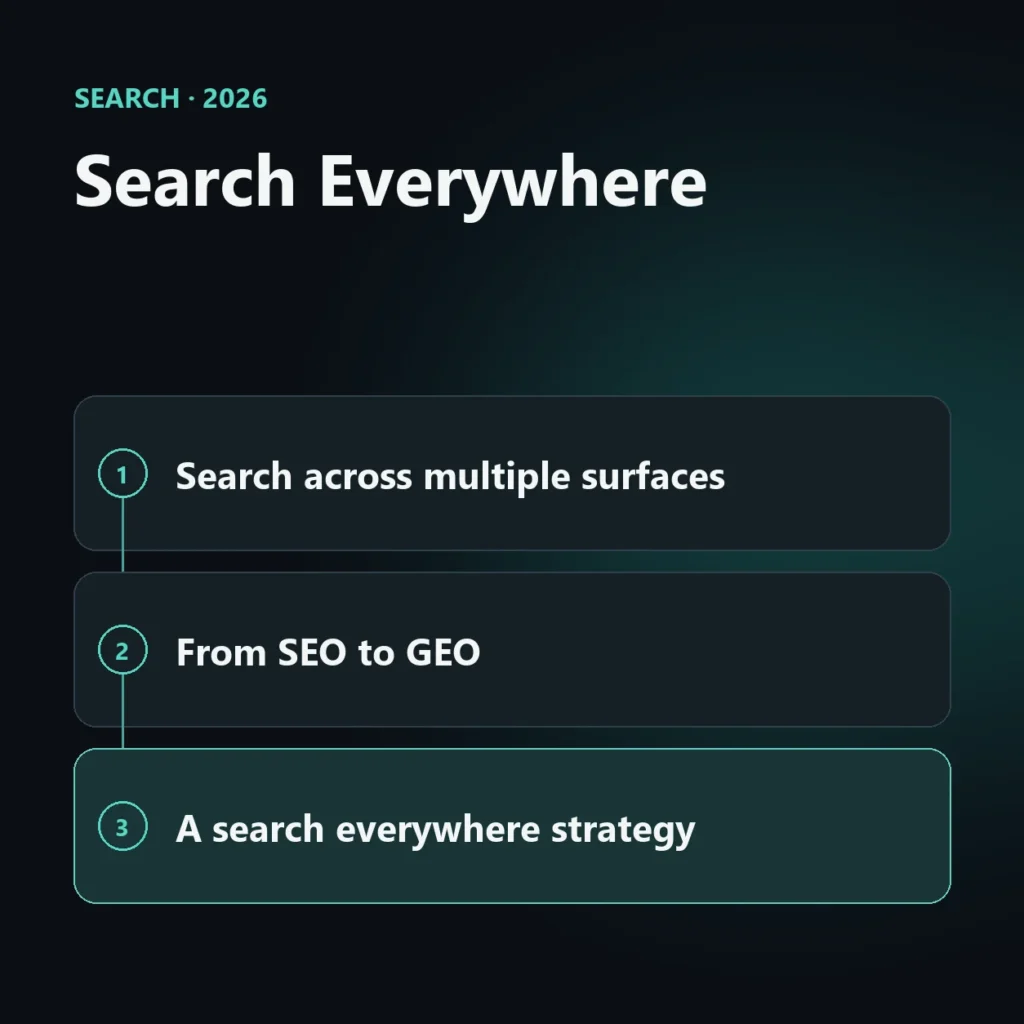
The concept of search everywhere means that users today look for information across a plurality of surfaces — search engines, conversational assistants, social media, marketplaces, messaging apps — and no longer only on Google. For those working in digital marketing this change in habits has a direct consequence: visibility is no longer built on a single channel, but on a fragmented ecosystem in which every platform has its own logic of indexing, ranking and answering. Those who keep thinking only in terms of classic organic ranking risk losing significant shares of attention, because users’ questions are answered elsewhere, often without passing through a traditional web page.
Why search has moved to multiple surfaces
For years the equation was simple: if a piece of content ranked well on Google, it generated traffic. Today that linearity is broken. People query conversational assistants for summaries, use search engines with answers generated right on the page, look for products inside marketplaces, ask for advice in communities and messaging apps. The phenomenon of search everywhere describes exactly this dispersion: the same search intent is satisfied at different points, in different formats.
The consequence for a company is that its digital presence must be thought of as a network, not as a funnel centered on a single engine. Each surface has a different ranking model: some favor domain authority, others content freshness, others still the ability to answer in a direct, citable way. Ignoring this variety means letting others speak about our brand in generated answers.
One structural aspect must also be considered: generative models don’t “link” in the traditional sense, but synthesize and cite. This changes the success metrics. Measuring the click is no longer enough: the mention, the citation, the presence of the brand within an automatically composed answer also count.
The new search surfaces and how they work
To get oriented in search everywhere it helps to distinguish at least four families of surfaces. Each requires a dedicated editorial and technical approach, because what works on one may be ineffective on another.
Search engines with generative answers
Google has integrated generated answers directly into the results page, in many cases reducing the need to click. To capture this space you need specific work on Google AI Overview, which depends on the clarity of the content, its semantic structure and its ability to be an easily extractable source. The text must answer a question sharply, with passages that a model can pick up without ambiguity.
Conversational assistants
Tools like ChatGPT and Perplexity have become habitual access points for complex information. Here the logic is not the classic SERP, but the construction of a reasoned answer.ChatGPT optimization andPerplexity optimization require well-documented content, with verifiable data and recognizable sources, because these systems tend to favor material they can cite with confidence.
It is precisely the vocation for real-time search that distinguishes these tools. As stated in the technical documentation of one of the main players in the sector:
«Power your products with unparalleled real-time, web-wide research and Q&A capabilities.» — official Perplexity API documentation
This ability to draw on the web in real time means that content published today can enter tomorrow’s answers, but only if it is structured to be retrieved and understood correctly.
Social platforms and communities
A growing share of searches happens inside social networks and forums, where users trust community answers more than company pages. In these contexts search everywhere is played on reputation and active presence, not just technical SEO. The brand’s voice in relevant discussions becomes a visibility asset.
Marketplaces and vertical apps
Those looking for a product often start directly from a marketplace, skipping the general-purpose search engine. Here too there are specific ranking rules, based on complete listings, reviews and relevance of descriptions. Overall visibility depends on the sum of these partial presences.
From classic SEO to Generative Engine Optimization
The move from traditional ranking to Generative Engine Optimization is not a simple terminological evolution. The goal changes: it is no longer just about appearing in a list of results, but about being the source that a generative model chooses to cite. This requires content that is authoritative, up to date and structured to be reused.
A useful principle is citability. Content is citable when it states something precise, verifiable and well delimited, avoiding vague wording. Generative models tend to pick up clear, self-sufficient passages that keep their meaning even outside the original context. This doesn’t mean writing in fragments, but making sure every section stands on its own.
The second pillar is consistency across surfaces. A brand that says different things on Google, on a conversational assistant and on a social network disperses authority. Search everywhere rewards those who maintain a stable informational identity, recognizable by any system that interprets it.
Signals that really matter
Among the factors that influence presence in generative answers we find the clarity of the structure, the presence of external sources that confirm the claims, regular updating and the authority of the domain. There is no single formula, but these elements recur across the board. Building technical trust and content trust is the basis for being selected.
A table to navigate the surfaces
To help plan your digital presence, the table below summarizes the main search surfaces, the dominant logic and the priority action for each. It is an operational tool for turning search everywhere into concrete decisions.
| Surface | Dominant logic | Priority action |
|---|---|---|
| Engines with generated answers | Extractability and authority of the source | Structure content in clear, citable blocks |
| Conversational assistants | Verifiable documentation and freshness | Update data and sources, make citation easy |
| Social and communities | Reputation and participation | Cover relevant discussions continuously |
| Marketplaces and vertical apps | Completeness of listings and reviews | Take care of descriptions, attributes and customer feedback |
How to set up a search everywhere strategy
An effective strategy starts from mapping users’ questions and checking where those questions get answered. It often emerges that a significant part of search intents no longer goes through the company site. From there you set priorities: which surfaces to cover, with which content and how often.
The second step is producing content designed to be reused by automated systems. This means clean semantic structure, consistent heading hierarchies and direct answers to questions. It isn’t about writing for robots, but about making the value of the content accessible even to those who interpret it in summary form.
Finally, measurement must adapt. Besides organic traffic, the brand’s presence in generated answers, the frequency of citations and the consistency of messages across channels all count. Monitoring these metrics lets you understand whether your search everywhere strategy is producing lasting results or only fleeting visibility.
Frequently asked questions about search everywhere
What exactly does search everywhere mean?
It means users look for information on many different surfaces, not just Google, and that visibility has to be built across all these platforms.
Is traditional SEO no longer enough?
It remains important, but on its own it doesn’t cover generated answers, conversational assistants and searches inside social networks and marketplaces.
How do you optimize content for generative answers?
By focusing on clarity, verifiable sources, updating and self-sufficient blocks of text that a model can cite without ambiguity.
Do you need a different approach for each platform?
Yes, every surface has its own ranking and answering logic, so the strategy must be adapted to the specific context.
How do you measure success from a search everywhere perspective?
Besides traffic, you look at brand citations in generated answers and the consistency of messages across channels.
Where is it best to start?
From mapping users’ questions and the surfaces where they find answers, and then defining intervention priorities.
Your visibility is getting lost across platforms
Whoever searches for your product today doesn’t only go through Google: they query AI assistants, scroll videos, compare reviews and communities, often without ever reaching your site. The result is a patchy presence, with content saying different things on every channel and a brand struggling to stay recognizable. I, with geo-seo.pro, work on exactly this: I map where your company is searched for, align the messages and build a consistent presence across search, AI and social platforms. If you want to understand where to start, we can talk it through together.

SEO, GEO and AEO specialist
Related articles
 SEOContent Gap Analysis: What Competitors Write and You Don’tOctober 30, 2026
 SEOBacklink Gap: Analyzing Competitor LinksOctober 30, 2026
 SEOHow to Find Your Real SEO CompetitorsOctober 30, 2026
Explore by topic