
Measuring SEO success means evaluating the real impact of a visibility strategy on business results, not limiting yourself to observing a page’s position in search results. For years ranking was the reference yardstick, but today the search landscape has changed: generative engines answer questions directly, users interact with more touchpoints and visibility is built on several fronts. Understanding how to measure SEO success in a solid way therefore requires a change of perspective, one that holds together visibility, behavior and authority metrics and the concrete contribution to company objectives.
Why ranking alone is no longer enough
SERP position remains a useful indicator, but it is a partial snapshot. A keyword can rank high without generating clicks, because the query is satisfied directly by the engine’s answer or because the search intent differs from the one assumed. Likewise, a page in second or third position can bring qualified traffic and better conversions than one in first. Ranking measures competition, not the value generated.
With the rise of answers generated by artificial intelligence, moreover, part of the visibility moves outside the classic ten blue links. The user can get a summary without visiting any site, or reach the cited source after a different path. This makes it even more important to distinguish between being present and being chosen. Measuring SEO success today means observing both dimensions, with metrics that tell what really happens after exposure.
A mature approach starts from business objectives and works back to metrics. If the goal is to generate leads, the key metric will be the qualified lead; if it is to cover a topic, coverage and frequency of citations will count. Ranking thus becomes a diagnostic tool, not a goal in itself.
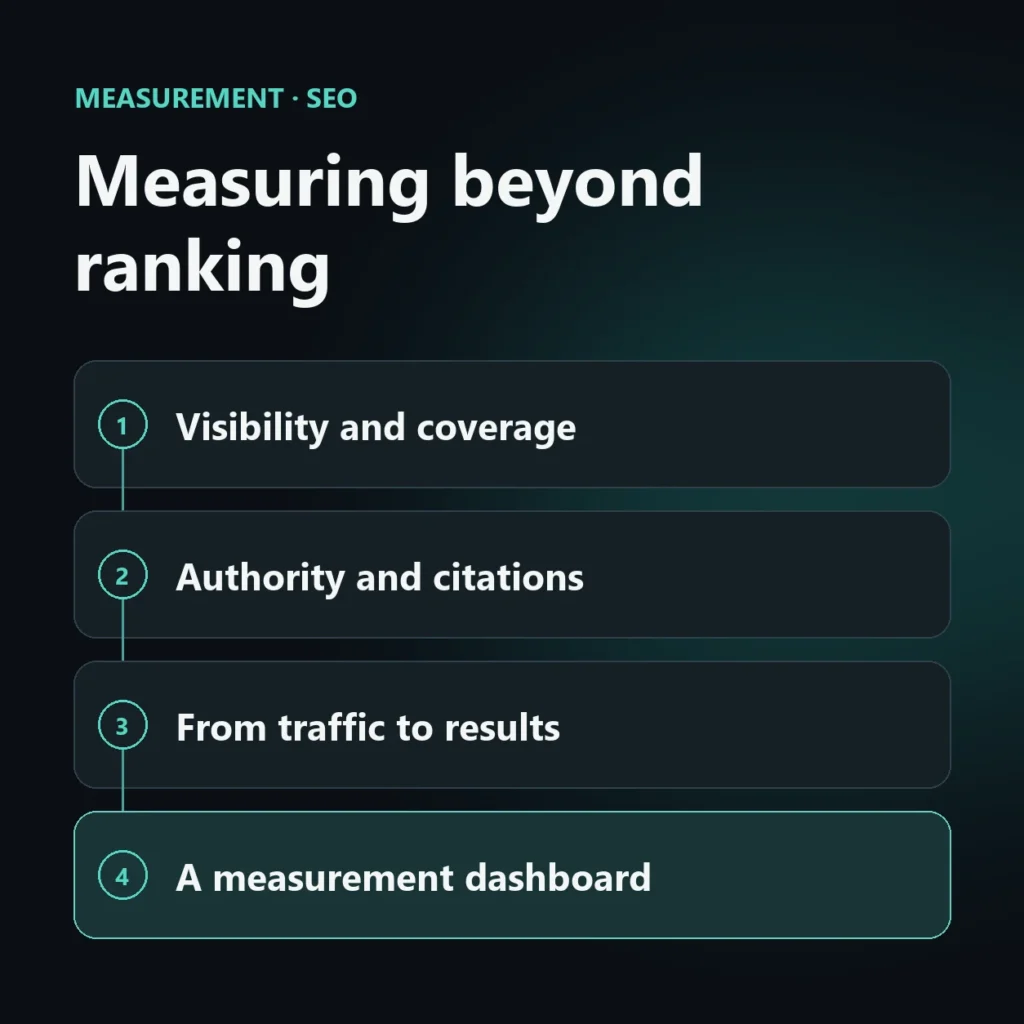
Visibility and coverage metrics
The first area to cover is how much and where the brand appears. Besides ranking, it is useful to monitor the coverage of relevant queries, that is, how many of the questions that matter to the audience are intercepted. A strategy growing in coverage is widening its range, even if individual keywords fluctuate.
Another valuable metric is visibility share, which estimates overall presence across a set of searches compared with competitors. Measuring SEO success through coverage helps tell a physiological drop from a structural problem. If coverage grows but traffic doesn’t, the bottleneck is probably in the way pages are perceived or clicked.
Impressions, clicks and CTR from a qualitative perspective
Impressions and clicks remain basic indicators, but they must be read together. A low CTR on informational queries can be normal, because the user finds the answer in the SERP. A high CTR on transactional queries, instead, signals that the message is aligned with intent. Analysis should be done by query groups, not on the aggregate total, otherwise context is lost.
This is where a SEO audit done well makes the difference: it relates visibility data, technical structure and content, identifying where presence doesn’t turn into results.
The role of authority and citations
Sustainable visibility rests on authority. Being recognized as a reliable source makes it possible to obtain stable positions and, above all, to be cited. The link between domain authority and backlinks remains a pillar: quality links signal trust and contribute to the site’s ability to compete on crowded topics.
But authority today is also measured elsewhere. The citations in generative engines represent a new form of recognition: when an artificial intelligence system cites your content as a source, it is validating your expertise. Monitoring how many and which pages get cited helps understand whether the brand has become a reference.
How to monitor citations without official data
There are not yet standardized and universally reliable reports for AI-generated citations. A pragmatic approach consists in periodically testing a set of prompts consistent with your sector and recording whether the brand or the site appears among the sources. It is qualitative monitoring, but repeated over time it offers a readable trend.
In parallel, it is useful to observe referral traffic from AI platforms and unlinked brand mentions. Consistency between mentions, links and citations builds the reputation that no single ranking can guarantee.
From traffic metrics to business results
The decisive step to measure SEO success is linking visibility to what happens after the visit. Traffic, time on page and pages per session tell about interest, but not whether the user did what matters. That is why you need conversion metrics aligned with objectives: contact requests, sign-ups, downloads, purchases.
A common mistake is evaluating conversions only in aggregate. It is more useful to segment by channel, by query group and by landing page, so as to understand which content brings real value. A page that receives less traffic but generates qualified leads is worth more than a heavily visited, unproductive page.
Attribution models and value over time
The user’s path is rarely linear. A first informational contact can precede by weeks a conversion attributed to the last click. Adopting attribution models that value intermediate touchpoints helps avoid underestimating SEO’s contribution. Assisted-conversion analysis, that is, how many times organic search takes part in a conversion without closing it, also offers a more honest reading.
Finally, value over time must be considered. Well-ranked, authoritative content tends to produce lasting results, unlike activities that burn out quickly. Measuring SEO success also means assessing the sustainability of what you build.
| Measurement area | Main metric | What it really indicates | Limit to consider |
|---|---|---|---|
| Visibility | Query coverage and visibility share | Breadth and solidity of presence on relevant topics | Doesn’t tell whether the user chooses the site |
| Interaction | CTR by query group | Alignment between message and search intent | Affected by direct answers in the SERP |
| Authority | Quality backlinks and citations | Recognition as a reliable source | Citation monitoring still poorly standardized |
| Business | Segmented conversions and assists | Real contribution to company objectives | Requires adequate attribution models |
Building a sustainable measurement dashboard
A good measurement system doesn’t collect everything, but what is needed to decide. It is best to start with a few indicators per area, define a reading cadence and establish in advance which thresholds prompt intervention. Clarity about objectives avoids chasing vanity metrics that don’t change operational choices.
It is useful to pair quantitative data with qualitative observation. Numbers show what happens, but don’t always explain why. Pairing data analysis with a reading of content and SERPs helps interpret drops and correct course with full knowledge of the cause.
Finally, measurement should be reviewed periodically. The search context changes, generative engines evolve and user behavior shifts. A rigid dashboard ages quickly; a flexible one stays useful over time and lets you measure SEO success continuously, adapting without losing coherence with business objectives.
Frequently asked questions about how to measure SEO success
Is ranking no longer useful as a metric?
It remains useful as a diagnostic indicator, but on its own it doesn’t tell the real impact of the strategy. It must be read together with coverage, clicks and conversions.
What is the most important metric for measuring SEO success?
It depends on the objectives: for a company that generates leads, the key metric is the qualified lead, not SERP position.
How do you measure citations in generative engines?
There are no reliable standard reports: you periodically test prompts consistent with the sector and record whether the brand appears among the cited sources.
Why can traffic grow without conversions increasing?
Often because the pages attract queries poorly aligned with commercial intent, or because the path to conversion is unclear.
How often should the measurement system be reviewed?
It is good practice to review it at regular intervals, because the search context and user behavior change over time.
Can authority be measured?
Yes, through the quality of backlinks, brand mentions and the frequency with which content is cited as a source.
Ranking goes up, but the business doesn’t follow?
It is the most frustrating paradox for those who invest in visibility: positions improve, yet leads and requests stand still. The problem is that ranking measures only part of the story and doesn’t say whether your brand is cited, chosen or remembered in the answers that really matter. I start right here: I read the signals ranking doesn’t capture and turn them into a map of what needs fixing.

SEO, GEO and AEO specialist
Related articles
 SEOContent Gap Analysis: What Competitors Write and You Don’tOctober 30, 2026
 SEOBacklink Gap: Analyzing Competitor LinksOctober 30, 2026
 SEOHow to Find Your Real SEO CompetitorsOctober 30, 2026
Explore by topic