
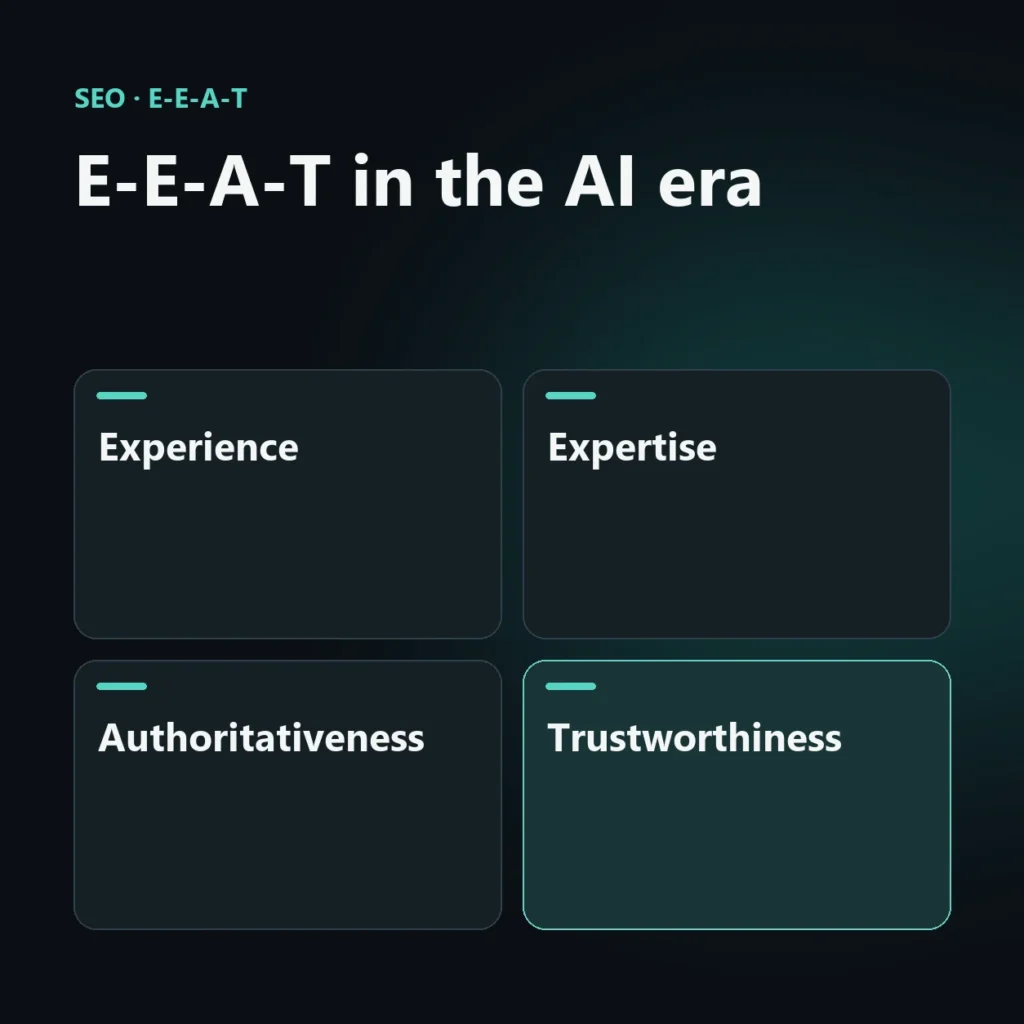
E-E-A-T is the framework with which Google evaluates the experience, expertise, authoritativeness and trustworthiness of those who publish content, and in the era of generative AI it has become the real battleground of visibility. If until yesterday authority was built mostly to convince a human reader, today that reader is more and more often a language model that synthesizes, cites and recommends. The recipient changes, the signals to cover change: it is no longer enough to write well, you have to be recognizable as a source. In this scenarioE-E-A-T stops being a list of best practices and becomes an operating system for digital reputation, to be updated as often as the models are updated.
Why E-E-A-T matters more than before in the AI era
When a generative search engine answers a question, it doesn’t show ten links to choose from: it builds a synthesis and decides which sources deserve to be cited. This selection is based on reliability signals that go beyond textual relevance. A piece of content can be perfectly optimized for a keyword and remain invisible if the algorithm can’t link it to a credible source. This is whereE-E-A-T 2026 comes into play as a filtering criterion, not as a reward for those who write more.
The central point is that models don’t “read” the way a person does. They extract entities, relationships and consensus signals, and compare them with what they already know. If your site isn’t clearly associated with a recognizable entity — a brand, an author, a specific expertise — the model will tend to prefer sources that already have that association established. Working onE-E-A-T 2026 therefore means building this association explicitly and repeatedly, not hoping it emerges on its own.
There is also a multiplier effect: when a source is cited by a model, the citation itself becomes a new signal of authority, which strengthens the source for subsequent queries. A loop is created in which those who are already recognized become more and more so, while those who stay anonymous struggle to get into the circle. Building brand authority is therefore not an exercise in vanity, but a concrete distribution lever.
The four pillars, reread for an algorithmic reader
Experience: concrete proof, not promises
The experience pillar rewards those who show they have really done what they talk about. For an algorithm this translates into verifiable details: cases, contexts, specifics that a generic model wouldn’t produce. An article describing a real process, with its steps and difficulties, is much harder to confuse with synthetic content than a vague, generalist piece.
From the perspective ofE-E-A-T 2026, experience must be made legible even to those who don’t live it: bylines, bios, references to projects, links between who writes and what is written. These are all elements that help the model understand that behind the text there is a source, not an aggregator.
Expertise: verifiable depth
Expertise is shown through precision, not through jargon. Expert content covers the nuances, distinguishes cases, avoids simplifications that an insider would recognize as wrong. Language models are particularly sensitive to this: a text that holds up against specialist sources is treated differently from one that repeats commonplaces.
This has an important practical consequence: content authority is built by accumulating depth on a topic, not by spreading thin across dozens of marginal subjects. Better to be the reference source on a narrow area than a generic voice on everything.
Authoritativeness: who recognizes you
Authoritativeness is largely relational: it depends on who talks about you, who cites you, who links to you. For an algorithm this translates into consistent mentions and a brand identity that is stable over time. Scattered, inconsistent citations are worth less than repeated and consistent recognition from relevant sources.
In the logic ofE-E-A-T 2026, consistency beats volume. A brand that always says the same thing, in the same way, on the same topics, builds a recognizable entity that models can confidently connect to its areas of expertise.
Trustworthiness: the foundation of everything
Trustworthiness is the pillar that holds the others together. Transparency about who writes, how the project is funded, how data is handled: these are signals an algorithm uses to decide whether a source is worth citing. An opaque site, even a competent one, remains a risk for whoever recommends it.
In the AI era trustworthiness takes on a further nuance: being clear about what you know and what you don’t. Sources that admit the limits of their claims come across as more credible than those that promise absolute certainty, and this also applies to how models assess the reliability of a text.
Concrete signals to cover for E-E-A-T 2026
Moving from theory to practice,E-E-A-T 2026 is built on a set of signals that we can group into three families: entity signals, content signals and relationship signals. The first concern identity — who you are, what you do, where you state it consistently. The second concern the quality and depth of what you publish. The third concern who recognizes and cites you.
On the entity front, the priority is consistency: name, description and areas of expertise should be identical wherever they appear, from the site to external profiles. On the content front, specificity and byline matter: who writes, with what experience, on what basis. On the relationship front, qualified mentions and continuity over time matter, more than a single peak of visibility.
A useful way to reason is to ask, for every important page: if a model had to explain to its user why it is citing you, could it answer? If the answer is vague, a signal is missing. The referenceentity is not yet clear enough, or the content doesn’t offer enough distinctive elements to justify a citation.
| E-E-A-T pillar | What an algorithm looks at | Signal to cover | Typical mistake |
|---|---|---|---|
| Experience | Evidence of direct experience | Bylines, concrete cases, real context | Generic content with no author |
| Expertise | Depth and technical precision | Specialization in a narrow area | Spreading across too many topics |
| Authoritativeness | Consistent external recognition | Qualified, repeated mentions | Scattered, inconsistent citations |
| Trustworthiness | Transparency and consistency of sources | Clarity on who writes and how | Opaque site, vague information |
How to build authority when an algorithm is reading
The first step is to stop thinking of authority as a result and start treating it as a process. An algorithm isn’t convinced by a single brilliant piece of content: it is convinced by a consistent pattern, repeated over time, that links your name to a specific topic. Consistency is worth more than intensity.
The second step is to make explicit what often stays implicit. Who writes, why they are credible on that topic, which sources they use, how it can be verified. These are things a human reader infers from context, but that a model needs to find stated. TheE-E-A-T 2026 rewards clarity, not understatement.
The third step is to measure what matters. Not rankings in themselves, but how many times you are cited as a source, by whom, on which topics. These are the indicators that really reflect authority-building in the generative era, and they are the ones worth focusing your efforts on.
Frequently asked questions about E-E-A-T 2026
What does E-E-A-T 2026 mean compared with earlier versions?
It refers to the evolution of the E-E-A-T framework in the context of generative search engines, where authority is also assessed by how models cite and recommend sources.
Is E-E-A-T an official ranking factor?
It is not a single factor with a score, but a set of criteria that guide the assessment of the quality and reliability of sources.
Why does authority matter more with generative AI?
Because models have to choose which sources to cite, and they tend to prefer those already recognized as reliable and consistent over time.
Can a small site build E-E-A-T effectively?
Yes, by focusing on a narrow area, signing its content and building consistent recognition on that specific topic.
How long does it take to see results on authority?
It depends on the starting point and on consistency: authority is built with patterns repeated over time, not with isolated actions.
How is authority measured in the AI era?
By observing how many times you are cited as a source, by which counterparts and on which topics, rather than looking only at ranking positions.
Your E-E-A-T doesn’t convince the algorithm reader
You have real experience, solid skills, a brand recognizable in your sector. Yet the content you publish isn’t read as authoritative: generative AI cites others, Google rewards competitors less prepared than you, and your expertise stays invisible exactly where it matters. The problem isn’t what you know, but how you make it legible to whoever is evaluating: an algorithm reader looking for signals of experience, expertise, authoritativeness and trust. I build those signals into your site, with a brand authority framework designed for the AI era.

SEO, GEO and AEO specialist
Related articles
 SEOContent Gap Analysis: What Competitors Write and You Don’tOctober 30, 2026
 SEOBacklink Gap: Analyzing Competitor LinksOctober 30, 2026
 SEOHow to Find Your Real SEO CompetitorsOctober 30, 2026
Explore by topic