
A content gap is the list of topics for which your competitors appear on Google and you have no page that answers. It is the most concrete way to decide what to write next, because it starts from searches that already exist and pages that already work.
This guide explains how to get it, how to choose its entries and how to turn them into pages. It is part of the guide to online competitor analysis.
What it measures
Three different situations under the same name:
- Missing topic: they have a page, you do not.
- Weak page: you have a page, but shorter, older or less clear than theirs.
- Different intent: they answer an informational question, you with a commercial page (or vice versa).
How to do it
- Pick three to five competitors (see the guide to how to find them).
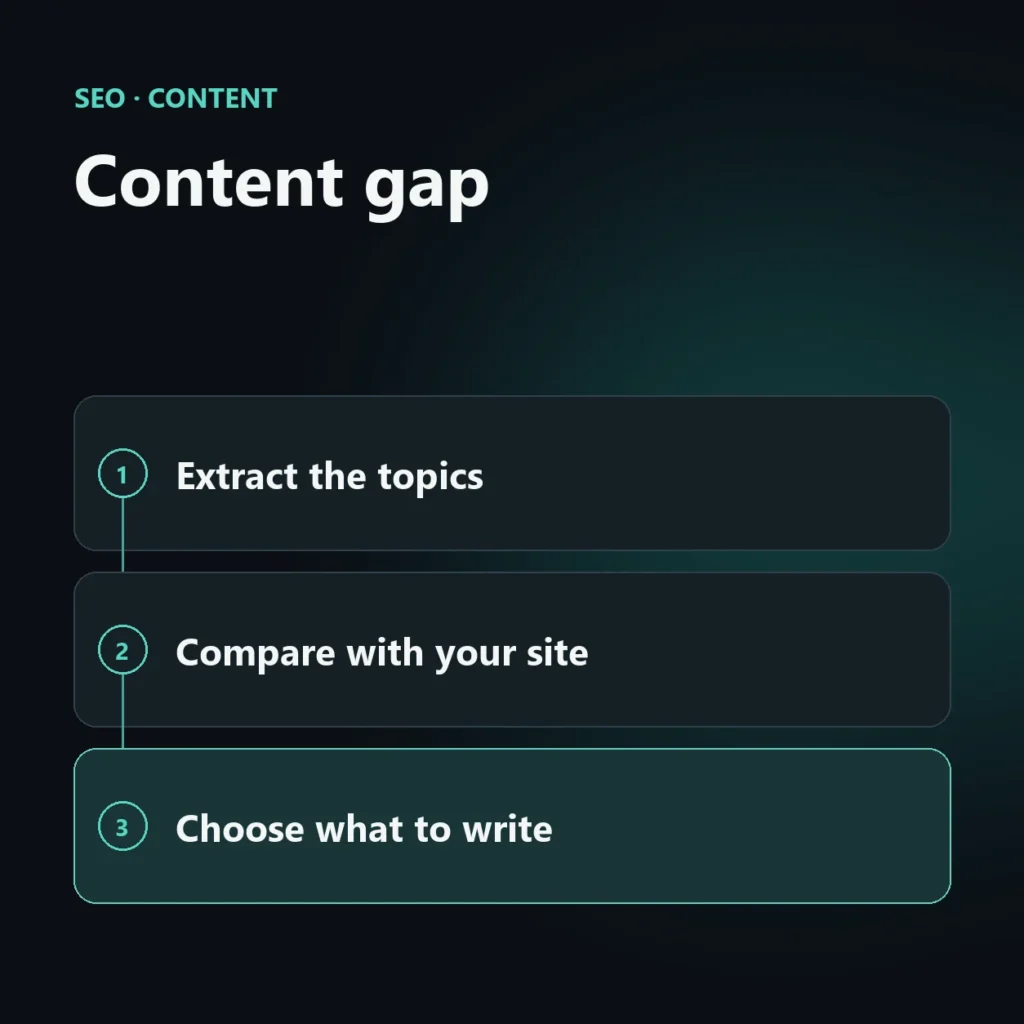
- Extract their keywords. Paid tools have a comparison report: in Semrush it is called “Keyword Gap”, in Ahrefs “Content Gap”. It shows the keywords competitors appear for and you do not. Without tools, use the competitors’ sitemap and read the titles of their blog and service pages.
- Put your site next to it. List your pages and for each topic mark whether the page exists, is weak or is missing.
- Group by topic, not by keyword: many variants lead to the same page.
- Set a priority. What counts is closeness to your services, search volume, difficulty and the type of page holding the top spots.
How to choose what to write
| Criterion | Question to ask |
|---|---|
| Relevance | Does this topic lead to a service or product I sell? |
| Intent | Does the searcher want to learn, compare or buy? |
| Difficulty | Are the sites holding the top spots ones I can reach? |
| Expertise | Do I have first-hand experience or original data to add? |
If there is no relevance to what you sell, the topic does not go in, even with many searches: traffic that brings no enquiries is no use.
How to write better than competitors
- Answer the question in the first lines.
- Cover the subtopics competitors cover and add the ones they miss.
- Use examples, data and verifiable sources.
- Update the page and show the date.
- Link the page to your services and to related pages.
Mistakes to avoid
- Copying the competitor’s structure without adding anything.
- Writing for every keyword on the list instead of choosing.
- Publishing pages that overlap with ones you already have (see also keyword cannibalization).
- Ignoring weak pages that already rank: strengthening them often pays more than writing new ones.
Frequently asked questions
What is the difference between keyword gap and content gap?
Keyword gap lists the competitors’ keywords that you do not have. Content gap groups them into topics and compares them with your site’s pages.
Do I have to write everything that is missing?
No. Choose on relevance to your services, intent and difficulty, and start from the pages that already rank and need strengthening.
Can I do it without paid tools?
In part: by reading competitors’ sitemaps and page titles, and using Search Console for your own. Tools speed up and widen the comparison.
How often should I redo it?
Every three to six months, or when a new competitor enters.
What should you write next?
I compare your content with your competitors’ and propose the pages to write or strengthen, in order of priority.


SEO, GEO and AEO specialist
Related articles
 SEOBacklink Gap: Analyzing Competitor LinksOctober 30, 2026
 SEOHow to Find Your Real SEO CompetitorsOctober 30, 2026
 SEOSEO Competitor Analysis: A Practical GuideOctober 30, 2026
Explore by topic