
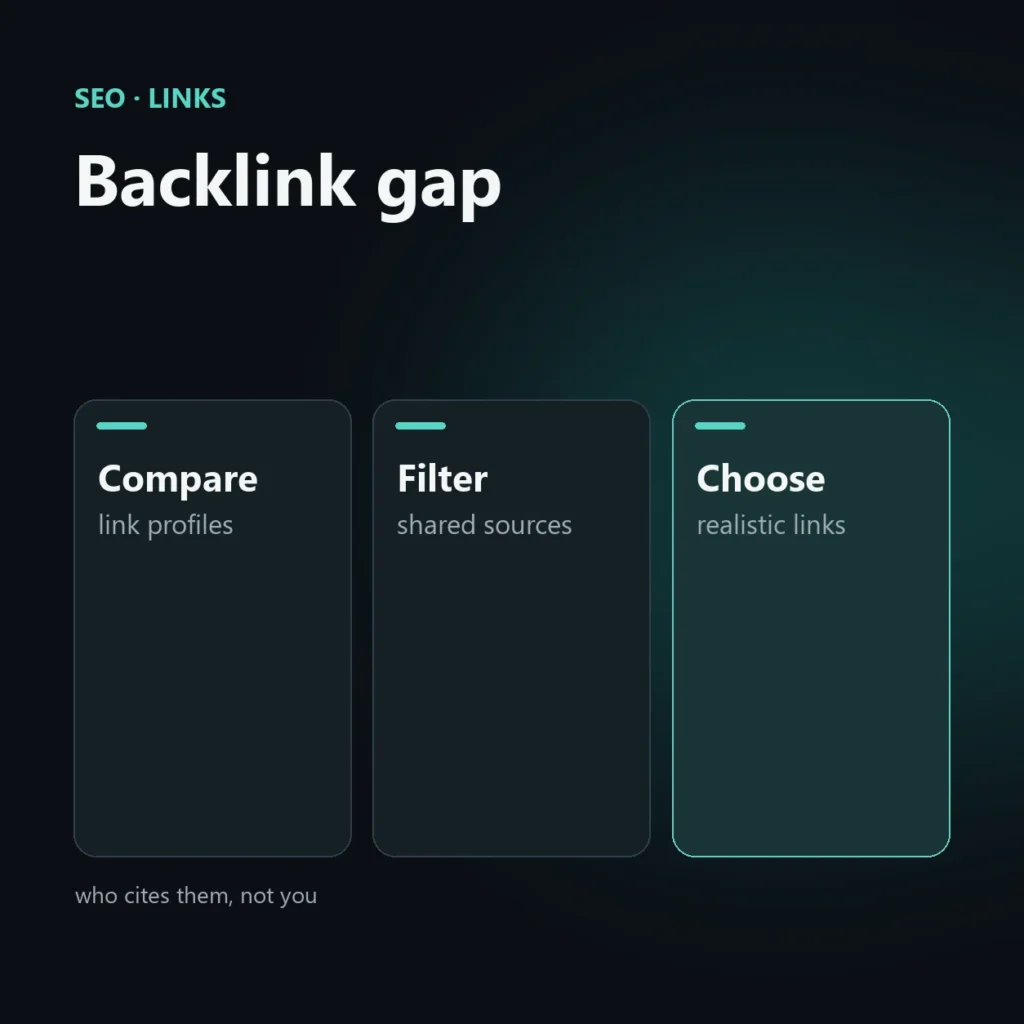
A backlink gap is the comparison between the sites that link to your competitors and those that link to you: the list of who cites them and not you. It helps you understand where links can be earned in your industry and which ones are realistic for you. It is not for chasing quantity.
This guide explains how to do it, with which tools and how to choose the links that are worth it. It is part of the guide to online competitor analysis.
Why look at competitors’ links
Links from other sites are one of the signals Google uses to evaluate pages. If a competitor ranks above you on a search with content similar to yours, the difference may lie in links. Looking at them also shows where links can be obtained in your industry: associations, directories, newspapers, partners, supplier sites.
How to do it
- Pick three to five competitors from your list of SEO competitors (see the guide to how to find them).
- Open the comparison report in your tool. In Ahrefs it is called “Link intersect”, in Semrush “Backlink Gap”; other tools, such as Sistrix and SE Ranking, have similar features. Enter your site and the competitors: the tool lists the sites that link to them and not to you.
- Filter the list. Keep the sites that link to more than one competitor: if several rivals earned a link from the same source, there is a repeatable reason.
- Classify the links by type and by how likely you are to get them.
- Choose and act. A few well-chosen links are worth more than a long list.
Without paid tools you can do a reduced version: search Google for a competitor’s name in quotes and see who mentions it, or use free tools with limited features. The result is partial, but it shows the types of source.
What kinds of links they are
| Type | Realistic for you? |
|---|---|
| Directories and industry associations | Often yes, if you meet the requirements |
| Partners, suppliers, clients | Yes, with a targeted request |
| Articles and interviews in newspapers or blogs | Depends on what new you have to say |
| Resources and guides that cite sources | Yes, if you have a better piece to offer |
| Paid lists, mass exchanges | No: risk of breaking Google’s guidelines |
How to judge a link
- Is the site relevant to your industry and does it have a real audience?
- Is the link in the text of a page people read, not in a list of dozens of links?
- Is there a concrete reason for it to cite you too?
- Can it be obtained without paying for the link itself?
Authority scores in tools (such as domain ratings) are each tool’s own estimates, not Google values. Use them to compare sites with one another, not to judge a single link.
Mistakes to avoid
- Buying links or joining exchange networks: Google treats them as spam and may ignore or penalize them.
- Chasing links from big sites that will never cite you.
- Looking only at the number of links and not the quality.
- Asking for links without content that justifies them.
Frequently asked questions
What is a backlink gap?
It is the list of sites that link to your competitors and not to you, obtained by comparing link profiles with a tool.
Do I need a paid tool?
For a complete comparison yes, because link reports are a feature of paid services. Without one you can do a partial version by hand.
How many links do I need to beat a competitor?
There is no number. It depends on link quality, content and other factors.
Can I buy the links on the list?
It is not advisable: Google’s guidelines forbid paid links meant to influence ranking.
Where do your competitors’ links come from?
I compare link profiles and pick the sources that are realistic for you, with no swaps or purchases that risk doing harm.
SEO, GEO and AEO specialist
Related articles
 SEOContent Gap Analysis: What Competitors Write and You Don’tOctober 30, 2026
 SEOHow to Find Your Real SEO CompetitorsOctober 30, 2026
 SEOSEO Competitor Analysis: A Practical GuideOctober 30, 2026
Explore by topic