
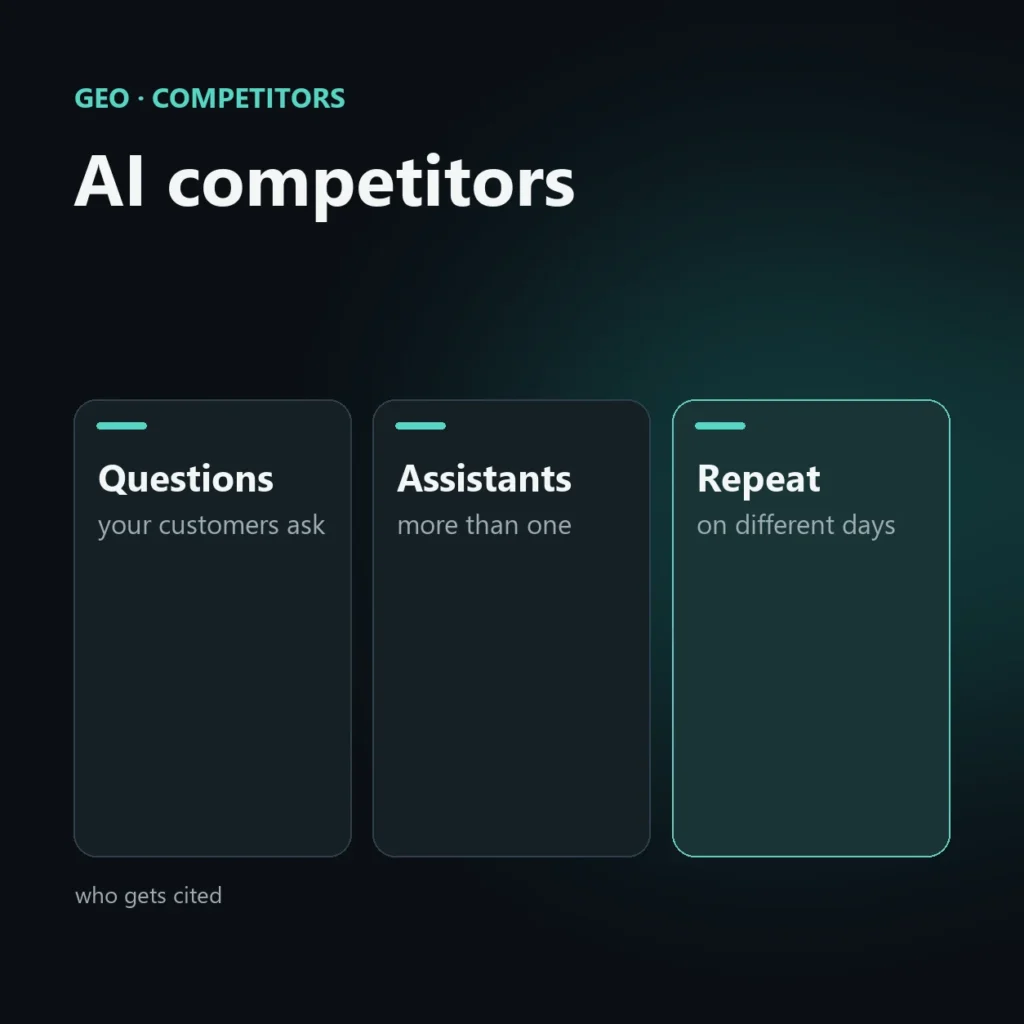
In AI-generated answers, your competitors are the sites cited as a source instead of yours. They can be different from the ones you see on Google’s first page. Finding them takes a manual test with fixed rules, because answers change from one request to the next.
This guide proposes a simple method and says what its limits are. It is part of the guide to online competitor analysis.
Why it needs a separate analysis
AI assistants choose sources with their own, unpublished criteria. A site in tenth position on Google may be cited often because it answers a question clearly, while the top result may not appear at all. That is why the list of SEO competitors does not match the list of competitors in AI answers.
The sample method
- Write 15-20 real questions a customer would ask before choosing: comparisons, costs, “how to choose”, problems, alternatives.
- Ask them to several assistants: ChatGPT with web search on, Copilot, Perplexity, Google AI Overviews and AI Mode. Each system has different sources and behavior.
- For each answer record whether you appear, which sites are cited and in what role: main source, example, comparison.
- Repeat three times on different days. A single answer says nothing: recurrences are what counts.
- Count citations per domain and compare with the list of SEO competitors.
What to look at in the cited sources
- What type of page is cited: guide, product page, forum, comparison site, institutional site.
- How it is written: answer in the first lines, clear headings, tables, data with sources.
- How up to date it is.
- Which questions have no good source: those are the opportunities.
Paid tools
Some SEO tools, including Semrush and Ahrefs, are adding reports on visibility in AI answers, and specialized services exist that query the assistants automatically. They are recent and the metrics are not standardized: one tool’s numbers are not comparable with another’s. Use them to see the trend, not as an exact measure, and check the most important questions by hand.
The limits of the method
- Answers vary by request, place, language and moment. What you see is a sample.
- Some assistants do not show sources, or show them only in some cases.
- You do not know how many people ask those questions: frequent citations on a rare question are worth little.
- A citation is not a visit (see the guide to measuring traffic).
What to do with it
- For questions where you are already cited, strengthen the page and keep it updated.
- For those where others are cited, study their page and write a clearer, better documented answer.
- For those without good sources, create the missing page.
For Microsoft’s guidance on getting cited, see the guide to Copilot SEO.
Frequently asked questions
Are competitors in AI answers the same as on Google?
Often in part. Sites that sit lower on Google can appear, and some from the first page can be missing.
How many times should I repeat the test?
At least three times, on different days, on the same questions. Then every one to three months to see the trend.
Is there a tool that does it automatically?
Some do, but they are recent and the data are not standardized. Use them as an indication and check by hand.
Can I guarantee a citation?
No. No assistant publishes the criteria it uses to choose sources.
Do AI answers cite you or your competitors?
I run the test on the questions that matter for your business, repeated over time, and tell you which pages to write or strengthen.
SEO, GEO and AEO specialist
Related articles
 GEOChatGPT and Bing: What We Actually KnowOctober 30, 2026
 GEOBing AI Performance Report: How to Read ItOctober 30, 2026
 GEOMicrosoft Copilot SEO: How to Get CitedOctober 30, 2026
Explore by topic