
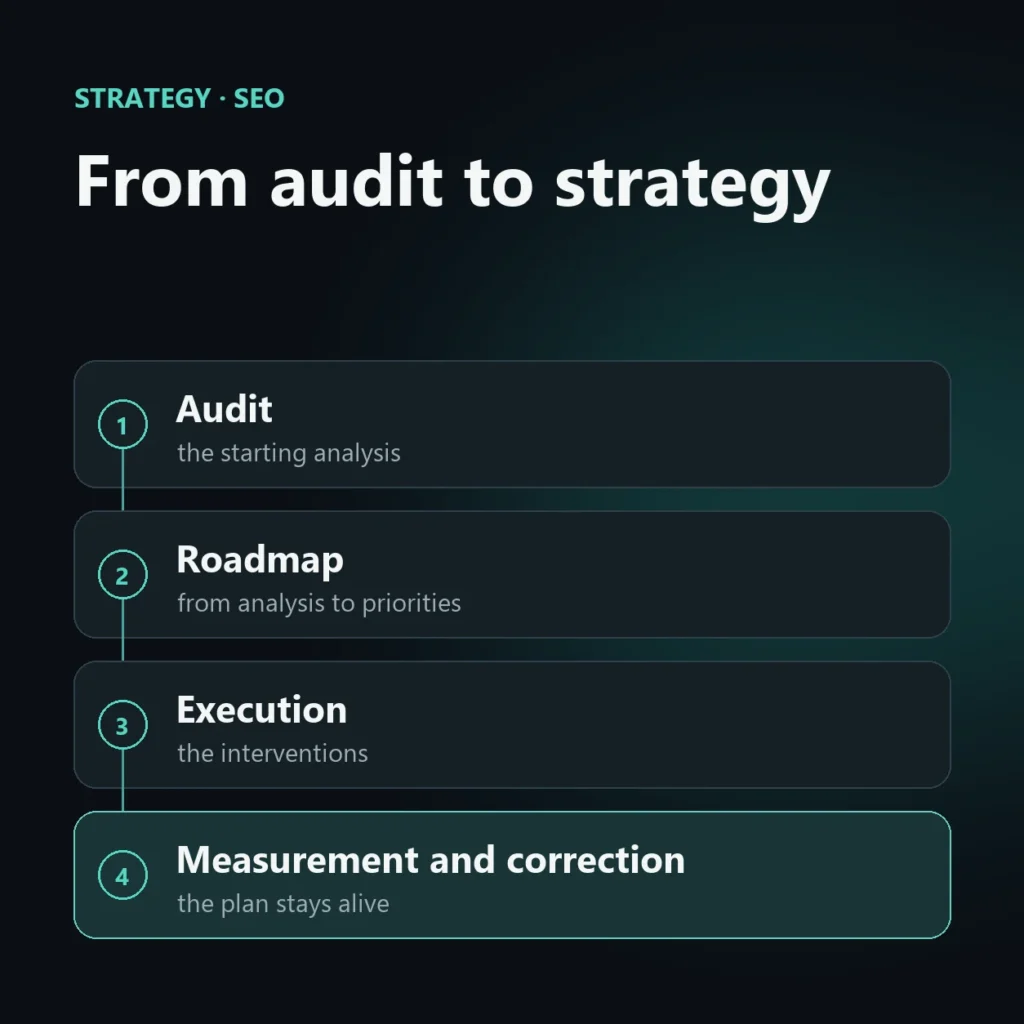
A digital visibility plan is the operational translation of an audit into a sequence of coordinated, measured actions that are sustainable over time. It isn’t a list of tasks lined up in a row, but a strategy that holds together technology, content, authority and paid channels, with clear objectives and defined priorities. In this article we see how to go from the initial analysis to a plan that doesn’t run out after a few weeks, but keeps producing results even when the context changes.
Why an audit without strategy isn’t enough
Many companies come out of a technical audit with a list of problems: broken links, slow pages, duplicate metas, thin content. Fixing them is useful, but on its own it doesn’t generate visibility. The audit is a snapshot: it tells you where you are, not where you want to go. Without a direction, interventions pile up in a disorderly way and results remain fragmentary. This is where the digital visibility plan: it takes the outputs of the analysis and orders them by impact, effort and timing.
An SEO audit done well isn’t limited to technical aspects. It includes analysis of existing content, query mapping, comparison with competitors and evaluation of domain authority. All these elements flow into the strategy, which decides what to do first and what can wait. The difference between a project that lasts and one that fizzles out lies precisely in this translation phase.
It must be said that the audit is not a one-off event. A mature digital visibility plan provides for periodic checks, because the context changes: new competitors, algorithm updates, evolving demand. The strategy must be able to absorb these changes without being rewritten from scratch every time.
The components of a digital visibility plan that holds up over time
A solid plan is built on four pillars that support each other. The first is the technical foundation: speed, indexing, site structure, structured data. Without a stable base, any content struggles to rank. The second is producing content that answers real search intents, not keywords chosen at a desk. The third is authority, which is built over time through consistent signals. The fourth is measurement, which tells whether the plan is working or needs correcting.
Priorities and sequence of interventions
Not everything can be done at once. A good digital visibility plan establishes a sequence: first the interventions that unlock indexing and speed, then those on content, then those on authority. Reversing the order means investing in pages that aren’t even being crawled correctly. Sequence counts more than the single action, because each step prepares the ground for the next.
Measurable objectives and time horizons
Every phase of the plan must have verifiable objectives: query coverage, qualified organic traffic, ranking on key topics, conversions. Time horizons help avoid judging the plan too early. SEO and visibility in AI-generated answers take time to consolidate. Setting intermediate milestones lets you correct course without waiting months.
From analysis to roadmap: how the plan is built
Building the plan starts from the synthesis of the audits. Technical data are crossed with content and authority data, gaps compared with competitors are identified and the topics on which the company wants to be recognized are defined. From here a roadmap is born that distributes interventions over time, with clear responsibilities and assigned resources.
An often underrated element is the evaluation of authority. The data on domain authority and backlinks help understand how much ground there is to recover and which content deserves to be promoted to attract links. Without this reading, the plan risks focusing only on production, neglecting the external signals that weigh on overall visibility.
The roadmap must also integrate paid channels, not treat them as a separate world. A Google Ads audit can reveal queries and intents that feed the organic strategy, and vice versa. Integration between organic and paid makes the digital visibility plan more robust, because the data from one channel informs the choices of the other.
Execution, measurement and continuous correction
Once the roadmap is defined, the plan enters the execution phase. Here discipline makes the difference: content published regularly, technical interventions monitored, link building carried out consistently with the brand’s positioning. Measurement isn’t only for producing reports, but for deciding what to continue, what to stop and what to test.
What to really monitor
Not all numbers count the same. It is more useful to follow the trend of the queries of interest, the quality of traffic, the conversion rate of key pages and presence in answers generated by AI tools. A single indicator rarely tells the story: reading must be done by coherent sets.
When and how to correct the plan
The digital visibility plan is not a static document. It should be reviewed at regular intervals and whenever a significant change requires it. Corrections must be based on data, not on impressions. A plan that doesn’t update is a plan that ages, and in a rapidly changing context this means losing ground.
| Plan phase | Main goal | Indicators to watch | Typical horizon |
|---|---|---|---|
| Audit and analysis | Capture the current state and the gaps | Technical coverage, covered queries, competitor comparison | Short |
| Technical foundations | Make the site crawlable and fast | Indexing, Core Web Vitals, errors | Short-medium |
| Content and intents | Answer users’ real question | Growing queries, engagement, conversions | Medium |
| Authority and external signals | Strengthen the domain’s reputation | Qualified backlinks, mentions, brand search | Medium-long |
| Measurement and correction | Adapt the plan to the results | Trends by sets, tests, periodic reviews | Ongoing |
Mistakes that shorten the life of a digital visibility plan
The first mistake is confusing the audit with the strategy: producing a detailed report and stopping there. The second is chasing every novelty without a direction, scattering resources on too many fronts. The third is measuring only traffic, ignoring quality and conversions. Each of these mistakes erodes the sustainability of the plan in the medium term.
Another risk is lack of internal alignment. If marketing, tech and management don’t share the same objectives, the digital visibility plan loses coherence. Visibility is a system result, not that of a single department. You need a common language and clear responsibilities on who does what.
Finally, there is the mistake of treating visibility as a project with an end date. It isn’t. It is a process that must be maintained, fed and adapted. Those who understand this build an advantage that accumulates; those who ignore it start over every time.
Frequently asked questions about a digital visibility plan
What is the difference between an audit and a digital visibility plan?
The audit analyzes the current state and identifies problems; the digital visibility plan decides what to do, in what order and with what objectives, translating the analysis into coordinated actions.
How long does it take to see results?
It depends on the starting point and the sector. Technical interventions give signals in relatively short times, while content and authority take months to consolidate.
Does the plan have to be redone from scratch if the algorithm changes?
No. A well-built plan adapts: priorities and tactics are reviewed, but the strategic direction remains valid if it is based on real intents and not on shortcuts.
Is it necessary to integrate SEO and paid campaigns?
Yes, it is worthwhile. Paid campaign data reveals queries and intents useful for the organic strategy, and organic work reduces dependence on ads over time.
How do you measure the success of a digital visibility plan?
With sets of indicators: query coverage, traffic quality, conversions and presence in answers generated by AI tools, read in their trend and not as isolated values.
How much does domain authority matter in the plan?
A lot, especially in competitive sectors. External signals and brand reputation influence the ability of content to rank and to be cited.
You have the audit, but don’t know where to start?
Many companies accumulate SEO audits full of critical issues — indexing errors, content channels that don’t convert, weak visibility on Google and on AI assistants — and then stand still. The real problem isn’t the analysis: it is turning it into a strategy with clear priorities, defined timing and precise responsibilities, avoiding scattered interventions that move nothing. It is exactly the step I handle with you: from reading the data to the operational roadmap, with measurable objectives and actions ordered by real impact on your business.

SEO, GEO and AEO specialist
Related articles
 SEOContent Gap Analysis: What Competitors Write and You Don’tOctober 30, 2026
 SEOBacklink Gap: Analyzing Competitor LinksOctober 30, 2026
 SEOHow to Find Your Real SEO CompetitorsOctober 30, 2026
Explore by topic