
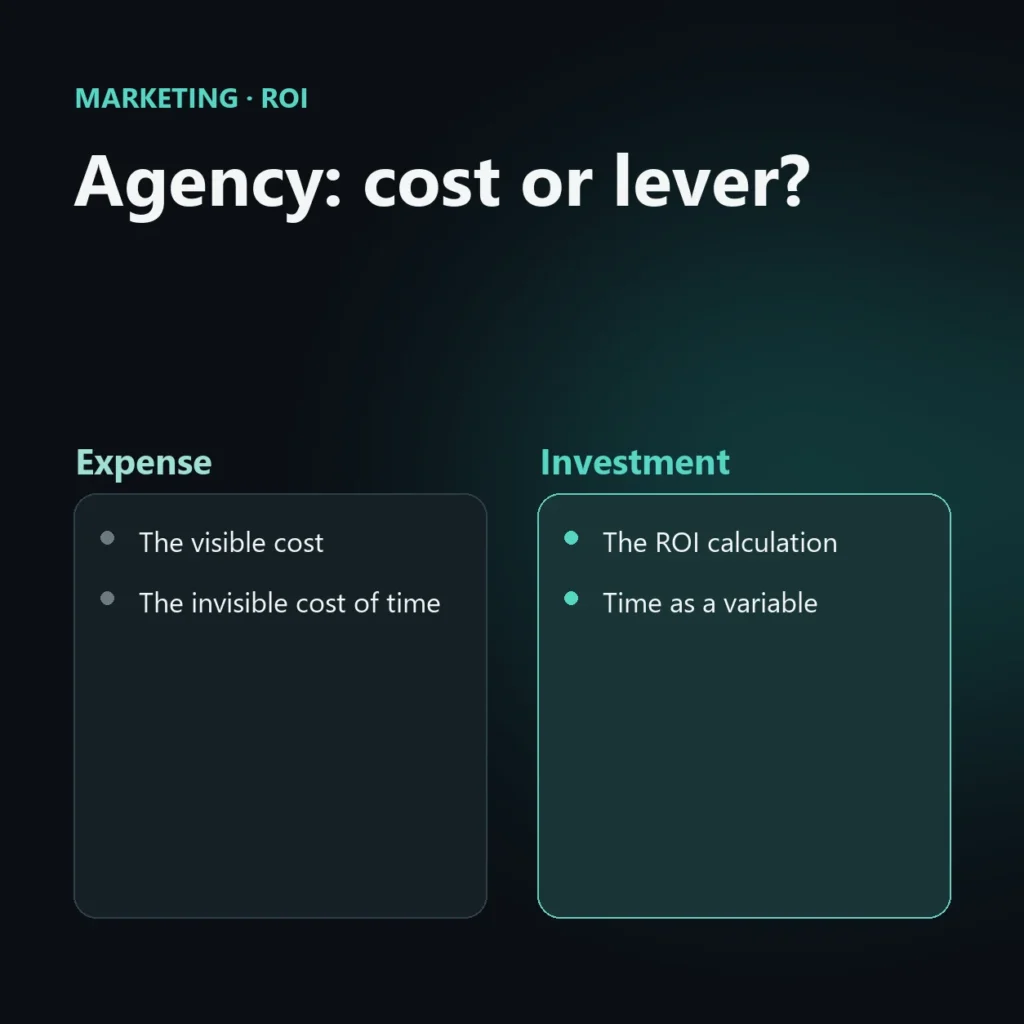
The ROI of a marketing agency is not measured on the invoice you pay, but on the incremental value that spend generates over time. It is the calculation almost no company really does, because it requires comparing two scenarios: the one in which you invest in outside expertise and the one in which you try to do it yourself, with the internal resources you have. Most businesses look only at the first column, the cost, and not at the second, the lost earnings. Yet that is exactly where the difference between an expense and an investment hides. In this article I try to build the reasoning concretely, without shortcuts.
The visible cost and the invisible cost of doing it yourself
When a company evaluates an agency, it usually starts from the quote. The quote is a clear, readable, comparable number. The problem is that this number tells only part of the story. On the other side of the table there are internal hours diverted from other activities, trial and error, tools purchased and then abandoned, skills learned slowly while the market runs. None of this appears on any invoice, but it weighs.
The real marketing agency ROI comes from comparing these two scenarios, not from reading the quote in isolation. An agency brings with it proven methods, a team working on several similar projects and the possibility of avoiding mistakes that others have already made. This is not an abstract advantage: it translates into shorter times to reach measurable results.
It is worth clarifying what is meant by return, because the concept is often used loosely.
«it expresses, that is, how much the capital invested in that company yields» — Wikipedia, entry “Return on investment”
Applied to marketing, the reasoning stays the same: it’s about understanding how much the capital you decide to allocate to channels, content and positioning yields. If the capital isn’t allocated, the return is simply zero, and the passing time is not neutral.
Why time is the variable that escapes the calculation
Many companies postpone the decision to rely on an agency because «first we try internally». It is an understandable position, but it ignores one thing: in the meantime competitors publish, rank, build authority. Delay is not a neutral wait, it is an opportunity cost that accumulates silently.
The opportunity cost of postponing
Every month in which you don’t work on visibility and ranking is a month in which someone else occupies the space that could have been yours. In the calculation of the marketing agency ROI this element is almost always omitted, yet it is often the heaviest. It isn’t a hypothesis: it is demand being intercepted by others.
Relying on an outside partner shortens learning times. A team that has already faced dozens of similar situations knows where to intervene first, which activities to prioritize and which to avoid. This translates into a faster results curve, which in turn improves the ratio between investment and return.
Quality as a multiplier
Then there is a factor that escapes any spreadsheet: the quality of the work produced. Well-written content, technically solid pages, a strategy consistent with the brand’s positioning. All of this has a direct impact on the ability to attract qualified traffic and convert it. Sloppy work doesn’t just produce fewer results: it produces damage that must then be repaired, often at costs higher than those that would have been incurred by doing it right from the start.
An SEO audit carried out with method, for example, brings to light problems that a superficial analysis doesn’t see. And those problems, if ignored, keep eroding the return of every other activity.
How to build a ROI calculation that holds up
To turn intuition into a decision you need a calculation. You don’t need a complicated formula: you need a few quantities compared honestly. The first step is estimating the value of an average customer and the number of additional customers that marketing activity can generate in a reasonable period. The second is adding up all the costs of the internal scenario: hours, tools, training, management time.
The third step, often the most neglected, is comparing the two scenarios over the same time horizon. If the comparison is made over one month, the agency always looks more expensive. If it is made over one year, the picture changes, because internal costs grow over time while the agency’s results tend to consolidate. This is where the marketing agency ROI becomes readable.
The items that go into the calculation
In the internal scenario you must count the actual hours spent, not the declared ones. You must count the tools, even those that seem cheap but weigh in when added up. You must count coordination time, which often absorbs more energy than you’d imagine. In the external scenario, instead, the cost is explicit and contracted, which makes the calculation simpler to do and harder to postpone.
An element that affects return, in both scenarios, is brand reputation. A company perceived as authoritative converts more easily, and this improves the return of every marketing activity, regardless of who carries it out.
Difference between expense and investment: a comparison framework
To make the reasoning more concrete, it is worth comparing the two approaches on some key dimensions. It isn’t about establishing which is always better, but about understanding under which conditions an agency becomes a lever and under which it remains a cost.
| Dimension | In-house management | External agency |
|---|---|---|
| Costs | Diluted and less visible, growing over time | Explicit and predictable, contracted |
| Time to results | Long, dependent on the learning curve | Faster, thanks to proven methods |
| Skills | Limited to the available team | Broad and up to date across several projects |
| ROI measurability | Difficult, many variables not tracked | Clearer, with agreed objectives |
| Opportunity cost | High, the time not recovered weighs | Reduced, you start earlier and with method |
Read this way, the table shows one simple thing: the marketing agency ROI doesn’t depend only on how much the agency costs, but on how much it costs not to have one. And the second cost is almost always less visible, so easier to ignore.
The mistakes that distort the ROI calculation
The first mistake is comparing the agency’s quote with zero. As if the alternative were free. It isn’t: the alternative has a cost, simply distributed across items that don’t end up in a single invoice. The second mistake is measuring over horizons that are too short, where no strategy has time to produce readable effects.
The third mistake is not defining objectives before starting. Without clear objectives, any result becomes debatable, and the return calculation gets lost in discussions. A serious agency insists on exactly this point: defining what you want to achieve, how it is measured and in how much time. It is the condition for being able to truly talk about marketing agency ROI without falling back on impressions.
The fourth mistake is considering the agency a passive supplier. The best return is obtained when there is collaboration, when information circulates and when decisions are made together. In that case the agency stops being an external cost and becomes an extension of the team. If you want to understand how to set up this relationship, you can request a consultation and reason through the numbers of your specific case.
Frequently asked questions about the ROI of a marketing agency
What exactly does the ROI of a marketing agency mean?
It indicates the ratio between the value generated by marketing activities and the investment made to entrust them to an outside partner. It isn’t a fixed number, but depends on the objectives and the chosen time horizon.
How long until the first results appear?
It depends on the channel and the starting point. Some activities give signals within a few weeks, others take months to consolidate. The important thing is to agree on the intermediate milestones in advance.
Is it always worth relying on an agency?
No, not always. If the company has a structured internal team and up-to-date skills, it can handle part of the activities on its own. The agency becomes a lever when specific skills or time are lacking.
How do you measure return without historical data?
You start by defining simple, trackable indicators, then build a basis for comparison over time. Even without history, a clear objective lets you assess whether the work is producing effects.
Is the agency’s cost the only item to consider?
No. You must also consider the internal costs avoided, the time saved and the value of the opportunities that would have been lost by postponing. The comparison must be made between scenarios, not between one item and zero.
How do you tell whether the investment is working?
You need regular monitoring against agreed objectives, with periodic reviews. If the numbers don’t arrive, you analyze the causes and correct the strategy, instead of waiting passively.
You chose the agency, but results don’t come
The knot is almost always the same: an SEO agency is hired as a growth lever, but without a clear method for measuring its work. Generic reports, priorities that change every month, activities disconnected from business objectives. So the lever stays still and the budget is consumed without direction. I start here: I define together with you where you want to get to, I build the SEO and GEO plan and show you how the path is measured, without inflated promises. If you want to understand whether your project is set up well, let’s talk about it.

SEO, GEO and AEO specialist
Related articles
 SEOContent Gap Analysis: What Competitors Write and You Don’tOctober 30, 2026
 SEOBacklink Gap: Analyzing Competitor LinksOctober 30, 2026
 SEOHow to Find Your Real SEO CompetitorsOctober 30, 2026
Explore by topic