
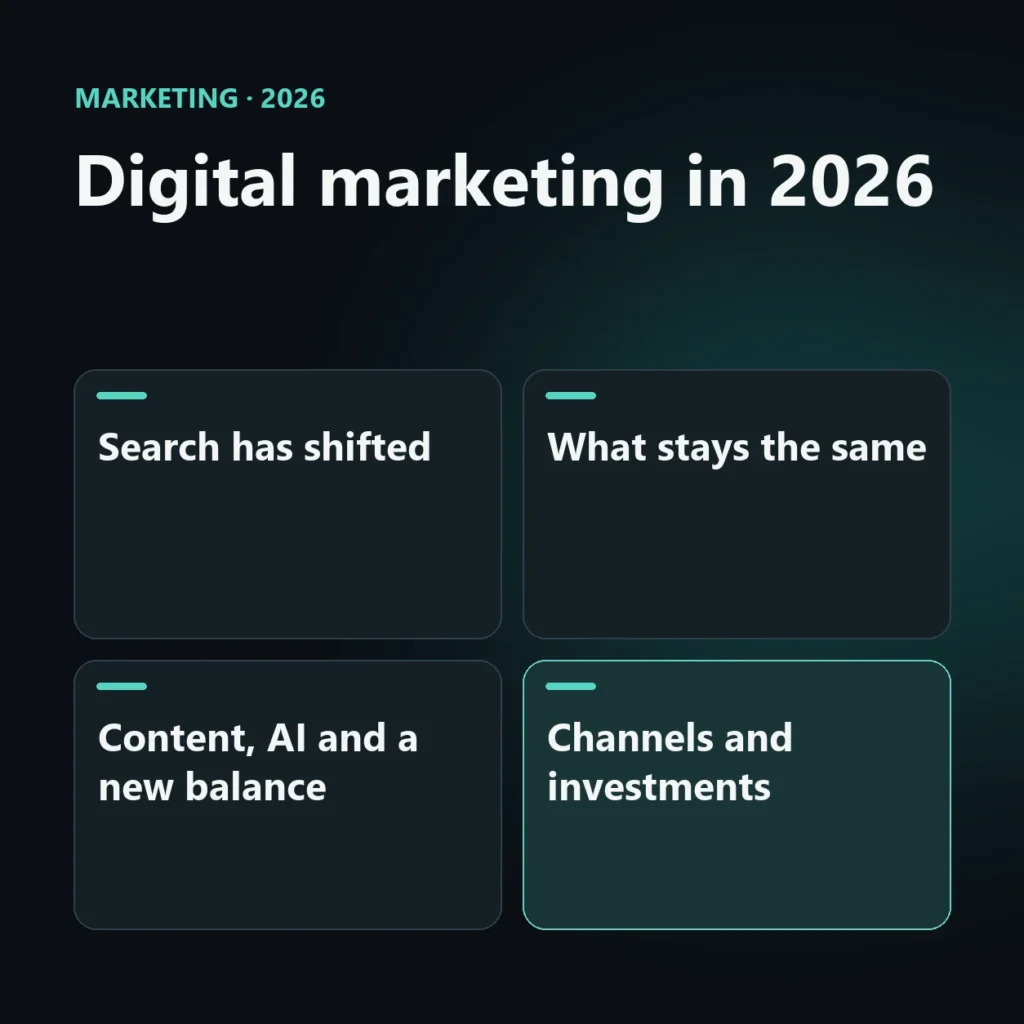
Digital marketing in 2026 is not a sudden revolution, but the end point of an evolution that began years ago and was accelerated by generative artificial intelligence. Those working online today face an ecosystem in which traditional search engines coexist with conversational assistants, content is evaluated by machines before people, and public trust is built with consistency more than with advertising budget. In this scenario, understanding what has really changed in digital marketing in 2026 — and what instead stays identical to the principles of always — is the first step to avoid chasing passing fads and to invest where the return is real.
Search has moved: from links to answers
For years the marketer’s job consisted in ranking a page on a keyword and attracting clicks. In digital marketing in 2026 this model hasn’t disappeared, but it has been joined by a different behavior: the user asks an assistant a question and gets a synthesized answer, often without visiting any site. The result is that pure informational traffic has shrunk, while the value of qualified interactions grows, the ones in which the user already has a precise intent.
This shifts attention from simple optimization for engines to a broader discipline, which many call answer engine optimization. It is no longer enough to be found: you have to be cited, summarized and considered a reliable source by the artificial intelligences that generate the answers. Companies that have built solid foundations in brand authority find themselves at an advantage, because machines tend to favor those already recognized as authoritative in their sector.
The practical consequence is that writing for the web must become clearer, more structured and more verifiable. Direct sentences, citable data, readable content hierarchies: these are the same elements that people like and that AIs manage to extract easily.
What stays the same in digital marketing in 2026
It would be a mistake to think everything has been turned upside down. Digital marketing in 2026 still rests on foundations that haven’t changed: knowing the audience, solving a real problem, communicating in a recognizable tone. Technology changes the channels, not the nature of human need. Those who confuse the novelty of the tool with the novelty of the strategy end up chasing every update without building anything lasting.
The principle of trust also remains central. Useful content, signed, consistent with the brand’s promise continues to generate better results than content optimized only for engines. The difference is that today trust is also built outside the site: in mentions, in reviews, in citations on publications and third-party platforms.
The role of digital reputation
Relations with the media and with industry communities count more than before. A well-run digital PR strategy doesn’t just serve to obtain coverage, but to create that fabric of external references that strengthens credibility in the eyes of both people and algorithms. Those who want to see how this translates into practice can look at some practical examples of digital PR that show the path from mention to recognition.
Content, AI and the new balance between quantity and quality
Generative artificial intelligence has made producing text trivial. This is the most concrete change in digital marketing in 2026: scarcity is no longer in the ability to write, but in the ability to say something worth reading. When everyone can generate content, the competitive advantage shifts to direct experience and original point of view.
The winning answer is not to produce more, but to produce better and with a recognizable voice. Generic content, the kind that could be written by anyone on any topic, loses ground. Content that brings concrete examples, real cases, argued opinions grows instead.
Optimizing for people and for machines
Good content in digital marketing in 2026 passes two exams: it convinces those who read it and is understood by those who summarize it. This means taking care of structure, using explanatory subheadings, answering questions directly, avoiding ambiguity. It isn’t double writing, but more disciplined writing.
In this context the term generative engine optimization describes precisely the effort of making content citable by assistants. It is a young discipline, but its underlying rules — clarity, authority, verifiability — are the same ones that have always distinguished good communication.
Channels and investments: where the budget shifts
On the channel front, digital marketing in 2026 shows a redistribution rather than a replacement. Paid advertising remains effective, but its cost grows and its yield depends more and more on the quality of creative and targeting. The companies getting the best results are those that treat paid as amplification of a solid organic strategy, not as a shortcut.
Social, for its part, has consolidated as a space for relationship more than pure distribution. Niche communities, thematic channels and newsletters are counting again, because they offer a more attentive and less scattered audience. Owning the channel — a list, a community, a site — is worth more than a presence on a platform you don’t control.
For this reason many digital marketing strategies in 2026 bring the company site back to the center as a hub of content and conversions, while external channels play the role of attracting and directing. It is a return to common sense: building on your own ground, not just on rented land.
A summary overview: what changes and what doesn’t
To get your bearings, it is best to clearly distinguish the elements that have transformed from those that remain stable. The table below summarizes the main ones.
| Area | What has changed | What stays the same |
|---|---|---|
| Search and visibility | Synthesized answers reduce informational clicks | Authoritative sources get cited more often |
| Content production | AI makes writing generic texts trivial | Experience and point of view make the difference |
| Trust and reputation | External mentions weigh as much as the site | Consistency builds credibility over time |
| Channels and budget | Paid costs more and requires quality | The owned channel remains the most solid |
| Measurement | Conversions count, not visits alone | Business objectives guide the choices |
Reading this overview suggests a simple conclusion: digital marketing in 2026 rewards those who have already understood that technology is a means, not an end. Those who build authority, solid content and authentic relationships are in the best position, regardless of the latest fashionable tool.
It is worth recalling an essential definition of the field we operate in. As the encyclopedia entry on the subject observes, it concerns:
«any form of advertising that uses the Internet to deliver promotional marketing messages to consumers» — Wikipedia, entry “Internet marketing”
This definition, broad and deliberately neutral, reminds us that under the label of digital marketing in 2026 very different practices coexist. What unites them is the medium, not the method. And it is precisely on method that the difference is made between those who get lasting results and those who chase only the noise of the moment.
Frequently asked questions about digital marketing in 2026
Is digital marketing in 2026 really different from that of previous years?
The underlying principles remain the same, but tools and audience behavior change. The main novelty is the presence of AI assistants in the information search phase.
Why is traditional SEO no longer enough?
Because many answers are provided directly by assistants, with no click to the site. You therefore need to work on citability and on the authority of the source as well.
What does it mean to optimize for answer engines?
It means writing clear, structured and verifiable content, so that artificial intelligences can understand and cite it easily in their answers.
Will artificial intelligence replace content writers?
It is unlikely to replace those who bring experience and an original point of view. It instead reduces the space for generic content, which loses value.
How much does external reputation matter in digital marketing in 2026?
A lot. Mentions on publications and third-party platforms strengthen credibility both toward people and toward the algorithms that generate the answers.
Where is it best to start to adapt?
From a review of the content and its structure, followed by steady work on authority and external relationships. Technology comes after strategy.
Yesterday’s strategies no longer hold up
You’ve updated the site, you publish content, you invest in advertising, and yet results don’t come the way they used to. Digital marketing in 2026 has really changed: searches go through AIs, engines answer in your place, and those who don’t adapt lose visibility every day. It isn’t a matter of budget, it’s a matter of method. That is why I work on SEO, GEO and AEO in an integrated way, starting from a real analysis of how your audience searches for and finds information today.
SEO, GEO and AEO specialist
Related articles
 SEOContent Gap Analysis: What Competitors Write and You Don’tOctober 30, 2026
 SEOBacklink Gap: Analyzing Competitor LinksOctober 30, 2026
 SEOHow to Find Your Real SEO CompetitorsOctober 30, 2026
Explore by topic