
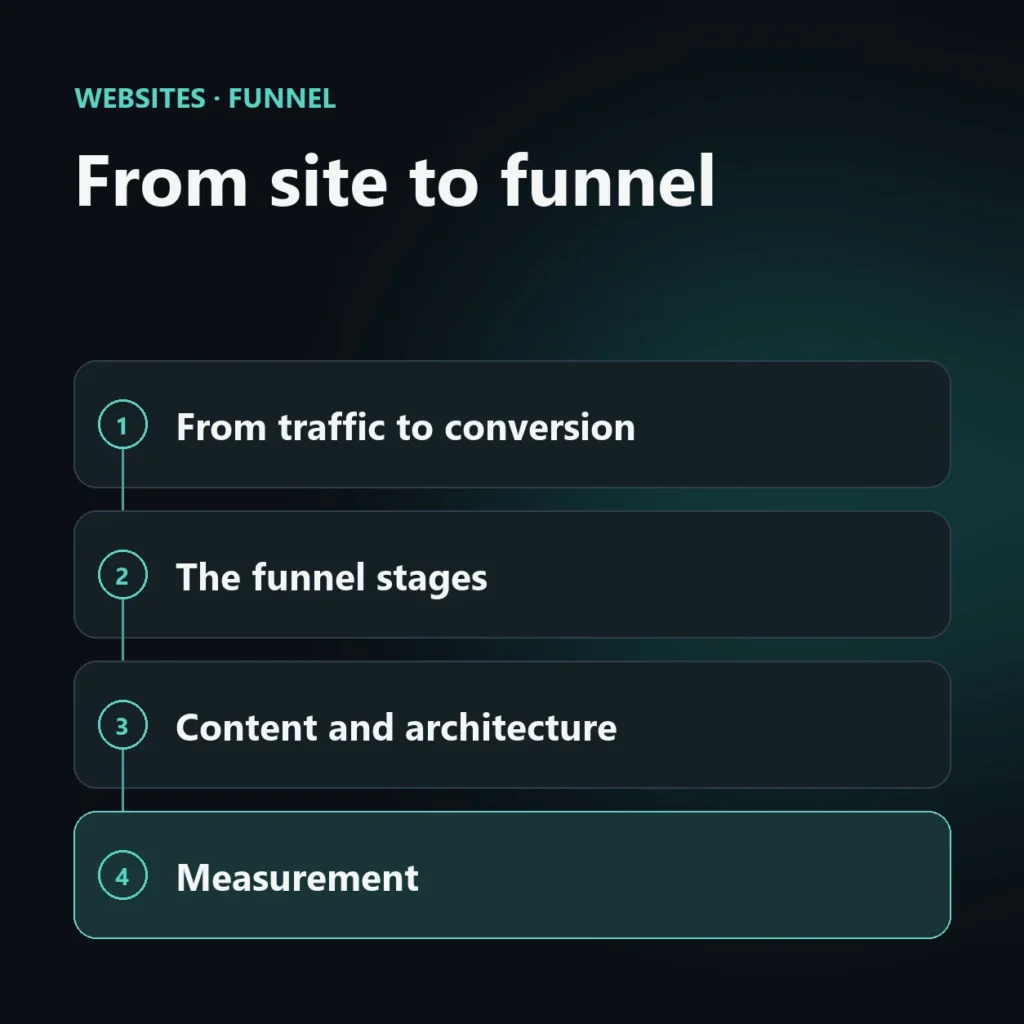
An acquisition funnel is the structured sequence of steps that guides a person from first contact with your brand to the desired action, whether a purchase, a quote request or a sign-up. Designing it well means stopping thinking of the site as a static showcase and starting to see it as a path with precise stages, friction to remove and signals to measure. In this article we see how to move from a generic site to an acquisition funnel that works for you, integrating SEO, GEO and AEO principles at every stage of the journey.
Why the site isn’t enough: from traffic to the acquisition funnel
Many companies invest time and budget to bring visitors to the site, then stop. The result is a flow of traffic that arrives, looks around and leaves without a trace. A well-made site is the starting point, but without a clear acquisition funnel it remains a container of pages that guides no one toward a decision.
The substantial difference lies in design intent. A traditional site presents information; an acquisition funnel organizes that information so that every page has a job: moving the visitor forward one step. Every element of the page must have a function in the journey, from the headline to the final button, passing through social proof and supporting content.
This change of perspective requires first mapping your audience’s decision stages, then building the pages accordingly. It isn’t about adding pop-ups or intrusive banners, but about designing a coherent architecture in which visitors immediately understand where they are and what they can do next.
The stages of a well-designed acquisition funnel
An acquisition funnel is typically divided into three macro-stages: awareness, consideration and conversion. To these is added a loyalty stage, often neglected but decisive for long-term value. Each stage has different objectives, content and metrics.
In the awareness stage the visitor discovers the problem or the opportunity. Here you need informative, accessible content, optimized for search and for the direct answers of AI assistants. In the consideration stage the user compares alternatives: this is the moment for detailed service pages, case studies, comparisons. In conversion, finally, the user is ready: you need to remove every friction, make the action obvious and reassuring.
Continuity between stages is what distinguishes an effective funnel from a series of disconnected pages. If awareness content leads to a conversion page with no intermediate steps, the jump is too abrupt and most users leave. You need a logical progression, with intermediate micro-conversions that prepare the final one.
Map the journey before writing a line of code
Before intervening on the site, it is worth drawing the journey on paper: which questions the user asks at each stage, which objections they have to overcome, which proof they look for. Only afterwards do you decide which pages are needed and how to link them. This approach avoids building useless pages and focuses resources on what generates movement in the acquisition funnel.
Content and architecture: how to guide the user step by step
Site architecture is the backbone of the acquisition funnel. A clear structure, with short paths to key actions, reduces drop-off. Fewer clicks to get to the point, fewer distractions, more chance of conversion. This applies both to the main navigation and to internal links between content.
content creation plays a central role here. Every text, every page, every answer must be designed for a specific stage of the funnel. An article explaining a problem shouldn’t sell; a service page shouldn’t digress. Consistency between page intent and funnel stage is the factor that most affects conversion.
Even the choice of a custom website compared with a generic template can make the difference: a tailor-made architecture lets you build paths consistent with the funnel, without having to adapt the journey to pre-existing technical constraints.
The role of SEO, GEO and AEO in the acquisition funnel
SEO, GEO and AEO are not disciplines separate from the funnel: they are the engines that bring people into the right stages. Classic SEO intercepts those searching for solutions; GEO optimizes for generative engines, which cite structured and authoritative content; AEO works on direct answers, to be the source the assistant chooses. All three feed the same acquisition funnel, at different points.
Content optimized for AEO, for example, answers a specific question and leads the user to a natural next step. Well-structured GEO content is picked up by assistants and generates qualified traffic. Optimization for generative engines does not replace SEO, it complements it in a funnel logic.
Common mistakes that break the acquisition funnel
The first mistake is treating all pages the same way, with the same call to action and the same tone. An acquisition funnel requires differentiation: someone arriving from informational content isn’t ready to buy, and proposing a purchase right away is counterproductive.
The second mistake is the absence of measurement by stage. If you only look at the final conversion rate, you can’t tell where the user is lost. You need to monitor the intermediate steps: how many people move from one page to another, where they drop off, which content holds them. Without data by stage, every optimization is blind.
The third mistake is the fragmentation of content across different channels, with no common thread. Social, blog, service pages and landing pages must tell the same story and lead toward the same goal. An acquisition funnel works when each piece points to the next in a predictable way.
Measuring what matters at every stage
Not all metrics carry the same weight. In the awareness stage, qualified views and time on page count; in consideration, clicks to service pages and downloads; in conversion, the action completion rate. The conversion rate must be read together with entry data, otherwise it tells you nothing useful.
| Funnel stage | Goal | Content type | Key metric |
|---|---|---|---|
| Awareness | Attract attention and intercept the need | Informational articles, guides, answers to questions | Qualified traffic and time on page |
| Consideration | Compare solutions and reduce doubts | Service pages, case studies, comparisons | Clicks to conversion pages |
| Conversion | Drive the desired action | Landing pages, forms, direct contacts | Action completion rate |
| Loyalty | Maintain the relationship and generate repeat visits | In-depth content, updates | Returns and subsequent interactions |
From project to measurement: closing the loop
An acquisition funnel is not a one-off project: it is a system to monitor and correct. After launch, the data show where the path loses effectiveness. At that point you intervene with targeted changes, tests, new pages or revisions of existing content.
The key is cyclicality: design, measure, correct, repeat. Every iteration makes the funnel closer to the real behavior of the audience, which rarely coincides with the initial hypotheses. Those who treat the funnel as a static document watch it age within a few months.
If you want to understand where your site is losing opportunities and how to turn it into an effective acquisition funnel, you can request a consultation dedicated to this: together with you I analyze the current journey and identify the priority actions.
Frequently asked questions about the acquisition funnel
What is the difference between a site and an acquisition funnel?
The site is the set of pages; the acquisition funnel is the designed path that links them to lead the user toward an action. A site can exist without a funnel, but it converts much less.
How many stages should an acquisition funnel have?
There is no fixed number: the typical stages are awareness, consideration, conversion and loyalty, but they can be adapted to the sector and the type of offer.
Are SEO and the acquisition funnel the same thing?
No. SEO brings qualified traffic, the acquisition funnel organizes it and guides it toward conversion. They are complementary and should be designed together.
Do I need a new site to build an effective funnel?
Not always. In many cases you can reorganize the existing architecture and content. A custom website helps, but it isn’t an absolute prerequisite.
How do you measure the success of an acquisition funnel?
You measure the intermediate steps, not just the final conversion: qualified traffic, clicks between pages, completion of actions. Every stage has its own metric.
How long does it take to see results?
It depends on the starting point and the sector. The first signals arrive when you start monitoring the intermediate steps, while consolidated results require successive iterations.
Your site brings visits, but not customers
If the site receives traffic but requests don’t come in, the problem is rarely the design: it’s the journey. Pages that don’t guide, scattered forms, buried contacts and no connection between what the user is looking for and what you want them to do. The result is a site that informs but doesn’t sell, and a funnel that breaks before conversion. I start here: I design sites and conversion paths built on the real intentions of those who arrive, with a structure that guides the visit toward action.

SEO, GEO and AEO specialist
Related articles
 Website CreationHacked WordPress site: anatomy of a real caseOctober 5, 2026
 Website CreationSpeed, usability and SEO: the three technical pillars no site can ignoreSeptember 24, 2026
 Website CreationNo-code, low-code and custom development: which approach should you choose for your company?September 24, 2026
Explore by topic