
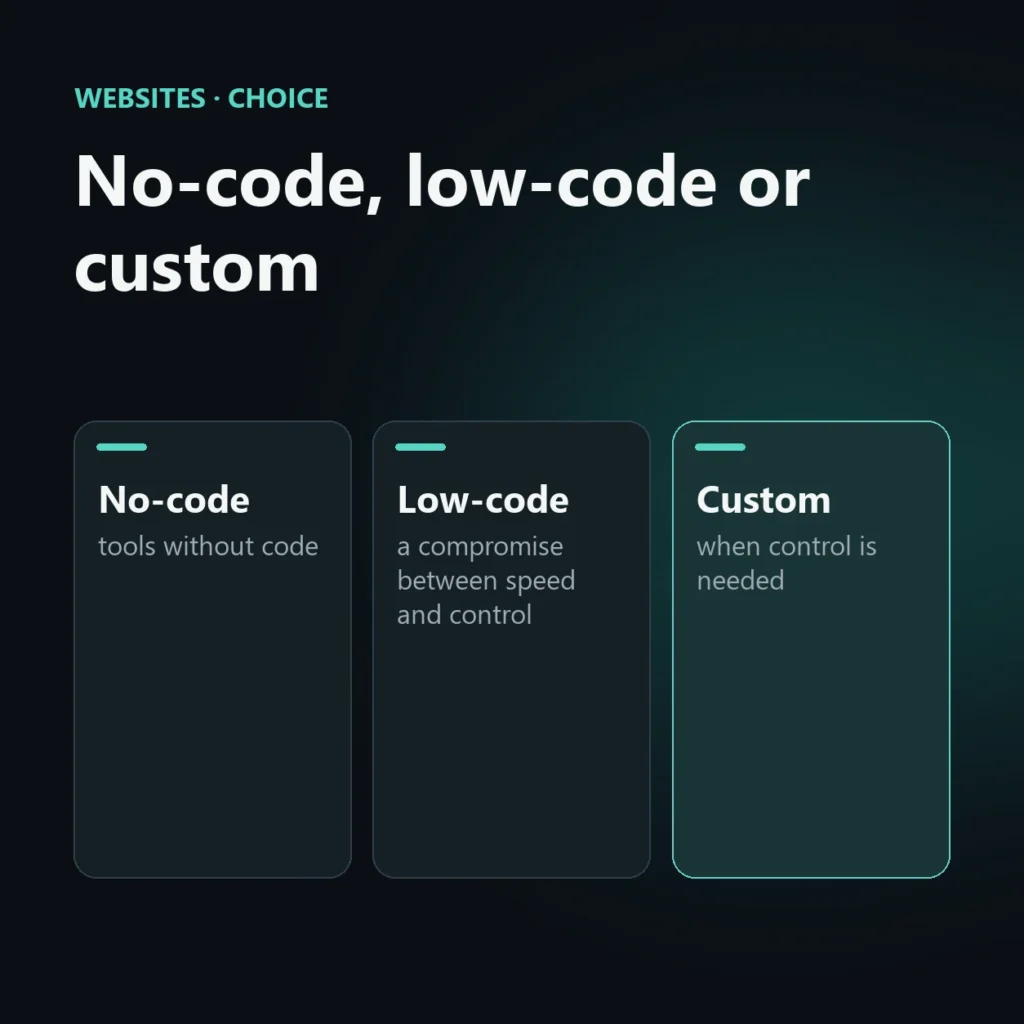
No-code website building is the approach that lets you build and manage a site through visual platforms, without writing code, while low-code and custom development are the alternatives when you need more control, integrations or tailor-made functionality. The choice between these three models is not a matter of fashion, but of objectives, in-house skills, budget and growth prospects. In this article I analyze when a no-code approach makes sense, when low-code offers the right compromise and when custom development remains the most solid path, with practical criteria for finding your bearings.
What is meant by a no-code website
When we talk about no-code website we refer to a set of platforms that let you design pages, manage content and publish online through drag-and-drop interfaces. The user doesn’t write lines of code: they configure components, choose templates, connect forms and publish. Tools such as modern website builders, visual content management systems and landing page platforms fall into this category.
The main advantage is the speed of going live. A professional or a small team can go from idea to publication in a short time, without depending on a developer. This makes no-code particularly suited to projects where the priority is validating an offer, collecting leads or presenting a service, rather than building a complex architecture.
There are however limits to be aware of. Graphic and functional customization remains bound to what the platform provides, and integrations with external systems can prove rigid. Moreover, the portability of data and content is often partial: migrating from a no-code platform to a different solution takes work, sometimes a rebuild from scratch. For this reason it is better to evaluate no-code as a conscious choice, not as a fallback.
When no-code is the right choice
No-code works well for showcase sites, blogs, campaign landing pages and pilot projects. If the goal is to test a market or communicate a local business, ease of management weighs more than technical flexibility. Maintenance is lighter too: security updates and hosting are largely the provider’s responsibility.
Low-code: the compromise between speed and control
Low-code sits halfway. It offers visual environments for building interfaces and flows, but allows custom code to be inserted where needed. It is the typical approach of platforms that let you extend functionality with scripts, APIs or purpose-built plugins. In practice, you start from ready-made components and intervene only on critical points.
This model is useful when the project has needs that pure no-code doesn’t cover: automations, integrations with management systems, specific business logic. Low-code cuts times compared with development from scratch, but it still requires technical skills to manage the customized parts. It is therefore not a shortcut for those who have no in-house technical people or a reliable partner.
A recurring example is WordPress site creation, which combines a CMS accessible to non-technical users with the possibility of extending the site through plugins and custom code. WordPress is a good example of the low-code idea applied to the web: you start from themes and blocks, but you can go down to the detail when the project requires it.
The hidden risks of low-code
The main risk is the accumulation of customizations that are hard to maintain. Every change to the code must be documented and tested, otherwise the site becomes fragile. You need clear technical governance: who puts their hands on the code, with which procedures, and how updates are managed. Without this discipline, low-code can turn into silent technical debt.
Custom development: when you need total control
Custom development means building the site or application from scratch, or nearly so, with technologies chosen according to needs. It is the approach that guarantees maximum control over performance, security, architecture and integrations. Every function is designed for the specific project, without constraints imposed by a platform.
This model is indicated when the site is a central part of the business: platforms with registered users, private areas, complex transactional flows, integrations with company systems. In these cases the flexibility of custom pays back the higher initial investment and the longer development times. A custom website makes it possible to optimize every aspect, from loading speed to user experience, without compromises.
E-commerce often falls under this logic too. A project of PrestaShop e-commerce development, for example, makes it possible to manage large catalogs, elaborate promotional rules and integrations with warehouse or invoicing systems. These are scenarios in which no-code can hardly bear the weight of operational complexity.
The real cost of custom development
Custom is not just an initial expense: it requires maintenance, updates and ongoing skills. It should be evaluated as a long-term investment, not as a one-off cost. If the project grows, though, the solidity of the architecture reduces future problems and makes it easier to evolve the site without rebuilding it.
How to choose based on the business context
The decision depends on three main factors: business objectives, available skills and time horizon. If the site has to validate an idea in a few weeks, no-code is often the most sensible choice. If you need flexibility without giving up speed, low-code offers a good balance. If the site is the heart of the company’s operations, custom becomes almost obligatory.
A common mistake is choosing based on fashion or immediate cost, ignoring long-term costs. A cheap no-code platform today can become a limit tomorrow, when you need integrations or customizations that aren’t provided for. Conversely, starting with custom development for a simple project can be oversized and slow down going live.
A practical criterion is to ask how much the site will have to change over time. Static, informational projects are well suited to no-code. Projects that evolve, integrate data and grow in complexity require low-code or custom. The choice should be reviewed periodically, because a company’s needs change with the market.
Integration with SEO, GEO and AEO
Whatever the approach, the site must be optimized for search engines and for answers generated by artificial intelligence. No-code often offers good SEO foundations, but with limited room for customization. Low-code and custom allow you to intervene on structure, structured data and performance more precisely, an element increasingly relevant for visibility in AI answers.
| Approach | Development time | Flexibility | Skills required |
|---|---|---|---|
| No-code | Very short | Limited | No technical skills |
| Low-code | Medium | Medium | Basic technical skills |
| Custom development | Long | High | Structured development team |
| Maintenance | Handled by the provider (no-code) | Partial (low-code) | In-house or outsourced (custom) |
Mistakes to avoid in the choice
The first mistake is underestimating maintenance. Every site, regardless of approach, requires updates, security checks and adjustments. No-code simplifies, but doesn’t eliminate these activities. Custom makes them more complex, but also more controllable if the team is prepared.
The second mistake is not planning for growth. A site meant to last for years must be able to accommodate new functions without being rebuilt. If no-code doesn’t allow it, better to evaluate a more flexible approach from the start. The third mistake is ignoring in-house skills: choosing a model the company can’t manage leads to total dependence on external suppliers.
Frequently asked questions about no-code, low-code and custom development
Is no-code suitable for a professional business website?
Yes, for showcase sites, blogs and landing pages. It becomes limiting when you need complex integrations or tailor-made functionality.
What is the main difference between no-code and low-code?
No-code doesn’t require writing code, while low-code lets you add custom parts when the platform isn’t enough.
When does custom development make sense?
When the site is central to the business, requires integrations with company systems or has to sustain complex growth over time.
Can a no-code site rank well on Google?
Yes, if the platform handles structure, speed and structured data correctly. The room for optimization is however more limited than with custom solutions.
Does low-code require technical skills?
Yes, at least basic ones, because customizations must be managed, tested and maintained over time.
Can you migrate from no-code to custom without losing content?
Partly yes, but a partial rebuild is often needed. It is best to plan the migration carefully so as not to lose SEO and data.
Is your no-code site holding you back?
You chose a no-code builder to start quickly, but now every new need runs into the platform’s limits: functions that don’t exist, integrations it can’t handle, speed that won’t take off. And low-code, if badly managed, adds complexity without solving the underlying problem. I, with geo-seo.pro, start from how your company really works and assess whether it makes sense to stay on no-code, move to low-code or build a tailor-made development. I tell you honestly which path supports growth, without tying you to a template.

SEO, GEO and AEO specialist
Related articles
 Website CreationHacked WordPress site: anatomy of a real caseOctober 5, 2026
 Website CreationFrom site to funnel: how to design a path that convertsSeptember 24, 2026
 Website CreationSpeed, usability and SEO: the three technical pillars no site can ignoreSeptember 24, 2026
Explore by topic