
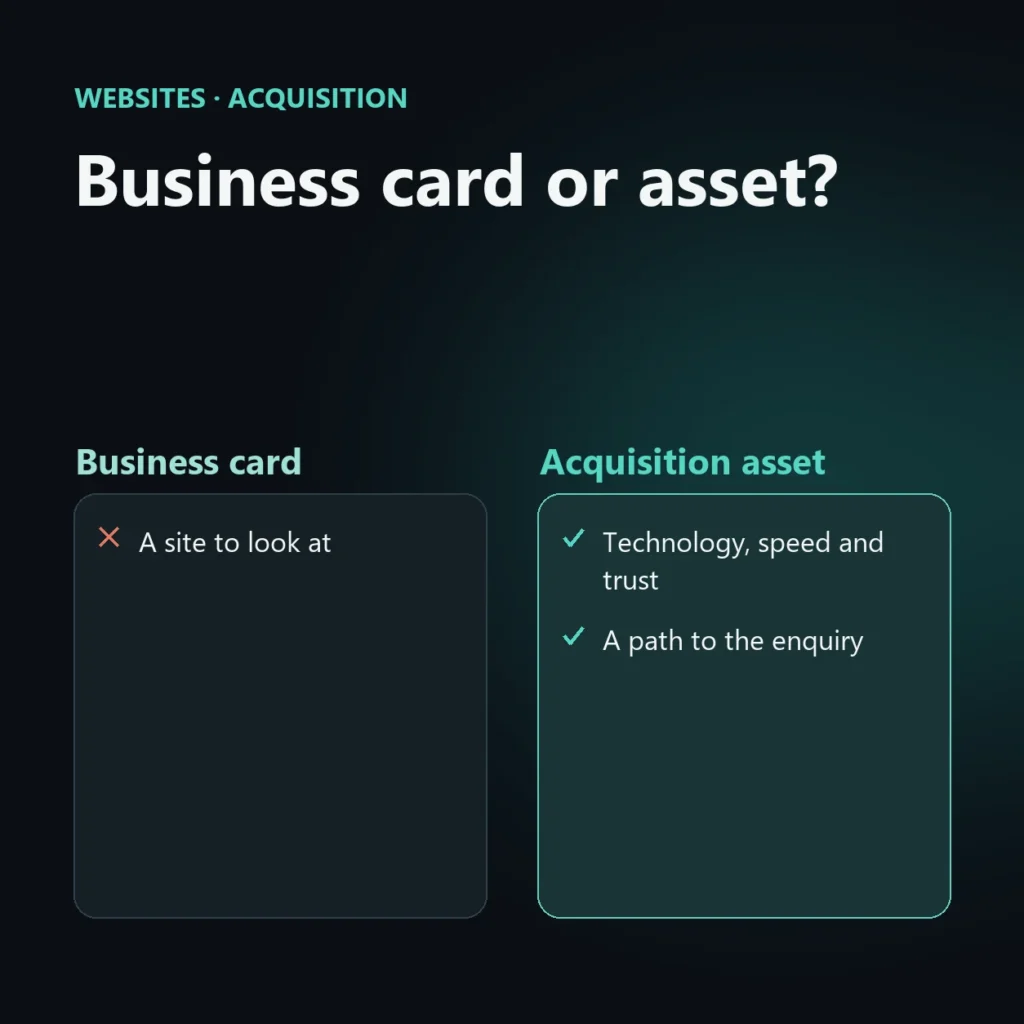
A website is not a digital business card: it is a customer acquisition asset that works for the company every day, even when nobody is actively looking after it. The difference between the two views is not terminological, but strategic: those who see the site as a static showcase invest once and forget it, those who see it as an acquisition channel design it, measure it and optimize it over time. In a market where most purchase decisions start with an online search, this distinction determines who stays visible and who disappears. A customer acquisition website doesn’t come about by chance: it comes from precise choices about structure, content, technology and measurement.
Why the «business card» model is no longer enough
For years the company website was conceived as a mandatory presence: a home page with about us, services and contacts, published and then left to itself. This approach made sense when traffic came from trade fairs, word of mouth and printed directories. Today the starting point of most commercial searches is a search engine or a conversational assistant, and a static site has nothing to say to someone looking for a specific solution.
The problem isn’t aesthetic. A site can be graphically polished and still be a business card: nice to look at, useless to use. What makes the difference is the ability to intercept a search intent and guide it toward a concrete action. If the site doesn’t answer a real question with a dedicated page, it generates no leads, no matter how pleasant it is.
An acquisition asset, on the contrary, is designed to be found, understood and chosen. Every page has a job: answer a need, anticipate an objection, bring the user one step closer to a contact request. This logic turns the site from a fixed cost into an operational marketing and sales tool.
The characteristics of a customer acquisition website
A site oriented toward acquisition is recognized by a few recurring structural elements. They are not tricks, but architecture and content choices that respond to how people search for and evaluate a supplier.
Architecture by intent, not by company department
Many sites are organized following the internal org chart: one page for each service, one for each location, one for the company history. Users, however, don’t think in departments: they think in problems. A customer acquisition website builds pages around the questions people type, not around how the company is structured. This means pages dedicated to specific problems, not just generic service categories.
The practical consequence is that the site intercepts more precise searches, with a clearer intent and therefore a higher probability of conversion. A page that answers a precise question converts better than a generic home page, because it speaks exactly to whoever has that problem at that moment.
Content that anticipates objections
A good acquisition site doesn’t just list what the company does: it explains why do it, how the process works, what to expect, what the timelines and limits are. Anticipating objections before they become silent doubts is one of the most underrated conversion levers. Readers want to understand whether they can trust you, whether the supplier has experience in their sector, whether the path is clear.
This type of content has a double effect: it improves direct conversion and feeds visibility on search engines and AI assistants, which reward pages able to answer completely and in a structured way. A custom website built on the real needs of the target audience starts precisely from this analysis of questions and objections.
Clear and measurable conversion paths
Every page must have an obvious next action: request a quote, book a call, download a resource, write a message. If users have to hunt for how to contact you, the site is working against you. Paths must be few, clear and consistent with the awareness level of whoever arrives.
Measurement must be added to clarity. Without data you don’t know which pages bring leads and which don’t, which keywords work and where users drop off. A customer acquisition website is a living tool, which corrects itself based on what the data shows.
Technology, speed and trust: the invisible foundations
There is a part of the site that users don’t see but perceive: loading speed, stability, security, consistency between what a page promises and what they find. These technical elements affect position in search results and the decision to stay or leave.
A slow or unstable site loses visits before the user has even read a word. Likewise, the clarity of trust signals — verifiable contacts, transparent company information, consistency between the site and presence on external channels — builds the credibility needed for someone to leave their details. Trust is not a graphic detail: it is a technical and content condition of acquisition.
In this scenario, working with those who deal with website creation with an approach oriented to search and conversion changes the starting point: you don’t build a «beautiful» site, you build a tool that brings leads.
Operational differences between a business card and an acquisition asset
The table below summarizes the main differences between the two models, to understand which of the two your company’s current site falls into.
| Dimension | Business card | Customer acquisition asset |
|---|---|---|
| Goal | Being online | Generating qualified leads |
| Structure | A few generic pages | Pages by search intent |
| Measurement | Absent or sporadic | Continuous, with defined objectives |
| Evolution | Rare updates | Periodic data-driven optimization |
| Role in the company | Fixed cost | Managed acquisition channel |
The table isn’t meant to classify, but to orient. Many sites find themselves halfway: they have some well-cared-for pages and others neglected, they measure only generic traffic and not leads. The shift from one model to the other is gradual and starts from a simple question: which pages are actually bringing customers?
How to turn your current site into an acquisition asset
The transformation doesn’t necessarily require a total rebuild. It is often better to start from an analysis of what already exists: which pages receive traffic, which convert, which keywords bring visits but not leads. From there you decide what to optimize, what to rewrite and what to delete.
The second step is filling content gaps: identifying the questions the audience asks that the site doesn’t address, and creating dedicated pages. Every content gap is an opportunity left to a competitor. The third step is making conversion paths explicit and measurable, linking every page to a clear action.
This work requires method and consistency. At this point it is useful to request a consultation to understand which interventions have priority and which can wait, avoiding scattering resources on changes that don’t affect leads.
Frequently asked questions about a customer acquisition website
What is the difference between a showcase site and an acquisition site?
A showcase site presents the company, an acquisition site is designed to intercept specific searches and lead the user to a concrete action, with dedicated pages and measured conversion paths.
Do I need to rebuild the whole site to make it an acquisition asset?
Not always. You often start by optimizing existing pages and adding targeted content, resorting to a complete rebuild only when the base structure can’t support growth.
How long does it take to see concrete results?
It depends on the starting point and on the sector. Technical and conversion interventions give signals more quickly, while organic visibility requires a longer, steadier path.
Is the site alone enough to bring customers?
The site is the pivot, but it must be integrated with external channels, content and measurement tools. Alone, without strategy and without updates, it hardly produces lasting results.
How do you measure whether the site is acquiring customers?
You measure the leads generated, not just visits: quote requests, bookings, messages. Every page should be linked to a verifiable goal.
Why does site speed matter for acquisition?
A slow site loses users before they read the content and worsens the position in search results, reducing contact opportunities even before conversion.
Is your site not bringing customers?
If the site is just a showcase that nobody finds and nobody contacts, the problem isn’t traffic: it’s how it was designed. A site that doesn’t intercept the right searches and doesn’t guide those who arrive toward a contact remains a cost, not an asset. I start here: structure, content and conversion paths built to turn visits into real requests. It’s how the site stops being a business card and starts working for you.
SEO, GEO and AEO specialist
Related articles
 Website CreationHacked WordPress site: anatomy of a real caseOctober 5, 2026
 Website CreationFrom site to funnel: how to design a path that convertsSeptember 24, 2026
 Website CreationSpeed, usability and SEO: the three technical pillars no site can ignoreSeptember 24, 2026
Explore by topic