
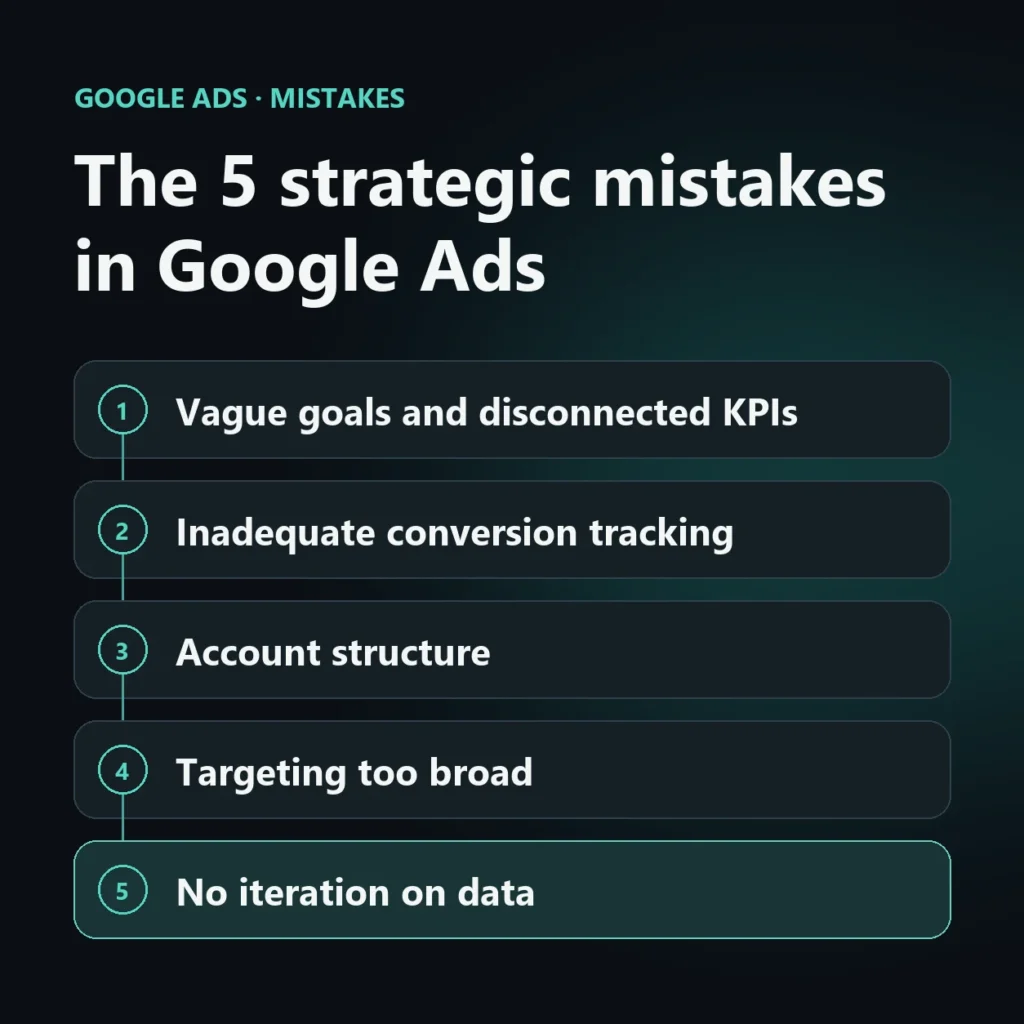
The most common Google Ads mistakes almost never originate from the platform, but from strategic choices made upstream. When a campaign brings no results, the temptation is to blame the algorithm, the budget or the competition. In most cases, however, the problem lies in a confusing account structure, in poorly defined objectives or in approximate conversion monitoring. In this guide I analyze the five strategic mistakes I see most often during my audits and, above all, how to fix them before they burn budget and trust in the channel.
Why Google Ads campaigns stop working
Before listing the recurring Google Ads mistakes, it is worth clarifying one thing: Google Ads is a system that amplifies what you give it as input. If the strategy is weak, the platform won’t save it. If the strategy is solid, the platform scales it. The breaking point, therefore, is almost never technical but decisional.
Many companies come to me after months of campaigns that are «on but stuck»: budget spent, clicks collected, but no real growth. Often the problem is that nobody ever questioned the initial objectives. You keep tactically optimizing a setup that, strategically, is already wrong. And this is where Google Ads mistakes silently accumulate.
Recognizing these mistakes requires an outside view and a reading of the data that goes beyond the platform’s automatic report. It is the kind of work I do when I start with a structured Google Ads audit, before touching any setting.
Mistake 1: vague objectives and KPIs disconnected from the business
The first of the Google Ads mistakes is also the most trivial and the most devastating: not having defined what «works» means. If the objective is «bring traffic» or «increase sales» without numbers, thresholds and accountability, the account becomes a container of activities with no direction. Campaigns run, reports get compiled, but nobody can say whether they are really contributing to the company’s results.
A useful objective is specific, measurable and tied to a business metric, not a vanity metric. Impressions and clicks are intermediate indicators: they count only if linked to qualified leads, quote requests, purchases or sign-ups. Without this link, every optimization becomes arbitrary.
How to translate objectives into operational KPIs
The practical step is simple: for each campaign there should be a main conversion action, a value assigned to that conversion and an acceptable cost threshold. If you don’t know how much a lead is worth, you can’t know whether you are paying too much for it. Many companies discover they don’t have this information when they start working seriously on Google Ads mistakes, and it is the first knot to untie.
Mistake 2: unreliable or missing conversion tracking
Without reliable data, every decision is a gamble. The second of the Google Ads mistakes is exactly this: campaigns optimized on conversions that aren’t tracked correctly, or tracked in duplicate, or attributed to multiple channels at once. The result is an account that «looks» performant when in reality it isn’t, or that looks stuck while it is generating value.
The conversion tracking is the backbone of any paid strategy. If it is broken, the algorithm learns from the wrong signals and distributes the budget toward the wrong audience. It is a mistake that propagates into every corner of the account and that no bid optimization can compensate for.
The typical signs of compromised tracking
Some warning bells recur: conversions that all arrive at the same instant, numbers that don’t match the CRM, anomalous spikes after site changes, or campaigns that report more conversions than the real leads received. When these signs appear, the priority is not to raise the budget but to stop and rebuild the measurement.
Mistake 3: account structure that doesn’t reflect the strategy
The third of the Google Ads mistakes concerns architecture. Accounts with hundreds of keywords crammed into a few groups, generic ads that speak to everyone and no one, campaigns that mix different intents: all of this makes it impossible to understand what works and what doesn’t. Structure is the grammar of the account: if it is confused, the message doesn’t get through.
A good structure separates search intents, assigns each group a clear theme and builds ads consistent with the queries. This doesn’t mean over-fragmenting, but ensuring every euro spent can be traced back to a precise logic. Without this clarity, even a substantial budget is scattered.
When restructuring is better than optimizing
If after months of optimizations results don’t change, the problem often isn’t in individual settings but in the overall setup. In these cases insisting on micro-changes is wasted time: you need a top-down review. This is the moment when a Google Ads consultant can help distinguish what needs correcting from what needs rebuilding.
Mistake 4: targeting that is too broad or poorly segmented
The fourth of the Google Ads mistakes is targeting. Campaigns open to the whole world, with no geographic distinction, no exclusion of irrelevant queries, no audience criteria consistent with the funnel. The result is a flow of clicks that looks promising but doesn’t convert, because it intercepts people far from purchase intent.
Targeting isn’t just geography and keywords: it also concerns the match type, exclusions, devices, hours and audience segments. Every choice should be justified by a verifiable hypothesis. When targeting is random, the data that derives from it is random too, and optimization becomes blind.
The role of exclusions in traffic quality
Exclusions are often neglected, yet they are one of the most powerful tools for improving traffic quality. Excluding irrelevant queries, ambiguous terms and geographic locations outside the market reduces waste and improves consistency between ad and search intent. It is boring but high-impact work, which distinguishes mature accounts from improvised ones.
Mistake 5: no data-driven iteration
The last of the Google Ads mistakes is cultural: treating the campaign as a system to switch on and forget. Google Ads is not a switch, it is a system that requires cycles of testing, data reading and continuous adjustments. Those who don’t iterate end up with an account frozen on decisions made months before, in a context that has since changed.
Iterating means formulating hypotheses, testing them on a small scale, measuring the effect and deciding whether to scale or abandon. It also means accepting that some ideas won’t work. The difference between an account that grows and one that stagnates isn’t in the number of changes, but in the quality of the learning cycle that governs them.
To get your bearings, it can be useful to compare the most common approaches and understand where your own account stands.
| Approach | Typical signal | Main risk | Recommended intervention |
|---|---|---|---|
| Campaigns on with no KPIs | Rich reports, no decisions | Wasted budget | Define objectives and conversion values |
| Approximate tracking | Numbers inconsistent with the CRM | Optimization on false data | Rebuild the measurement |
| Flat, confused structure | Keywords crammed together, generic ads | Impossible to tell what works | Restructure by intent |
| Broad targeting with no exclusions | Many clicks, few conversions | Unqualified traffic | Segment and add exclusions |
| No iteration | Account stagnant for months | Loss of competitiveness | Introduce testing cycles |
Frequently asked questions about Google Ads mistakes
Which is the most serious mistake among those listed?
Unreliable conversion tracking, because it compromises every subsequent decision and makes any optimization pointless.
How long does it take to tell whether a campaign works?
It depends on the available data volume, but in general you need a few weeks of collection before drawing reliable conclusions.
Can I fix Google Ads mistakes without rebuilding the whole account?
Often yes, but if the structure is compromised it is better to rebuild the setup instead of patching individual parts.
Why does targeting that is too broad hurt performance?
Because it intercepts users far from purchase intent, consuming budget on clicks that hardly ever convert.
Do I need an outside consultant to avoid these mistakes?
It isn’t mandatory, but an outside view helps spot problems that from the inside you tend not to see.
How often should a Google Ads campaign be reviewed?
At regular intervals, based on data volume and objectives, avoiding both neglect and continuous changes.
Google Ads that burns budget without bringing leads
You have active campaigns, clicks coming in, but the phone stays silent: the cost per acquisition rises and you don’t understand where the budget is lost. Often the problem isn’t the platform, but the account structure, conversion tracking or the match between ads and search intent. That’s where I step in: I analyze account, keywords, ads and tracking to find where leads are lost before reaching you. Before raising the budget, I find out what isn’t working.
SEO, GEO and AEO specialist
Related articles
 Google AdsGoogle Ads Competitor AnalysisOctober 30, 2026
 Google AdsAutomation and scripts in Google Ads: what is really worth automating (and what isn’t)September 24, 2026
 Google AdsLong tail and SMEs: why niche keywords are the best investmentSeptember 24, 2026
Explore by topic