
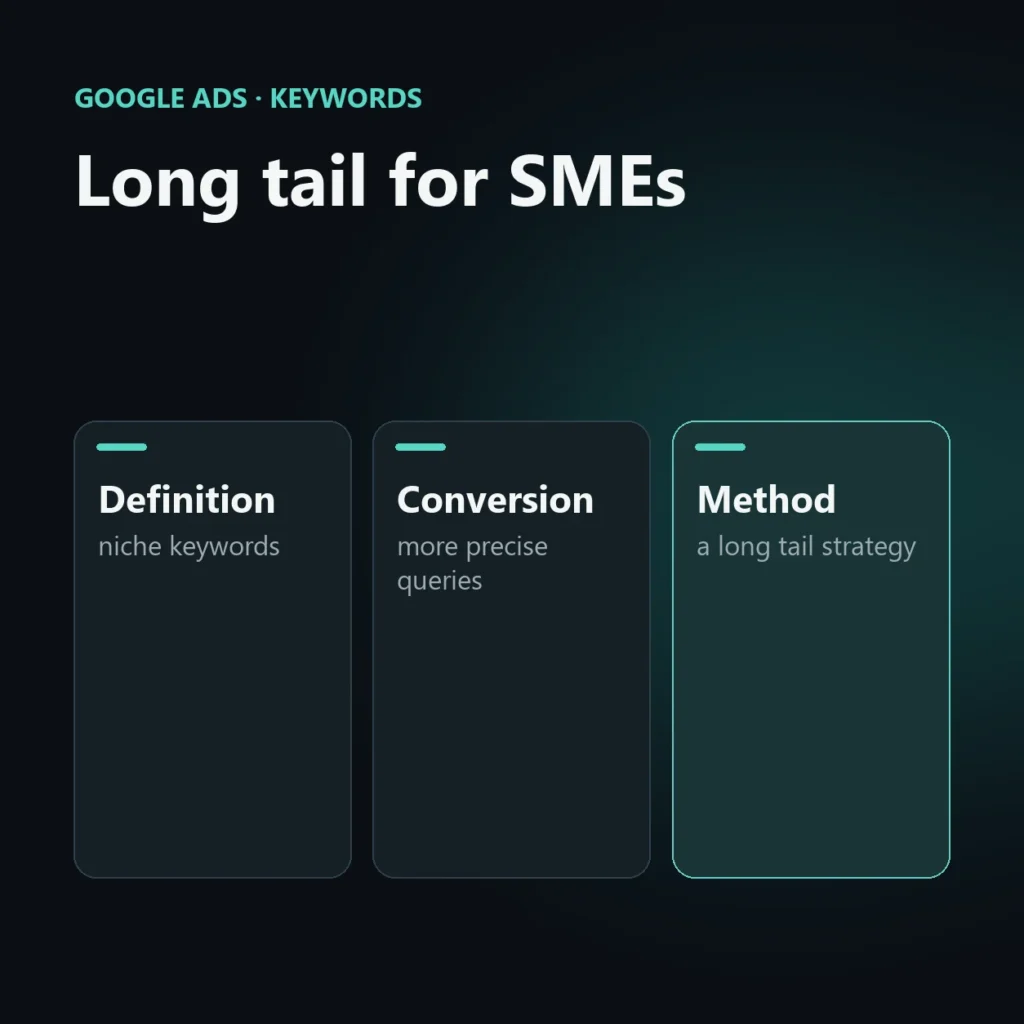
Long tail keywords for SMEs are very specific queries, often made up of three or more words, that generate limited search volume but a very clear purchase intent. While large companies fight over generic keywords, small and medium-sized businesses find in niche searches a competitive space where precision is worth more than volume. In this article we look at why investing in this type of query pays off, how to build a sustainable strategy and which mistakes to avoid.
What long tail keywords are and why they matter for an SME
Long tail keywords for SMEs are those long, detailed search strings a user types when they already have a fairly precise idea of what they are looking for. Think of someone who writes «condensing boiler repair north Milan area» instead of just «boiler». The monthly search volume of that query is low, but whoever formulates it has a concrete need and is often ready to contact a supplier.
For an SME this changes the rules of the game. Competing on generic terms means clashing with portals, marketplaces and companies with far larger visibility budgets. On long tails, instead, competition is fragmented and content relevance weighs more than domain strength. A small local or niche business can rank ahead of a giant simply because it answers that specific question better.
Then there is a cumulative effect worth understanding. Each single long tail keyword for SMEs brings little traffic, but the sum of dozens or hundreds of similar queries builds a steady, qualified flow. It is an asset that grows over time, unlike a paid campaign that switches off as soon as you stop funding it.
Why niche queries convert better
The main reason long tail keywords for SMEs perform well is search intent. Whoever writes a long query is expressing a need already at an advanced stage of their decision journey. They aren’t exploring a topic out of curiosity: they are looking for a solution, often with well-defined geographic, technical or budget constraints.
This translates into higher conversion rates and more relevant leads. A user who arrives at your site after searching for something very specific has fewer doubts and is more likely to become a customer. For an SME, which can rarely afford to scatter resources on poorly qualified traffic, the quality of the visitor counts more than the quantity.
The role of local and sector intent
Many long tail keywords for SMEs have a geographic or sector component that makes them even more valuable. Queries like «law firm specialized in corporate law in Bologna» or «supplier of custom packaging for e-commerce» intercept users looking for exactly that profile. Here the SME has a natural advantage: it knows the territory, the sector and the specific needs better than anyone else.
To build a list of these queries in a structured way you need methodical keyword research, able to cross volume, competition and intent data. Intuition isn’t enough: you need tools and judgment to tell the queries that bring customers from those that bring only visits.
How to build a sustainable long tail strategy
A strategy based on long tail keywords for SMEs can’t be improvised. The first step is mapping customers’ real needs, starting from the questions you receive every day by phone or email. Those questions are already queries: turning them into content means answering whoever searches for the same things online.
The second step is organizing content into topic clusters. Instead of writing disconnected articles, you build a main page on a topic and a series of in-depth pieces covering the variants of the query. This approach helps search engines understand what your site is about and strengthens your authority on a specific subject.
Content, local pages and product pages
The opportunities to cover long tail keywords for SMEs are several. Detailed service pages, blog articles that answer precise questions, product pages with accurate descriptions and pages dedicated to individual locations are all potential entry points. E-commerce can benefit too: a well-optimized product page intercepts those searching for that product with specific characteristics.
In a commercial context, tools such as Google Shopping amplify this work when product pages are curated down to the smallest detail, because niche queries find direct matches with precise titles and descriptions.
Measuring results without fixating on volume
One of the most common mistakes is judging a long tail keyword for SMEs only by its search volume. A query with a few dozen monthly searches can generate more leads than one with thousands, if the intent is right. The metric to watch is behavior: time on page, quote requests, contacts, conversions.
What you need, therefore, is patience and a reading of the data oriented to business goals, not to simple ranking. Long tails build visibility gradually, but once consolidated they tend to remain stable over time.
Long tail and paid campaigns: when to integrate them
Long tail keywords for SMEs are not an alternative to advertising, but a complement. In paid campaigns niche queries often cost less and convert better, because auction competition is lower. An experienced Google Ads consultant knows that segmenting campaigns on long tails reduces waste and improves return on investment.
The ideal combination is this: SEO builds an organic presence over time on long tail keywords for SMEs, while paid campaigns cover the more competitive queries or test new segments before investing in content. The two levers feed each other, because campaign data reveals which queries really work.
The advantage for an SME is the possibility of starting small, measuring and then scaling. You don’t need an enormous budget: you need to understand which niches are worth it and cover them consistently.
| Keyword type | Search volume | Competition | Purchase intent | Suitable for an SME |
|---|---|---|---|---|
| Generic (one word) | High | Very high | Low or variable | Not much |
| Mid tail (two words) | Medium | High | Medium | Partially |
| Long tail (three or more words) | Low | Low | High | Very much |
| Local or sector long tail | Very low | Very low | Very high | Extremely |
Mistakes to avoid and good practices
The first mistake is chasing long tail keywords for SMEs by volume alone, choosing crowded queries that don’t reflect your positioning. Better a few queries truly consistent with what you offer, covered well, than many generic queries where you have nothing distinctive to say.
The second mistake is writing content that is all the same, repeating the same query on every page. Google rewards variety and depth: each piece of content must answer a slightly different question, so as to cover the whole spectrum of niche searches. The technical care of the site also matters, because a slow or hard-to-read page undermines the work on content.
Finally, don’t forget updating. Queries change, products evolve, customers use new words. Periodically reviewing the map of long tail keywords for SMEs and updating content keeps the strategy effective over time.
Frequently asked questions about long tail keywords for SMEs
What is the difference between generic keywords and long tail keywords?
Generic keywords are short and high-volume, long tail ones are longer, with low volumes but a much more precise search intent.
Can an SME really compete on long tail keywords?
Yes, because competition is fragmented and content relevance counts more than domain size or budget.
How many long tail keywords do you need to see results?
There is no fixed number: what matters is consistently covering the queries that match your customers’ real needs.
Do long tail keywords also work for e-commerce?
Yes, especially when product pages have detailed titles and descriptions that intercept users’ specific searches.
How long does it take to rank for a niche keyword?
It depends on competition and content quality, but in general long tails give signs of growth faster than generic terms.
Better SEO or paid campaigns on long tail keywords?
The two levers complement each other: SEO builds a lasting presence, advertising covers competitive queries and tests new segments.
The long tails nobody searches for (or almost)
If your SME focuses on only two or three generic keywords, you are fighting against competitors with budgets you don’t have. Long tail keywords, the ones users really type when looking for a supplier or a specific service in their area, often remain uncovered: nobody covers them, nobody optimizes them. The result is traffic that doesn’t arrive, or that arrives wrong. I start from the analysis of the real queries of your sector and your area, build a plan of long keywords consistent with your offer and integrate them into the page structure, so that every piece of content intercepts the right search.
SEO, GEO and AEO specialist
Related articles
 Google AdsGoogle Ads Competitor AnalysisOctober 30, 2026
 Google AdsWhen Google Ads doesn’t work: the 5 most common strategic mistakes (and how to avoid them)September 24, 2026
 Google AdsAutomation and scripts in Google Ads: what is really worth automating (and what isn’t)September 24, 2026
Explore by topic