
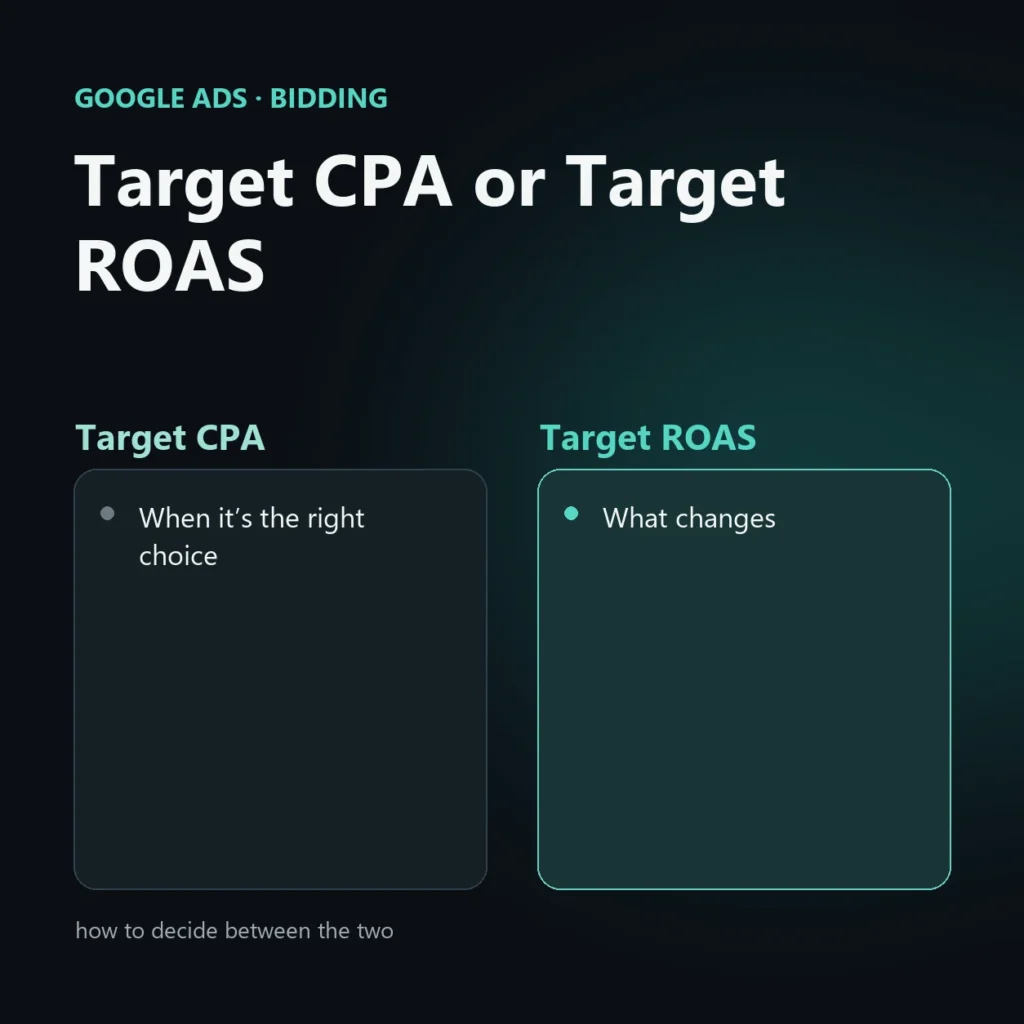
Target CPA is an automatic bidding strategy in Google Ads that tells the platform the maximum cost you are willing to pay to obtain a conversion. Together with target ROAS, it represents one of the two great tracks on which most modern performance campaigns move. Choosing badly between the two means paying too much for each lead or growing slowly without exploiting the budget’s potential. In this article we see how they work, when one makes sense and when the other, and how to connect them to a solid tracking strategy.
What it means to work with a target CPA
When you set a target CPA, you are telling Google Ads what cost per acquisition you consider sustainable. The algorithm uses auction-time signals — device, location, history, intent — to estimate the probability that a user will convert and adjusts the bid accordingly. The goal is not to pay as little as possible in absolute terms, but to get as close as possible to that average value, distributing the budget where the probability of conversion is highest.
The starting point is always history: without a sufficient flow of conversions, the system doesn’t have enough data to learn. This is why conversion tracking is not a technical detail, but the condition of existence of any automatic strategy. If conversions are duplicated, misattributed or filtered inconsistently, the target CPA works on a distorted reality and optimizes toward a goal that doesn’t match your business.
A second often underrated element is the choice of the target value. Setting it too low compared to historical reality leads to reduced impression volume and a slow learning phase; setting it too high means paying for conversions you would have obtained anyway. The correct logic is to start from an observed figure and then tighten progressively, not the other way around.
When target CPA is the right choice
The target CPA is the natural strategy when the value of each conversion is relatively uniform and known. Think of a quote request, a qualified lead, a demo sign-up: these are all events that, from an economic standpoint, are worth more or less the same to the company. In these cases optimizing on cost per conversion makes sense because there is no strong reason to prefer one conversion over another.
Typical contexts where it works best
B2B lead generation campaigns with a medium-to-long sales cycle, contact forms, consultation requests, newsletter sign-ups with strategic value. In all these scenarios the target CPA gives the system a clear, measurable goal, which you can compare with the average margin per customer to understand whether the campaign is sustainable.
A concrete advantage is how easy the result is to read: you know how much you are paying for each conversion and can reason in terms of break-even. The limit is that the system doesn’t distinguish between a ten-euro conversion and a thousand-euro one, because for the algorithm both are «one conversion». If your funnel produces events of very different value, this simplification becomes a problem.
What changes with target ROAS
Target ROAS (Return On Ad Spend) shifts the goal from cost per conversion to economic return. Instead of saying «I want to pay X for a conversion», you say «I want to get Y euros of revenue for every euro spent». It is the typical strategy of e-commerce and, more generally, of all contexts where every transaction has a trackable and variable value.
The practical difference is huge. With the target CPA, the system treats all conversions the same way; with target ROAS it can decide to pay more for a two-hundred-euro cart and less for a twenty-euro one, because the goal is to maximize overall value, not the number of conversions. This requires, however, that the conversion value be passed correctly to Google Ads, otherwise ROAS is calculated on incomplete data.
The role of data quality
Target ROAS is more sensitive to tracking quality than target CPA. An error in the conversion value ripples directly into bidding decisions and can lead to investing in less profitable segments. Before activating it, it is worth running a Google Ads audit to verify that values are consistent, up to date and free of duplicates.
There is also a matter of account maturity: target ROAS tends to perform better on accounts with significant volumes and an established history, where the algorithm has enough signals to estimate the expected value of each click.
Target CPA or target ROAS: how to decide in practice
The choice is not ideological, it is economic. If the value of your conversions is uniform, the target CPA is the most direct and transparent route. If instead conversions have very different values and you can track them reliably, target ROAS gives you finer control over profitability. In many mature accounts both strategies coexist, applied to different campaigns with different goals.
A frequent mistake is changing strategy too often. Every change partially resets learning and lengthens stabilization times. Before switching from a target CPA to a target ROAS, or vice versa, it is worth asking whether the problem is really the bidding strategy or whether it lies upstream, in the data or in the campaign structure. The same applies when comparing smart bidding vs manual bidding: the choice between automation and manual control follows similar logic, tied to the quality of the available signal.
A simple operational criterion
Always start from tracking, then from conversion value, then from volume. If you have few conversions per month, no automatic strategy will work well: better to focus on structure and creative. If you have volume and uniform values, the target CPA is the starting point. If you have volume and variable values, target ROAS becomes the choice most consistent with the margin objective.
| Aspect | Target CPA | Target ROAS |
|---|---|---|
| Optimized objective | Cost per conversion | Value per euro spent |
| Conversion value | Uniform or not tracked | Variable and tracked |
| Ideal context | Lead generation, forms, contacts | E-commerce, transactions |
| Dependence on tracking | Medium | High |
| Main risk | Treating different conversions the same way | Optimizing on wrong values |
Common mistakes and how to avoid them
The first mistake is setting a target CPA without a solid historical base. The starting value should reflect what you have actually observed, not what you would like to achieve. Once the system is stable, you can start tightening the target gradually and monitor the effect on volume and quality.
The second mistake is ignoring the conversion window. If your sales cycle is long, conversions arrive late and the target CPA looks worse than it is. In these cases it is useful to reason about consistent attribution models and adequate time horizons, instead of judging the campaign day by day.
The third mistake is forgetting the margin. A sustainable target CPA is not the one that lets you rest easy, but the one that leaves room for profit after product, service and management costs. Without this link to the company’s real economics, any optimization risks being technically correct and commercially useless.
Frequently asked questions about target CPA and target ROAS
What is the difference between target CPA and target ROAS?
Target CPA aims to contain the cost per conversion, target ROAS to maximize the value generated for every euro spent. The former is better suited to conversions of uniform value, the latter to conversions with different values.
Can I use target CPA on an e-commerce?
Yes, but only if you treat all transactions as equivalent. If cart values vary a lot, target ROAS is generally more consistent with the margin objective.
How many conversions do you need to activate an automatic strategy?
There is no universal threshold, but below a very low volume the algorithm struggles to learn. In these cases it is better to first increase the signal or work on broader campaigns.
Does target CPA also work with few conversions per month?
Hardly. With low volumes the system doesn’t have enough data to estimate the probability of conversion and the learning phase becomes long and unstable.
How often should the target value be changed?
Better to avoid frequent changes. Once learning has stabilized, it is best to intervene gradually and assess the effect over a sufficiently long time span.
Does target CPA guarantee that I will never exceed that cost?
No. It is an average goal, not a rigid ceiling. The cost per conversion can fluctuate above or below the set value depending on auctions and the period.
The Target CPA that never stabilizes
You’ve set a Target CPA or a target ROAS on Google Ads, but campaigns stay unstable: some weeks they perform, others they burn budget with no explanation. The problem is almost never the number you chose, but the way automatic bidding strategies are configured, fed and put in competition with each other. I start right here: I analyze how you are feeding the system, which signals you are giving the algorithm and where the settings work against your margins. Then I build a setup that holds.

SEO, GEO and AEO specialist
Related articles
 Google AdsGoogle Ads Competitor AnalysisOctober 30, 2026
 Google AdsWhen Google Ads doesn’t work: the 5 most common strategic mistakes (and how to avoid them)September 24, 2026
 Google AdsAutomation and scripts in Google Ads: what is really worth automating (and what isn’t)September 24, 2026
Explore by topic