
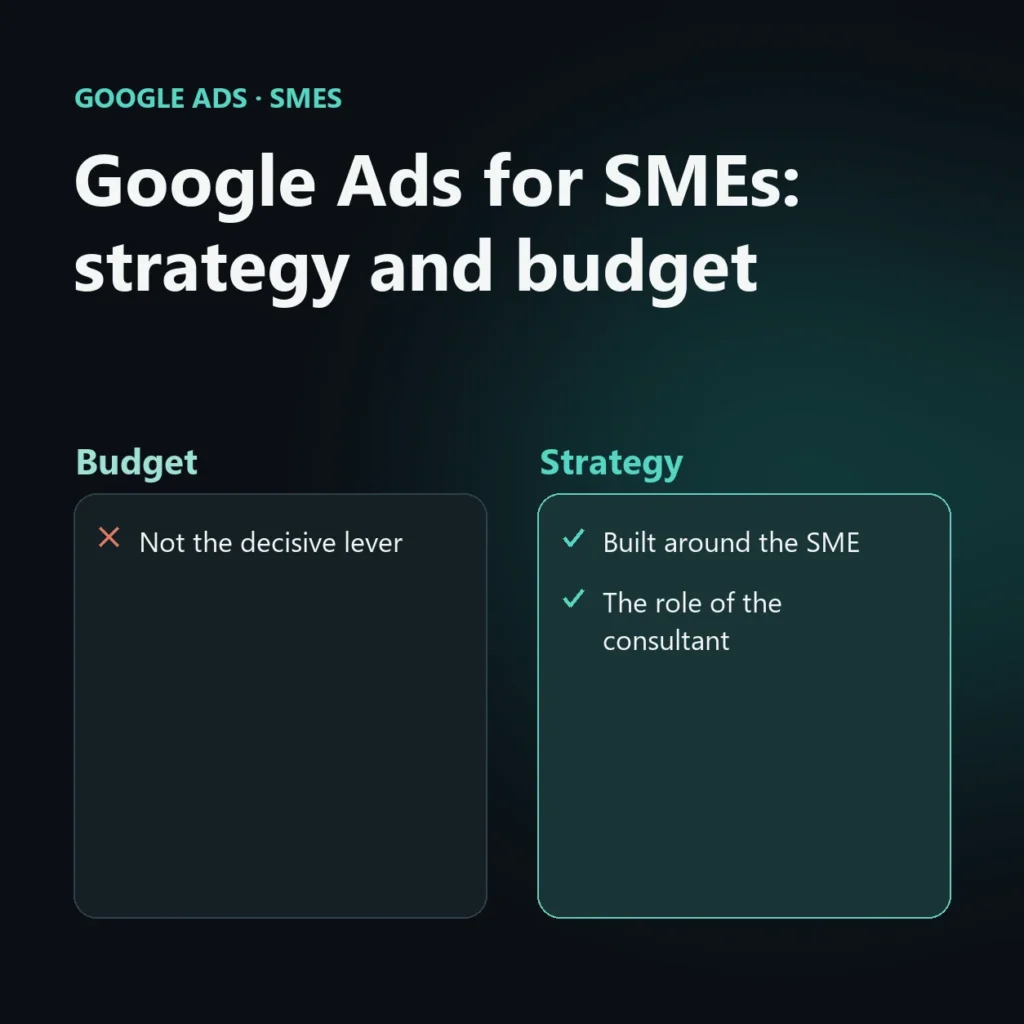
For Italian small and medium-sized businesses, Google Ads isn’t a question of how much you spend, but of how you spend it. Budget alone doesn’t generate qualified leads: without a coherent campaign structure, without a reasoned keyword selection and without continuous conversion monitoring, even substantial advertising spend ends up scattered. That is why thinking in terms of strategy, before even thinking about figures, is the difference between those who invest in online advertising and those who get concrete results.
Budget is not the decisive lever for an SME
When a small business first approaches Google Ads for SMEs, the recurring question is almost always the same: how much should I spend per month? It is a legitimate question, but framed backwards. The starting point is not the available amount, but the commercial objective: bringing quote requests, generating sign-ups, selling a specific product, covering a geographic area. Only after clarifying this can you understand which investment makes sense.
A well-built campaign with a modest budget can outperform a messy campaign with far greater resources. The reason is simple: Google Ads is an auction in which ad quality, landing page relevance and account history come into play. A well-structured account pays less per click and receives more qualified traffic. A neglected account, on the contrary, burns budget on irrelevant terms and on ads nobody clicks.
For this reason, for an SME, the most important cost item is not the media budget but the time and expertise invested in planning. Relying on a structured Google Ads management means starting from an analysis of the reference market, defining priorities and translating them into measurable campaigns.
Where wasted budgets go
The causes of waste are recurring and almost always the same. Keywords that are too generic that attract the curious and not buyers. Ads written once and never reviewed. Landing pages that don’t match the ad’s promise. No tracked conversions, which makes it impossible to understand what works. Campaigns running at night or on days when the company can’t answer requests.
Each of these elements, taken individually, looks like a detail. Added together, they turn an advertising investment into spending with no return. Correcting these mistakes doesn’t require more budget, it requires method.
Building a tailored Google Ads strategy for the SME
An effective strategy for Google Ads for SMEs starts with funnel mapping. Not all users are ready to buy at the same moment: some are looking for a problem, some are comparing solutions, some are looking for the supplier. Distinguishing these stages lets you assign each the right message and the right budget.
The second step concerns the choice of formats. Search, Display, Performance Max, YouTube, Shopping: each format has a function. An SME selling local services is unlikely to benefit from a Display campaign spread across all of Italy, while it can gain a lot from a Search campaign restricted to its own catchment area. Conversely, an e-commerce with a large catalog finds in Shopping and Performance Max campaigns its natural ground.
Geographic segmentation and targeting
For SMEs, territory is often the most underrated variable. Correctly delimiting the areas served, excluding the areas not covered, calibrating the radius of action based on operational capacity: these are choices that directly affect lead quality. A craftsman working in one province has no interest in showing ads across the whole region, because it would generate requests he can’t satisfy.
The same goes for hourly scheduling. If requests are handled during office hours, it makes sense to concentrate spend in those time slots, or to set up automatic replies outside hours. These are measures that cost nothing and noticeably improve performance.
Measuring what really matters
A Google Ads account without conversion tracking is an account flying blind. For an SME it is essential to define in advance which actions count: submitting a form, a phone call, a click on the email address, a completed purchase. Only then can you understand which campaign brings value and which one consumes resources without results.
Tracking must be set up before raising the budget, not after. Without reliable data, any investment decision becomes a gamble. For this reason a Google Ads audit is often the most sensible starting point: it highlights what works, what doesn’t and where to intervene first.
The role of the consultant and of in-house expertise
Many SMEs manage Google Ads on their own, often entrusting the task to a person who already has other duties. It is an understandable choice, but it has a limit: advertising platforms change continuously and require constant updating. A Google Ads consultant brings cross-sector experience across different industries, knows the most common pitfalls and knows where to intervene first.
The value of expert consulting is not measured only in time saved, but in the ability to avoid costly mistakes. A badly set up account can take months to recover, and in the meantime the budget has been lost. Having a competent reference means proceeding with more confidence and with an overall vision that is hard to develop by managing a single account.
This doesn’t mean every SME must outsource everything. In many cases the best combination is shared management: the consultant defines strategy and structure, the company keeps control over commercial decisions and communication. It is a balance that works well when roles are clear.
When it makes sense to increase the budget
The budget should be increased when the machine is already efficient. If campaigns bring leads at a sustainable cost, if the conversion rate is satisfactory, if the company can handle the volume of requests, then investing more makes sense. Conversely, increasing the budget on an inefficient structure only amplifies the waste.
It is a counterintuitive but solid principle: first you optimize, then you scale. SMEs that follow this order get more stable and predictable results over time, while those who chase volume without solid foundations tend to be disappointed and abandon online advertising.
| Approach | Priority | Effect in the medium term |
|---|---|---|
| Budget as the starting point | Increasing spend to get more visibility | Rising costs, poorly qualified leads |
| Strategy as the starting point | Defining objectives, audience and measurement | More relevant leads, cost per result under control |
| Reactive management | Intervening only when results drop | Lost opportunities and budget that is hard to recover |
| Structured management | Continuous monitoring and periodic optimization | Gradual, sustainable growth of the account |
To understand what Google Ads really is, it is worth recalling the definition of its nature:
«a platform that lets you place advertising spaces within Google search pages, on its properties such as YouTube, Maps, Discover and on third-party sites and apps» — Wikipedia, entry “Google Ads”
This breadth of channels is precisely what makes strategy indispensable: with so many possibilities available, choosing where not to be present becomes as important as choosing where to be.
Frequent mistakes in SME campaigns
The first mistake is treating Google Ads for SMEs as a channel separate from the rest of marketing. Ads must dialogue with the site, with the content, with organic presence on search engines and with social profiles. When these elements are disconnected, the user perceives a fragmented experience and conversion suffers.
The second mistake is lack of patience. Google Ads is not a switch: it takes time to collect data, to test ads, to understand which keywords convert. Those who stop campaigns after a few weeks don’t have the material time to read the results. You need an adequate observation window before drawing conclusions.
The third mistake is ignoring the landing page. Even the perfect ad fails if it lands on a slow, unclear page or one inconsistent with the promise. The landing page is an integral part of the campaign, not an accessory element.
Frequently asked questions about Google Ads for SMEs
How much budget do you need to start with Google Ads?
There is no figure valid for everyone: it depends on the sector, the competition and the objectives. It is more useful to start from a modest budget and check the results before increasing.
Can an SME manage Google Ads on its own?
Yes, especially if it has time and a person with basic skills. However, without constant updating, the risk of mistakes and waste remains high.
How long does it take before seeing results?
The first indications come after a few weeks of data collection. For solid evaluations you generally need a few months of observation and optimization.
Which is better for an SME, Search or Performance Max?
It depends on the objectives. Search is more controllable and suited to local services, Performance Max works well with large catalogs and sales goals.
What changes between in-house management and external consulting?
In-house management ensures direct control, external consulting brings experience across multiple sectors and a broader view of effective strategies.
How do you tell whether campaigns are working?
Through conversion monitoring: if leads arrive at a sustainable cost and are relevant, the campaign is working well.
Google Ads budget that burns without leads
If you run an SME, the problem is not the platform itself: it is watching the Ads budget being consumed month after month on costly clicks, off-target search queries and campaigns set up without an underlying strategy. That way the advertising investment becomes an expense that is hard to justify, while competitors keep intercepting your customers. This is exactly where I step in: I analyze the account, campaign structure, keywords and landing pages, then I build a Google Ads setup designed for your local market and for concrete business objectives, not for filling reports.
Keep reading
SEO, GEO and AEO specialist
Related articles
 Google AdsGoogle Ads Competitor AnalysisOctober 30, 2026
 Google AdsWhen Google Ads doesn’t work: the 5 most common strategic mistakes (and how to avoid them)September 24, 2026
 Google AdsAutomation and scripts in Google Ads: what is really worth automating (and what isn’t)September 24, 2026
Explore by topic