
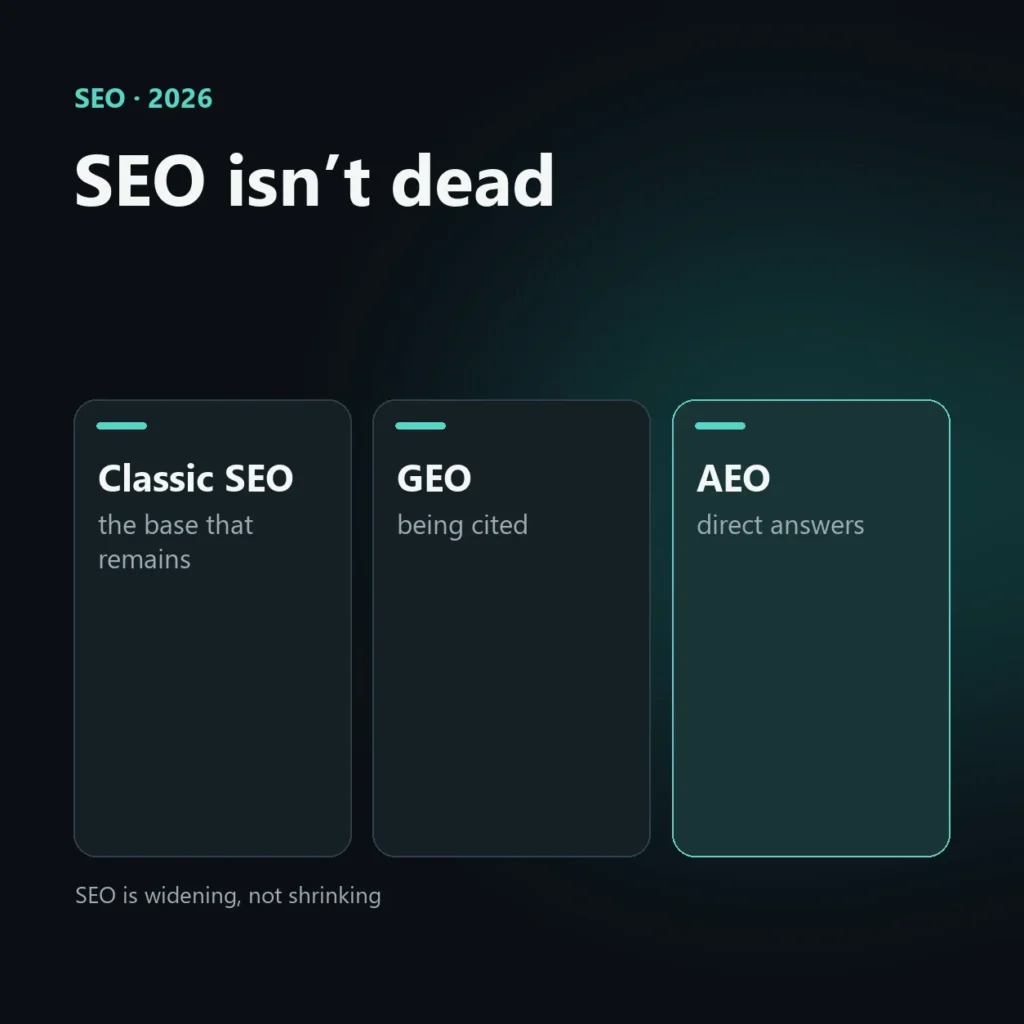
SEO is not dead: it has become something else, a system of signals designed to be understood both by search algorithms and by generative engines. Anyone who still pictures search engine optimization as a list of tricks for climbing the rankings is missing the deepest transformation of recent years. What used to be a game of rankings has become a job of clarity, authority and content structure. SEO in 2026 doesn’t reward whoever shouts loudest, but whoever makes themselves understandable, verifiable and citable. In this article we look at why the discipline is alive, how it has changed and what to do in practice to stay visible in an ecosystem where answers increasingly arrive before the click.
The false myth of the death of SEO
Every time a search engine changes its interface or introduces a new answer format, someone declares the end of SEO. It happened with featured snippets, with voice answers, with conversational assistants and now with summaries generated by artificial intelligence. Yet the underlying question has never changed: people look for information, solutions and products, and someone has to organize that content so that it can be found. As long as that need exists, there will be a discipline that takes care of it.
What has really changed is the endpoint of visibility. Once the goal was to appear in a list of ten blue links. Today the answer can be a summary, a panel, a block generated in real time. SEO in 2026 is no longer measured only in rankings, but in presence: being cited, summarized, linked as a source. It is a change of metric, not the end of a profession.
Those who have built solid, well-structured content over time find themselves at an advantage today, because the systems that generate answers rely on exactly those clear and reliable sources. Those who bet only on technical shortcuts, on the other hand, are discovering that shortcuts no longer work. SEO in 2026 is therefore a natural selection: whoever has something real to say survives.
From keywords to understanding context
For years SEO was synonymous with keywords: finding the right word, repeating it, optimizing its density. That model has faded because modern search engines no longer reason in isolated words, but in intents and semantic relationships. They understand the context of a sentence, the relationship between concepts, the implicit meaning of a question.
In SEO in 2026 the unit of work is not the keyword but the topic, that is, the subject with all its nuances. Content that covers a topic well, linking related questions and anticipating doubts, performs better than ten pages repeating the same phrase. This explains why pilot keywords remain useful as a compass, but not as a cage.
Entities, not text strings
Engines reason in entities: people, places, companies, concepts, products. When your content clearly defines the entities it talks about and relates them, it becomes easier for the machine to understand what you are covering. This is why good information structure is worth more than obsessive repetition.
Working on entities also means building consistency across pages, structured data and external mentions. It is less visible but more lasting work, which makes the site a recognizable source on a specific topic. It is one of the pillars ofcontent authority (E-E-A-T), which ranking systems use as a trust signal.
GEO and AEO: SEO widens, it doesn’t shrink
SEO in 2026 doesn’t end with traditional search. Alongside Generative Engine Optimization and Answer Engine Optimization, the work extends to generative engines that compose answers from multiple sources. Here the logic changes: you don’t just have to be found, you have to be chosen as material for synthesis. And to be chosen you have to be clear, verifiable and well organized.
This doesn’t mean abandoning classic SEO, but widening it. The same content that ranks well also tends to be cited well, because they share the basic requirements: structure, authority, direct answers to questions. The two disciplines feed each other, and those who treat them as separate worlds lose opportunities.
Writing to be cited
Being cited by a generative engine takes some care. Key information must be explicit, not scattered across long sentences. Definitions must be sharp. Data must be attributable. In short, the content has to work both for a person skimming and for a machine extracting. This is the heart of citations in generative engines.
A text well made for SEO in 2026 answers a question in the first lines, then goes deeper. It doesn’t make the reader wait, it doesn’t bury the answer under useless preambles. This writing discipline is now a concrete competitive advantage.
Structured data and clarity for machines
Structured data remains a valuable tool, not a trick. It helps engines understand the type of content and present it in the right format. A practical example is FAQ schema for AEO, which makes the questions and answers on the page explicit. It is not a shortcut to rank, but a way to reduce ambiguity.
The logic is simple: less ambiguity means more trust, and more trust means a higher chance of being used as a source. In SEO in 2026 structured data is not a technical extra, but part of the writing itself.
What distinguishes content that works today
If we had to reduce SEO in 2026 to a few operating principles, the first would be the direct answer. Content that works says right away what it is about and why it is useful. The second is proof: real experience, concrete examples, verifiable sources. The third is structure: clear headings, logical sections, information that is easy to extract.
To these is added consistency over time. A site that publishes regularly on a topic, updates its content and keeps a recognizable tone builds an identity that systems learn to trust. SEO in 2026 rewards consistency more than an isolated stunt.
Finally, the human dimension matters. Content written for people, with natural language and a clear idea, tends to perform better for machines too, because clarity is a shared value. This is the central point of Google’s guidelines.
«Google’s ranking systems aim to reward original, high-quality content that demonstrates qualities of what we call E-E-A-T: expertise, experience, authoritativeness, and trustworthiness.» — Google Search Central Blog, “Google Search’s guidance about AI-generated content”, Feb. 2023
Classic SEO, GEO and AEO compared
To get oriented it helps to see the differences between the three perspectives, which converge in practice but have different goals and metrics. The table below summarizes the points of contact and the main distinctions.
| Dimension | Classic SEO | GEO | AEO |
|---|---|---|---|
| Main goal | Rank in search results | Be cited in generative answers | Provide direct, structured answers |
| Typical metric | Position, clicks, impressions | Citations, mentions as a source | Presence in snippets and panels |
| Ideal format | Page optimized for intent and query | Clear, verifiable, well-segmented content | Explicit question and answer |
| Key signal | Relevance and authority | Clarity and reliability of sources | Structure and machine-readable data |
As you can see, the three perspectives don’t exclude each other. Content well made for SEO in 2026 tends to satisfy all three, because it shares the same foundations: clarity, structure and authority. What changes is how success is measured, not the substance of the work.
Frequently asked questions about SEO in 2026
Is SEO really dead with the arrival of artificial intelligence?
No. It has changed: SEO in 2026 is about being found, understood and cited, not just climbing rankings. The demand for well-organized content remains central.
What is the difference between SEO, GEO and AEO?
SEO works on traditional search results, GEO on citations in generative engines, AEO on direct answers. In practice they overlap and share the same foundations.
Are keywords no longer needed?
They are needed as a compass, not as a cage. The topic, the intent and the relationships between concepts matter more than repeating a single phrase.
Why is E-E-A-T so important today?
Because ranking systems and generative engines reward content that shows expertise, experience, authoritativeness and trustworthiness. Without these signals it is hard to be considered a reliable source.
Does structured data still help?
Yes, especially to reduce ambiguity and make questions and answers explicit. It is not a shortcut, but a clarity tool useful for SEO in 2026.
Where do you start to adapt?
With clear content that answers a real question right away, with a readable structure, verifiable sources and constant updates over time.
SEO is not dead: it is your visibility model that has aged
If you keep measuring ranking on the ten blue positions, the problem isn’t Google: you are reading a change of nature through yesterday’s lens. Today visibility is built across search, generated answers and citations in the sources that assistants use to respond. That is exactly where I start: I analyze how you are found and cited, I rebuild the content and the entities your authority rests on, and I tell you where you are losing ground. A method, not a promise.
SEO, GEO and AEO specialist
Related articles
 SEOContent Gap Analysis: What Competitors Write and You Don’tOctober 30, 2026
 SEOBacklink Gap: Analyzing Competitor LinksOctober 30, 2026
 SEOHow to Find Your Real SEO CompetitorsOctober 30, 2026
Explore by topic