
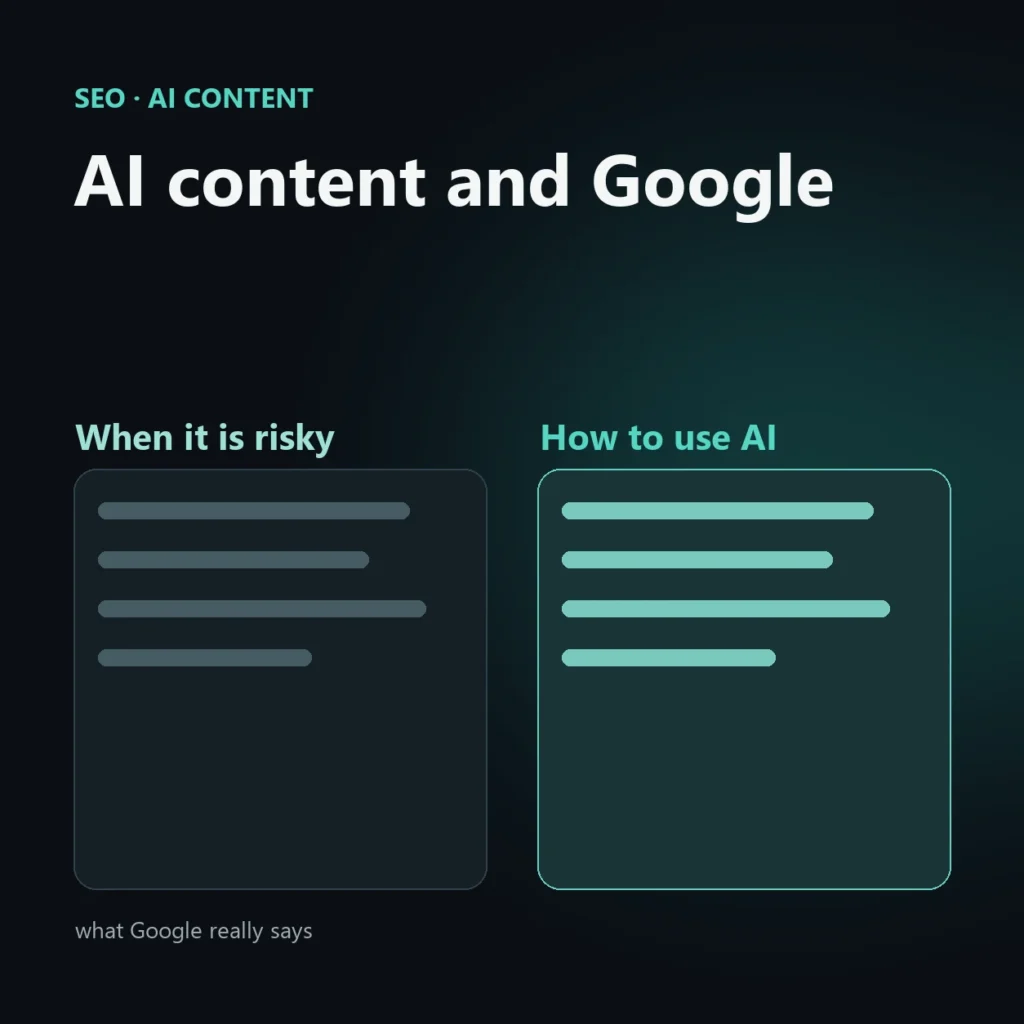
Google doesn’t penalize content just because it was generated with artificial intelligence: it penalizes low-quality content created mainly to manipulate rankings, regardless of who or what wrote it. It is an important distinction that is often misunderstood.
What Google really says about AI content
In its official documentation on AI-generated content, Google makes clear that the evaluation criterion is always the quality of the content according to the E-E-A-T principles (Experience, Expertise, Authoritativeness, Trustworthiness), not the method of production. Content written with AI but accurate, verified and useful can rank well; content written entirely by a human but superficial or inaccurate can be penalized anyway.
When AI content really risks a penalty
Mass publishing without review
Generating hundreds of articles with AI without editorial control, often with factual errors or repetitive content, is the pattern that Google’s anti-spam updates hit hardest.
Content with no real added value
Articles that simply rephrase what already exists online, without original data, direct experience or their own perspective, risk being classified as low-utility content.
Unverified factual errors
Language models can generate plausible but false information (so-called “hallucinations”): publishing it without verification harms both rankings and the site’s reputation.
How to use AI in content without risk
The safest practice is to use AI as a first-draft or research-support tool, always subjecting the final text to human review, fact-checking and the addition of real experience — exactly the principle behind good work in optimized content creation.
Frequently asked questions about AI content and Google
Can Google tell whether a text was written by AI?
Google has never confirmed a detection system that is 100% reliable: it focuses on evaluating the quality of the final result, not the method of production.
Do you need to disclose that a piece of content was written with AI?
It is not a Google requirement, but it may be required by specific regulations (e.g. advertising transparency) or industry best practices.
Is AI content penalized automatically?
No, there is no automatic penalty based on the origin of the text: the evaluation always concerns the quality and usefulness of the published content.
SEO, GEO and AEO specialist
Related articles
 SEOContent Gap Analysis: What Competitors Write and You Don’tOctober 30, 2026
 SEOBacklink Gap: Analyzing Competitor LinksOctober 30, 2026
 SEOHow to Find Your Real SEO CompetitorsOctober 30, 2026
Explore by topic