
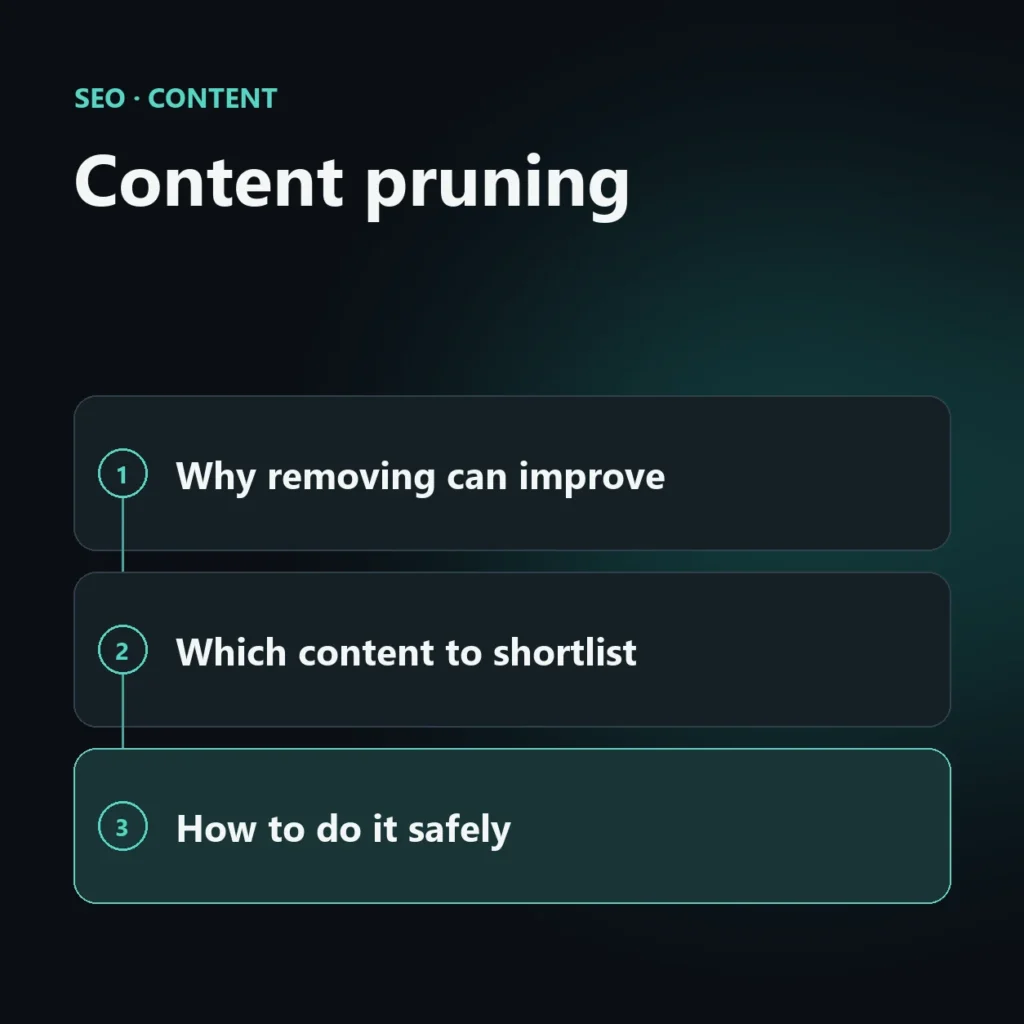
Content pruning is the removal or merging of low-value content from a website to improve the average quality perceived by Google: fewer weak pages often mean a more authoritative overall profile in the eyes of search engines.
Why removing content can improve SEO
Google also evaluates the quality of a site in aggregate, not just page by page. A domain with hundreds of superficial, duplicate or never-updated articles can see its overall authority diluted compared to a leaner site with solid content. This phenomenon is particularly relevant after core updates, which often penalize precisely the sites with large amounts of low-value content.
Which content to consider for pruning
Pages with no traffic for over 12 months
Content that generates neither impressions nor clicks in Search Console for more than a year, and that has no structural informational value for the site.
Duplicate or cannibalized content
Several articles competing for the same keyword: better to merge them into one complete piece of content than to let them compete with each other.
Obsolete content that can’t be updated
Articles on outdated topics (old software versions, changed regulations) that no longer have a reason to exist and can’t be updated credibly.
How to do content pruning without risk
The options are not just “delete”: you can merge several similar pieces of content into one with a 301 redirect, update a dated piece of content instead of removing it, or remove it permanently (with a redirect to a relevant page) only when there is no other sensible option. A history should always be kept before proceeding, and the results should be monitored for at least 4–6 weeks after the change, ideally within a broader content strategy.
Frequently asked questions about content pruning
Is content pruning always good for SEO?
No, it must be done with careful analysis: removing content that generates even minimal traffic without a redirect strategy can harm rankings.
Is it better to delete or set to noindex?
It depends on the case: deleting with a redirect consolidates value on another page, noindex leaves the content accessible but out of Google’s index.
How long does it take to see results from content pruning?
Generally a few weeks, but the full effect can take up to a couple of months depending on how often the site is crawled.



SEO, GEO and AEO specialist
Related articles
 SEOContent Gap Analysis: What Competitors Write and You Don’tOctober 30, 2026
 SEOBacklink Gap: Analyzing Competitor LinksOctober 30, 2026
 SEOHow to Find Your Real SEO CompetitorsOctober 30, 2026
Explore by topic