
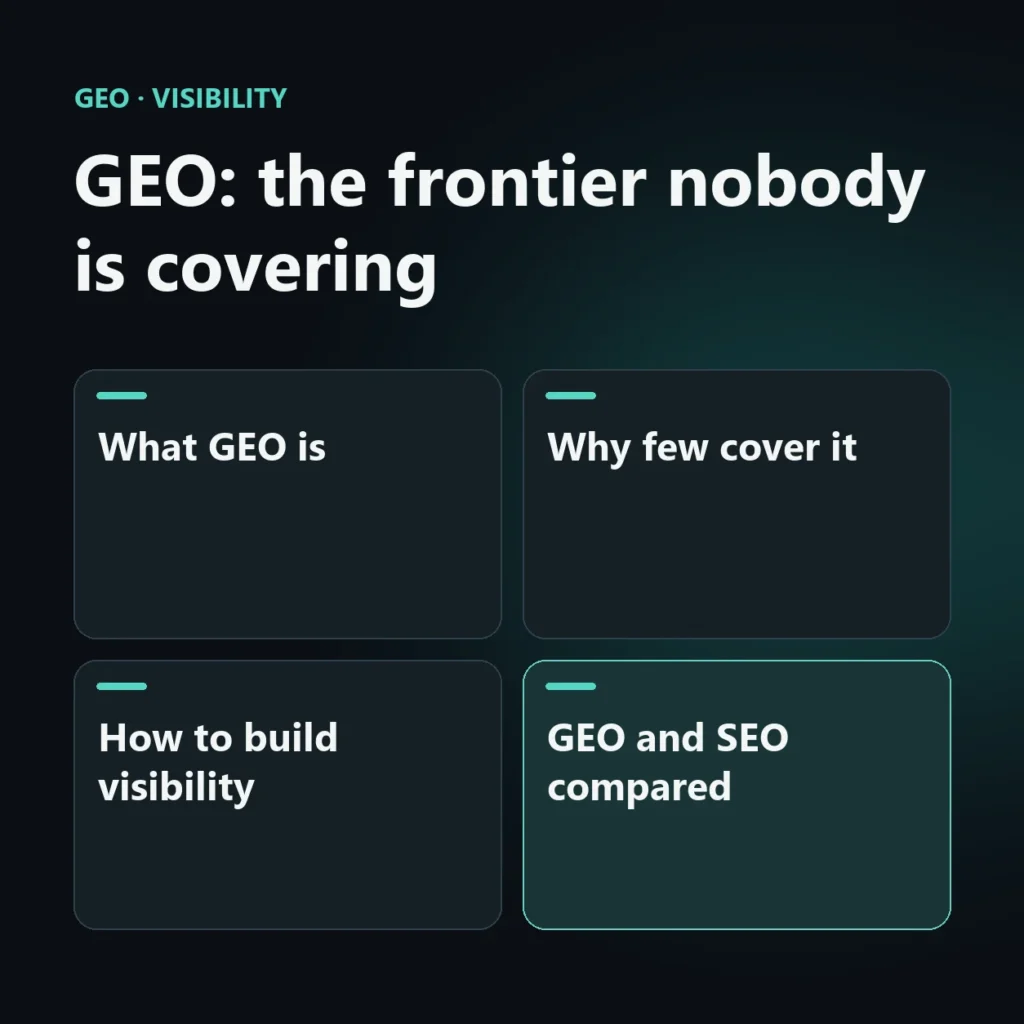
Generative Engine Optimization is the set of practices that make content citable and visible in answers generated by artificial-intelligence-based engines. While classic SEO keeps covering the blue-link results, a growing share of informational searches is shifting toward answers synthesized by language models, which aggregate sources and return a single text. In this hybrid space competition is still low: many companies haven’t yet adapted content, structure and trust signals to an ecosystem that rewards criteria different from the traditional ones. Those who move now have a concrete advantage, because they build a foothold while others are still debating whether it is worth doing.
What Generative Engine Optimization is and why it changes the rules
Generative Engine Optimization comes from the observation that generative engines don’t show a list of links, but compose an answer. This changes the endpoint of optimization: it is no longer just about winning a position, but about becoming one of the sources the model chooses to cite or paraphrase. Visibility thus becomes a matter of inclusion in the generated text, not of ranking on a results page.
The starting point is understanding how these systems select sources. A generative engine typically retrieves relevant documents, evaluates them for reliability and relevance, then synthesizes. Each step has implications for those who publish content: clarity of exposition matters more than keyword optimization, semantic structure helps retrieval, authority signals guide the choice. Those who approach Generative Engine Optimization with the logic of keyword stuffing alone get little, because models reward content that truly answers a question.
There is also a difference in measurement. If in SEO you look at rankings and clicks, in GEO you observe mentions and citations within answers. This requires new tools and metrics, but also a different attitude: you optimize to be a recognized source, not to capture an immediate click.
Why almost nobody is covering this space
The main reason is that the phenomenon is recent and evolving fast. Many companies have invested years in traditional SEO and see Generative Engine Optimization as a marginal variant, to be tackled when it becomes “mature”. The result is that entire sectors remain uncovered: those who publish well-structured, verifiable content today occupy a space that in a few years will be contested.
On top of this there is a certain terminological confusion. People talk about AEO, GEO, optimization for conversational assistants as if they were the same thing, and this ambiguity slows down decisions. In reality Generative Engine Optimization is a broad container, which includes the structure of content, its verifiability and the ability to be cited. Companies that don’t untangle this knot stay stuck.
A temporary advantage, not a permanent one
The advantage of those who move early is not definitive. As happened with SEO, the spread of the practices will lead to greater competition. The difference is that today the entry cost is low: clear, well-organized content and solid references are enough. Those who wait will have to catch up with those who have already built a consolidated presence in generated answers.
How to build visibility in generative engines
The first pillar is content structure. Generative engines work better with texts that answer precise questions, with clear sections and a readable hierarchy. An article that opens with the answer and then goes deeper is easier to extract than a text that keeps the conclusion at the end. This doesn’t mean dumbing down, but organizing information so that it is retrievable and citable.
The second pillar concerns sources and references. Content that cites verifiable data, studies and primary sources is more likely to be selected, because the model looks for reliability. This is where the topic of citations in generative enginescomes into play, which are not a technical detail but a signal of perceived quality. The more content is anchored to solid references, the more likely it is to be picked up.
The role of authority
The third pillar is authority. Models tend to favor recognizable sources, with a consistent editorial history and signals of expertise. Building content authority means working on who signs, on what is published and on how it is perceived. It is not a quick operation, but it is what distinguishes content that gets cited from content that is ignored.
These three pillars don’t work in isolation. A well-structured text with no sources remains weak; an authoritative source that is poorly organized is hard to extract. Effective Generative Engine Optimization comes from the integration of structure, references and reputation.
GEO and SEO: differences, overlaps and priorities
Many wonder whether Generative Engine Optimization replaces SEO. The answer is no: the two partly overlap and remain complementary. A good SEO base — speed, indexing, relevant content — remains necessary, because generative engines also draw from the indexed web. The difference lies in the goals and the selection criteria.
In SEO you optimize for a query and a position; in GEO you optimize for a question and a citation. In SEO backlinks and domain authority matter; in GEO clarity, verifiability and semantic consistency matter. In SEO the result is a click; in GEO the result is a mention, which can generate trust even without immediate direct traffic.
The table below summarizes the main differences to help set priorities.
| Dimension | Traditional SEO | Generative Engine Optimization |
|---|---|---|
| Goal | Position in the results | Inclusion and citation in the generated answer |
| Optimization unit | Page and keyword | Section, question and verifiable claim |
| Main signals | Backlinks, domain authority, relevance | Clarity, sources, semantic consistency, authority |
| Measurement | Rankings, clicks, impressions | Mentions, citations, presence in answers |
| Time horizon | Medium-long | Short-medium, with an advantage for those who move first |
An operational priority emerges from this reading: consolidate the SEO base and, in parallel, adapt content to the criteria of Generative Engine Optimization. It is not an alternative, but an extension of editorial and technical work.
«Generative Engine Optimization (GEO), the first novel paradigm to aid content creators in improving their content visibility in generative engine responses» — Aggarwal et al., “GEO: Generative Engine Optimization”, arXiv 2311.09735
Common mistakes and how to avoid them
The first mistake is treating Generative Engine Optimization as a technical shortcut. There are no stable tricks: models change, criteria get updated. Those looking for a fixed formula end up disappointed. Those who work on solid, well-structured content build an advantage that withstands change.
The second mistake is neglecting verifiability. Claims without a source, unattributed data and sensationalistic tones reduce the likelihood of being cited. Generative engines favor content that can be verified and attributed with reasonable certainty.
An incremental approach
The third mistake is wanting to redo everything at once. An incremental approach works better: start from the most strategic content, restructure the key sections, add sources and monitor how mentions change. Generative Engine Optimization is a process, not a one-off intervention.
Frequently asked questions about Generative Engine Optimization
What is the difference between SEO and Generative Engine Optimization?
SEO aims to rank a page in link-based results, while Generative Engine Optimization aims to get content cited within a generated answer. The two practices overlap but have different goals and metrics.
Is Generative Engine Optimization useful for small companies too?
Yes, because the criteria reward clarity, structure and verifiability, not just brand size. A small company with well-organized content can be cited as much as a large one.
How long does it take to see results?
It depends on the sector and the competition. In many cases the first signals arrive sooner than with traditional SEO, but consistency remains decisive.
Do you need to give up traditional SEO?
No. SEO remains the foundation on which visibility in generative engines is built. The two activities should be integrated, not set against each other.
How do you measure visibility in generative engines?
You observe mentions, citations and presence in generated answers, as well as how consistently a source is picked up over time. There is not yet a single shared standard.
Which content works best in Generative Engine Optimization?
Clear, well-structured texts with direct answers and verifiable references. Sections organized by question make extraction and citation easier.
When AI doesn’t cite you, you lose the customer before the search
If your brand doesn’t appear among the sources that ChatGPT, Gemini or Perplexity cite, that question will never reach you: visibility is shifting from SERPs to generative engines, and staying out means being invisible exactly where purchase decisions are formed. At geo-seo.pro I work on this: I structure content, entities and signals designed to get your company recognized and cited by AI assistants, with a measurable, ongoing method.

SEO, GEO and AEO specialist
Related articles
 GEOCompetitors in AI Answers: Who Gets CitedOctober 30, 2026
 GEOChatGPT and Bing: What We Actually KnowOctober 30, 2026
 GEOBing AI Performance Report: How to Read ItOctober 30, 2026
Explore by topic