
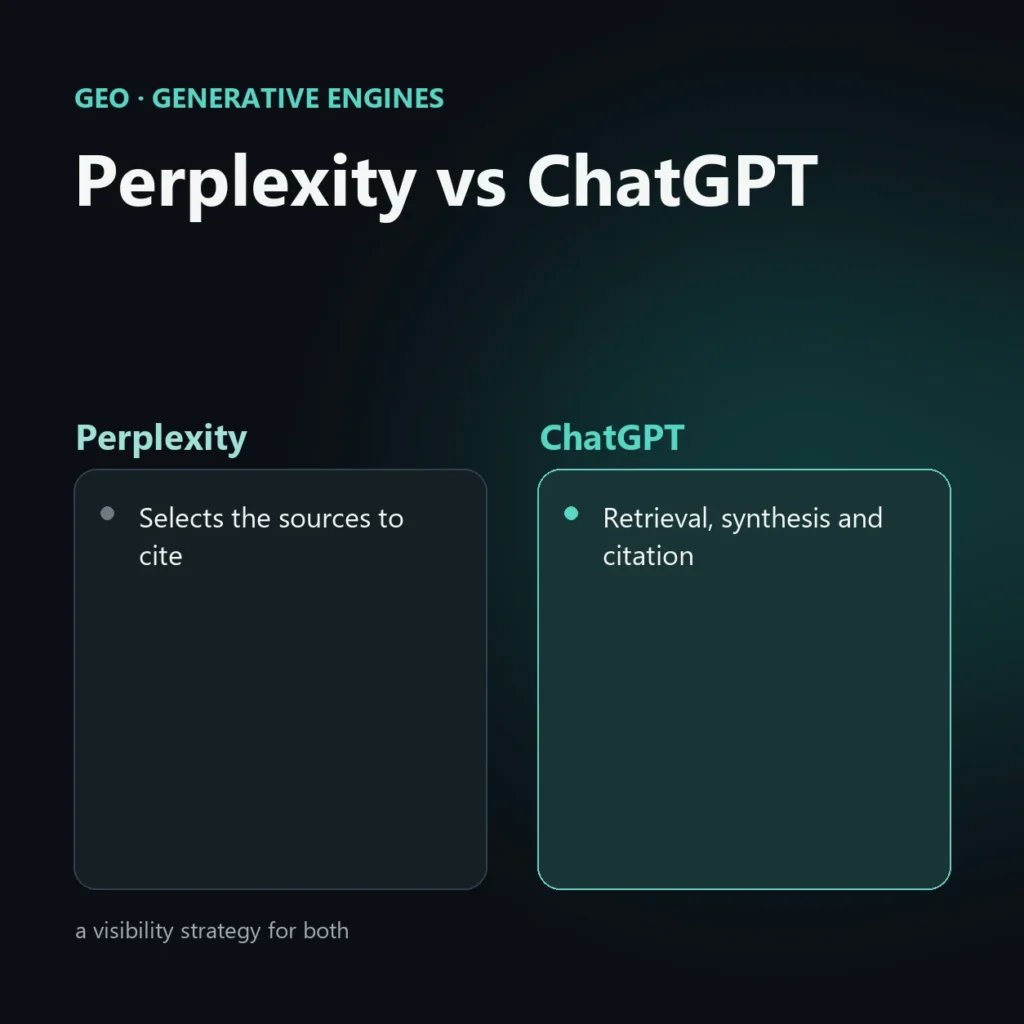
Perplexity visibility is the ability of a piece of content to be cited, summarized and linked by Perplexity in its generative answers. Unlike traditional search engines, which return a list of links, generative engines build a single answer from multiple sources and explicitly cite only some of them. This radically changes the rules of the game: ranking is no longer enough, you have to be chosen as an authoritative source. Perplexity and ChatGPT, while sharing the same generative nature, adopt different logics in how they select, synthesize and attribute sources. Understanding these differences is the starting point for building a visibility strategy that works on both fronts.
Perplexity and ChatGPT: two engines, two answer philosophies
Perplexity was born as a conversational search engine: its architecture is designed to query the web in real time, retrieve the most relevant sources and build a concise answer with numbered citations. Perplexity visibility therefore depends largely on a piece of content’s ability to be retrieved in real time by retrieval systems and to be authoritative enough to deserve an explicit citation.
ChatGPT, in its configuration with web search on, follows a partly different logic: it integrates browsing as an optional tool within a conversational model already trained on a vast base of knowledge. The result is that ChatGPT tends to mix prior knowledge and retrieved information, citing sources less systematically than Perplexity. For Perplexity the citation is the product, for ChatGPT it is often a side dish.
This structural difference has important practical consequences. Content optimized only for classic ranking can be retrieved by both engines, but only if it meets the generative source-selection criteria will it make it into the answer. Perplexity visibility therefore requires specific work on the structure of the content, the clarity of the statements and the verifiability of the information.
How Perplexity selects the sources to cite
Perplexity builds its answers from a narrow set of sources retrieved on the web. The system favors pages that answer the query directly, with well-structured, up-to-date content attributable to a recognizable source. The presence of verifiable data, clear definitions and self-contained paragraphs increases the chances of being selected.
Content structure and retrievability
Fragmented content, full of implicit references or lacking autonomous context, is rarely extracted as a source. Perplexity works best with blocks of text that answer a specific question completely, without depending on the rest of the page. This means each section should be readable and citable independently.
The presence of structured elements — clear headings, tables, property lists — also eases the work of retrieval systems. Perplexity visibility therefore comes from more modular writing, in which every paragraph has a precise role and a recognizable claim. Those who work on Perplexity optimization know that clarity of exposition counts more than keyword density.
Authority and freshness
Perplexity tends to prefer sources that show signals of authority: an identifiable author, a recent publication date, references to primary sources. Continuously updating content is a factor that affects the likelihood of being retrieved, because the engine favors current information over dated material.
This doesn’t mean evergreen content is penalized, but that it must be kept alive with periodic revisions. An article published years ago and never touched hardly competes with a recently updated resource on the same topic.
ChatGPT: retrieval, synthesis and optional citation
ChatGPT with web search on combines two sources of knowledge: what it learned during training and what it retrieves in real time. This makes it less dependent on the quality of any single retrieved page, but also less predictable in citation. A piece of content can influence the answer without being cited, or be cited briefly alongside other sources.
The consequence for those working on visibility is thatChatGPT optimization must aim at two distinct goals: being retrievable and being recognizable as a reliable source. The first depends on technique, the second on the domain’s reputation and the consistency of the content published over time.
The role of topical consistency
ChatGPT tends to trust domains that cover a topic continuously and in depth more. A site that publishes sporadically on unrelated topics is less likely to be considered a reference source than a site that builds recognizable expertise in a specific area.
Perplexity visibility and ChatGPT visibility therefore share a common principle: topical specialization pays more than quantity of content. Publishing a lot on everything is less effective than publishing well on little.
Operational differences between the two strategies
The two platforms require complementary but not identical approaches. For Perplexity what matters most is the ability to be retrieved and cited in real time, so content structure and freshness are the priorities. For ChatGPT what matters is the ability to be recognized as a reliable source, so domain consistency and the overall quality of the content weigh more.
In both cases, however, the work on citations in generative engines follows similar logics: clear, verifiable, attributable statements. Generative optimization is not a technical shortcut, but a way of writing and structuring content designed to be read and reused by a language model.
A common mistake is treating Perplexity visibility as a variant of traditional SEO. The two disciplines partly overlap, but the signals that matter are different: less weight on exact keywords, more on clarity, structure and the reputation of the source.
| Aspect | Perplexity | ChatGPT (with web search) |
|---|---|---|
| Retrieval mode | Real-time web search as a primary function | Web search integrated as an optional tool |
| Source citation | Systematic and numbered | Variable, often brief |
| Key factor for visibility | Content structure and freshness | Domain consistency and overall reliability |
| Role of prior knowledge | Limited, live retrieval prevails | Significant, combined with retrieval |
| Impact of topical specialization | Medium-high | High |
Building a visibility strategy that works on both
An effective strategy doesn’t choose between Perplexity and ChatGPT, but builds content that meets the criteria of both. This means writing clearly, structuring pages in self-contained blocks, updating content regularly and maintaining a recognizable topical consistency.
Perplexity visibility thus becomes a useful indicator for measuring the overall quality of a piece of content in the eyes of generative engines. If an article is cited by Perplexity, it has a good chance of being considered relevant by other generative answer systems too. The citation is a signal of quality, not just of technique.
Monitoring citations, checking how content is summarized and correcting ambiguities are ongoing activities, not one-off ones. Generative engines evolve quickly, and what works today may need adjustments tomorrow.
Frequently asked questions about Perplexity and ChatGPT
What is Perplexity visibility?
It is the ability of a piece of content to be retrieved, synthesized and cited by Perplexity in its generative answers, thanks to a clear structure, freshness and the authority of the source.
Do Perplexity and ChatGPT cite sources in the same way?
No. Perplexity cites systematically and with numbers, while ChatGPT integrates web search in a more variable and often brief way.
Do you need a different strategy for the two engines?
The basics are shared, but Perplexity rewards structure and freshness, while ChatGPT gives more weight to domain consistency and overall reputation.
Is traditional SEO enough for generative visibility?
Not entirely. SEO remains useful for retrieval, but generative visibility requires clarity of exposition, self-contained blocks and verifiability of claims.
How much does content freshness matter?
A lot, especially for Perplexity, which favors recent and verifiable information. Dated content that is never revised loses competitiveness.
How do you measure Perplexity visibility?
By monitoring how many times a piece of content is cited in Perplexity’s answers and how it is summarized, so as to correct ambiguities and improve the structure.
The visibility lost between Perplexity and ChatGPT
If your brand appears in ChatGPT’s answers but stays invisible on Perplexity, the problem isn’t the quality of the content: it’s the lack of a strategy designed for the citation logic of each generative engine. Optimizing for only one of the two means leaving room for competitors on the other. That is why I work on both fronts, calibrating content and signals to how each platform selects and cites sources. It is the heart of my Generative Engine Optimization.
SEO, GEO and AEO specialist
Related articles
 GEOCompetitors in AI Answers: Who Gets CitedOctober 30, 2026
 GEOChatGPT and Bing: What We Actually KnowOctober 30, 2026
 GEOBing AI Performance Report: How to Read ItOctober 30, 2026
Explore by topic