
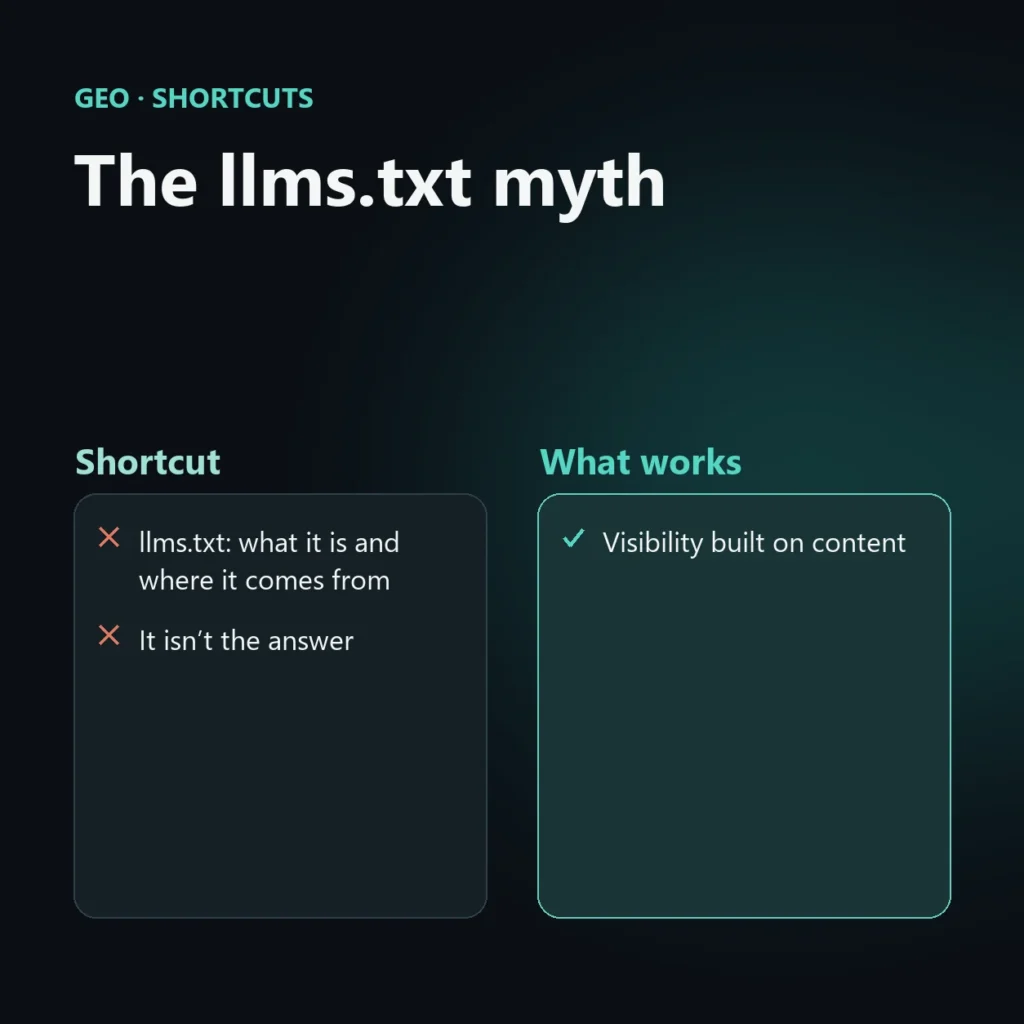
llms.txt is a text file that some sites publish in the root of the domain to give AI agents a concise map of the most useful content, but it is not a shortcut that guarantees visibility in generative engines. Since the proposal began to circulate, many marketing professionals have treated it as a kind of magic switch: you upload it, and artificial intelligence cites you. The reality is more nuanced. Understanding what this file really does, what it can’t do and which concrete alternatives exist is now a basic skill for those working on visibility in generative engines, well beyond simply adding a document to the site’s root.
What llms.txt is and where it comes from
The llms.txt proposal was born to address a real problem: language models browsing the web struggle to tell, within an HTML page full of menus, banners, scripts and promotional content, which information is really relevant. The idea is simple: offer a lightweight, structured Markdown file that lists the main sections of the site with short descriptions and direct links.
The format closely resembles robots.txt and sitemap.xml, but with a substantial difference: while those files serve traditional crawlers for technical purposes, llms.txt is designed for direct consumption by an agent that has to understand and cite the content. It is an attempt to speak the language of generative systems, not just that of classic search engines.
It is worth reading carefully what llms.txt really is before investing time and resources in it, because the distance between the intention of the proposal and the observable results is often wider than you might think.
Why llms.txt is not the shortcut it seems
The first misunderstanding concerns adoption. There is no official standard ratified by a standards body, nor any obligation for the major models to read that file. It is a convention proposed by the community, which some tools support and others ignore completely. This means that publishing llms.txt doesn’t automatically activate anything: it is an indication, not a command.
The second misunderstanding is strategic in nature. Even if a model did read the file, the decision to cite a source depends on far more complex factors: the perceived authority of the domain, the consistency of information across multiple sources, the clarity of the content and its actual usefulness for the user’s question. A well-made file on a site with weak content remains a well-made file on a site with weak content.
The verifiability problem
A further practical limit is the absence of reliable metrics. There is no dashboard showing how many times llms.txt has been read or has influenced a generative answer. Without verifiable data, any assessment of effectiveness risks turning into anecdote. That is why it makes sense to treat it as a hypothesis to test, not as a certainty to sell.
What really works for visibility in generative engines
If llms.txt is a bet, the real game is played elsewhere. Generative engines reward content that answers real questions directly, with clear structure, recognizable sources and information that stays consistent over time. This is the heart of Generative Engine Optimization: not a technical trick, but a set of editorial and technical practices that make content easy to extract, understand and reuse.
Among the elements that matter most are the clarity of headings, the use of short, self-contained paragraphs, the presence of verifiable data and consistency of tone. A model that has to generate a concise answer tends to favor passages it can cite without reworking them too much. Writing to be cited means writing so that every paragraph can stand on its own.
The role of citations and sources
Another decisive factor is the presence of explicit, recognizable references. When content cites authoritative sources and is in turn cited by others, a circuit of trust is created that models tend to reward. Digging into the topic of citations in generative engines helps you understand why reputation, more than technique, drives many automatic answers.
In this picture, llms.txt can play a marginal but not central role: it serves to ease reading, not to build authority. Whoever presents it as the key to AI ranking confuses a support tool with a strategic lever.
The myth of shortcuts: why they attract
Shortcuts are appealing because they promise quick results with minimal effort. In the field of AI visibility, this temptation shows up in various ways: magic files, plugins that “optimize for ChatGPT”, lists of prompts to insert into pages. They are all solutions that shift attention from content to technique, inverting the correct order of priorities.
The original proposal of the standard is clear in its intentions, and it is worth quoting verbatim:
«A proposal to standardise on using an /llms.txt file to provide information to help agents use a website.» — llmstxt.org, the original proposal of the standard
Note the word proposal: it is a proposal, not an established standard. That doesn’t make it useless, but it places it in the category of experiments to be evaluated with moderation. Those who treat a proposal as a rule risk building strategies on fragile foundations.
Comparison of approaches to AI visibility
To get oriented, it helps to compare the most discussed levers, distinguishing between what has structural impact and what remains accessory.
| Lever | What it does | Real impact | Priority |
|---|---|---|---|
| llms.txt | Provides agents with a concise map of the content | Variable, depends on the model’s adoption | Medium |
| Clear, structured content | Makes every paragraph extractable and citable | High and lasting | High |
| Authority and external citations | Build trust with models | High, but slow to build | High |
| Structured data and markup | Make technical interpretation easier | Medium, complementary | Medium |
| Plugins and automatic shortcuts | Promise optimization without editorial work | Low or none | Low |
The table makes one simple thing clear: the high-impact levers are also those that require the most work and time. Shortcuts, by definition, are at the bottom of the list.
How to use llms.txt sensibly
This doesn’t mean ignoring it. If your site has solid content, adding llms.txt is a low-cost operation that can make reading easier for some agents. It makes sense when a well-kept editorial base already exists, not as a substitute for it.
A reasonable approach is to treat it as a documented experiment: you publish it, observe whether anything changes in citations, and in the meantime keep investing in what really matters. Technology changes, the principles of clarity and authority remain.
Mistakes to avoid
Among the most common mistakes is filling llms.txt with huge lists of URLs, turning it into a disguised sitemap. A file like that loses its main function, which is to give priority and context. Better a few well-chosen, well-described entries, consistent with the site’s goals.
Another mistake is expecting measurable results in a short time. Visibility in generative engines is an emerging, evolving phenomenon: those who demand immediate certainty end up chasing passing fads instead of building lasting value.
Frequently asked questions about llms.txt
Is llms.txt mandatory to be cited by AI?
No, it is neither mandatory nor a ratified standard. It is a proposal that some tools support and others ignore, so its absence doesn’t rule out visibility.
Is publishing llms.txt enough to improve AI ranking?
No. The file can make content easier to read, but ranking depends mostly on the quality, clarity and authority of the published information.
How do you write a good llms.txt file?
With a few well-chosen entries, short descriptions and direct links to the most useful sections. Better to avoid endless lists of URLs without context.
Does llms.txt replace the XML sitemap?
No, they have different functions. The sitemap serves traditional crawlers, while llms.txt is designed for consumption by agents that need to understand the content.
Can you measure the effectiveness of llms.txt?
At the moment there are no reliable, widespread metrics. It should be treated as an experiment to observe, not as a lever with guaranteed results.
What are the most effective alternatives to shortcuts?
Clear, well-structured content, recognizable sources, consistency over time and attention to external citations. They are slower levers but much more solid.
llms.txt isn’t enough to get you cited by LLMs
You publish an llms.txt file, declare it in robots, and wait: and models keep ignoring you or reporting wrong information about your brand. The point is that no configuration file convinces a model to trust you: what weighs is how your entities and content are written, structured and corroborated where LLMs actually go to read. It is exactly the work I do at geo-seo.pro: I build generative visibility starting from solid technical and semantic foundations, not from a shortcut.
SEO, GEO and AEO specialist
Related articles
 GEOCompetitors in AI Answers: Who Gets CitedOctober 30, 2026
 GEOChatGPT and Bing: What We Actually KnowOctober 30, 2026
 GEOBing AI Performance Report: How to Read ItOctober 30, 2026
Explore by topic