
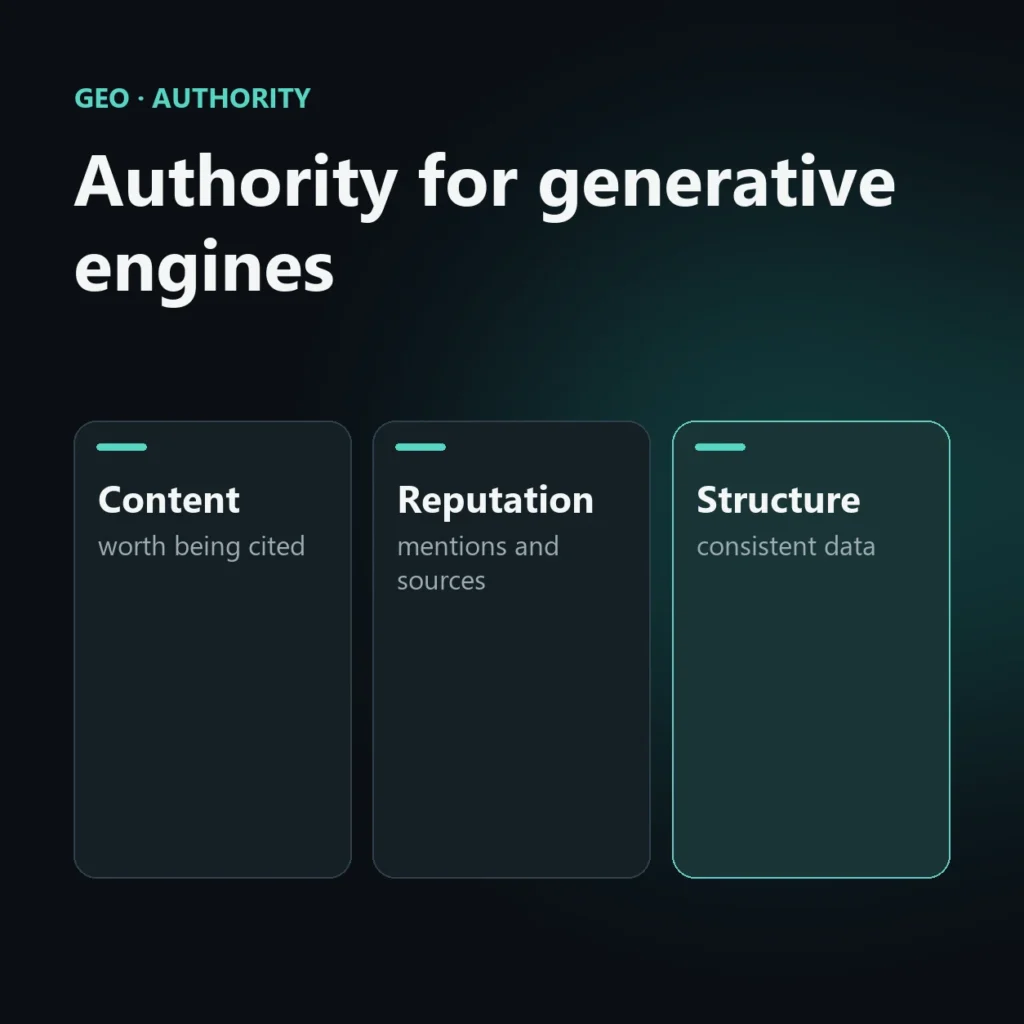
Building authority for generative engines means making an artificial intelligence system, when it generates an answer, choose to cite your company as a reliable source on a certain topic. It is not a technical trick nor a parameter to optimize overnight: it is the cumulative result of solid content, verifiable reputation and consistency over time. Generative engines don’t “read” an isolated page the way a traditional crawler did: they reconstruct a context, compare sources, assess how much an entity is recognized and cited elsewhere. This changes the rules of the game and makes the groundwork on credibility even more central.
Why authority with generative engines can’t be bought
Those who have worked in digital marketing for years know the immediate instinct: find the shortcut. Buy links, inflate profiles, publish dozens of generic articles hoping one takes root. With generative engines this logic crumbles, because the system doesn’t reward the single page but the consistency of the entire entity. Authority with automatic answer systems rests on signals that take time, such as recurring citation in third-party sources, presence in coherent topical contexts and the ability to be mentioned by name when a specific subject is discussed.
A language model doesn’t “know” who you are until it has met you many times, in many different sources, always associated with the same field. It is a reinforcement mechanism: the more a source is picked up, summarized and linked to a topic, the more likely it is to be cited in a generated answer. This is why authority is not an attribute of the page but of overall reputation.
The practical consequence is that quick tactics produce fragile results. A spike of uncoordinated mentions doesn’t build memory. What you need instead is a strategy that combines content, public relations and consistency of positioning, exactly as happens withE-E-A-T, the framework of criteria with which Google evaluates the experience, expertise, authoritativeness and trustworthiness of those who publish.
The foundations: content worth citing
No authority strategy for generative engines holds up if there isn’t content at the base that someone wants to cite. A generative system selects sources based on their usefulness in answering a question: if your content adds nothing to what is already available, there is no reason for it to be picked up. This moves the bar from quantity to information density.
What makes content citable
Citable content has a few recurring characteristics. It defines concepts precisely, avoids ambiguity, provides concrete examples and maintains a recognizable point of view. It doesn’t try to cover everything, but to be the reference source on a specific aspect. In this sensecontent authority is built by accumulation: every well-made piece strengthens the others and makes the whole archive more credible in a model’s eyes.
A second element is structure. Generative engines work better with texts organized in clear sections, with explicit headings and self-contained passages. It isn’t formatting for its own sake: a well-segmented answer is simply easier to extract and reuse. Writing to be understood by a model means, first of all, writing to be understood by a person.
Finally, the byline matters. Anonymous content is worth less than content signed by someone with a verifiable profile, a professional history and demonstrable skills. The author is part of the reliability signal.
External reputation: mentions, sources and relationships
The second pillar of authority with generative engines is what others say about you. A model doesn’t trust only what you write on your own site: it weighs above all how you are described elsewhere, in independent contexts. Mentions don’t necessarily require a link; a well-contextualized text citation can be worth as much as a link, because it feeds the system’s associative memory.
This is where digital PRcomes in, understood not as a mere search for media coverage but as building lasting relationships with publications, experts and industry communities. The goal is not the single article, but recurring, consistent presence in places a model considers reliable. Entity and knowledge graph are the technical concepts that describe this phenomenon: the more an entity is described unambiguously and linked to other relevant entities, the easier it is for it to be recognized and cited.
The role of third-party sources
Third-party sources work as a network of confirmations. If a company is described as a specialist in a certain field by a publication, by a trade association and by a recognized professional, the signal consolidates. If instead the descriptions are contradictory or generic, the system struggles to place the entity and tends to prefer more clearly defined subjects.
This explains why consistency of message counts more than volume. A few well-aligned mentions are worth more than many scattered ones. Consistent repetition builds recognition; dispersion dilutes it.
How reputation is measured
Measuring authority with generative engines isn’t as immediate as reading a ranking position. You observe indirect indicators: how often the brand is cited in generated answers, presence in authoritative sources of the sector, the consistency of the descriptions in circulation. They are qualitative signals, but over time they tell you whether the strategy is working.
Technical consistency and data structure
The third pillar concerns the most technical part, which is no less important for that. A generative engine must be able to link your name, your site and your content unambiguously. If information is scattered, inconsistent or unstructured, the work of reconstructing the entity becomes harder and the system will tend to trust clearer sources.
This means taking care of structured data, keeping company descriptions consistent across all channels, making sure the main pages state precisely who you are and what you do. It isn’t optimization for its own sake: it is reducing ambiguity to make recognition simpler.
| Pillar | What it builds | Time horizon | Possible shortcut? |
|---|---|---|---|
| Content | Information density and citability | Medium-long | No, quality can’t be faked |
| External reputation | Independent mentions and confirmations | Long | No, relationships take time |
| Technical consistency | Unambiguous recognition of the entity | Short-medium | Partial, but not enough on its own |
| Continuity over time | Memory and perceived reliability | Long | No, consistency can’t be bought |
The table makes one point clear: none of the pillars can be replaced with a shortcut. Technical consistency is the only area where results can be obtained faster, but on its own it doesn’t build authority. It is the enabling factor, not the substance.
Mistakes that weaken authority with generative engines
There are recurring behaviors that undo the work. The first is producing generic content, written to fill an editorial calendar rather than to answer a real question. The second is inconsistency: a company that presents itself in different ways on different channels confuses the system and loses recognizability.
A third mistake is chasing every trend without a clear editorial line. Thematic dispersion dilutes authority with generative engines, because the model can’t associate the entity with a specific expertise. Better to be recognizable on a few topics than invisible on many.
Finally, the most insidious mistake: treating authority as a project with an end date. It isn’t one. Reputation is maintained with the same care with which it is built, and generative systems continuously update their reference sources. Those who stop feeding their presence slip out of the answers over time.
«People-first content means content that’s created primarily for people, and not to manipulate search engine rankings.» — Google Search Central, “Creating helpful, reliable, people-first content”
This guidance, designed for traditional search, applies all the more to generative engines. A system that generates answers tends to favor sources that put people at the center, because those are the ones that prove most useful over time and therefore get cited more. Manipulation produces fragile, easily reversible results.
Frequently asked questions about building authority with generative engines
How long does it take to build authority with generative engines?
There is no fixed timeline: it depends on the starting point, the sector and continuity. In general the first signals appear after several months of steady work on content and reputation.
Is content enough to be cited by a generative engine?
No. Content is necessary but not sufficient: you also need independent mentions and entity consistency, otherwise the system has no external confirmations to rely on.
Are links still important for authority with generative engines?
They matter, but they aren’t the only signal. Mentions without links, if well contextualized, also help build entity recognition.
Can you use shortcuts to speed up the process?
Shortcuts produce fragile and often counterproductive results. Authority with generative engines rests on signals that take time and consistency, which are hard to fake.
How is authority toward generative systems measured?
You observe indirect indicators: frequency of citations in generated answers, presence in authoritative sources and consistency of the descriptions circulating about the brand.
Do you need a new site to work on authority with generative engines?
No. You can start from an existing site, as long as you act on content, data structure and entity consistency in a systematic way.
Authority that generative engines don’t recognize
You have solid content, real expertise, years of work in your sector. Yet when a generative engine builds an answer, your company isn’t cited: in its place appear sources that are more visible but no more authoritative than you. The problem isn’t what you know, it’s how that expertise is made legible and verifiable to algorithms. I work on exactly this: recognizable entities, trust signals, content structured to be understood and picked up. It is the core of what I do at geo-seo.pro.

SEO, GEO and AEO specialist
Related articles
 GEOCompetitors in AI Answers: Who Gets CitedOctober 30, 2026
 GEOChatGPT and Bing: What We Actually KnowOctober 30, 2026
 GEOBing AI Performance Report: How to Read ItOctober 30, 2026
Explore by topic