
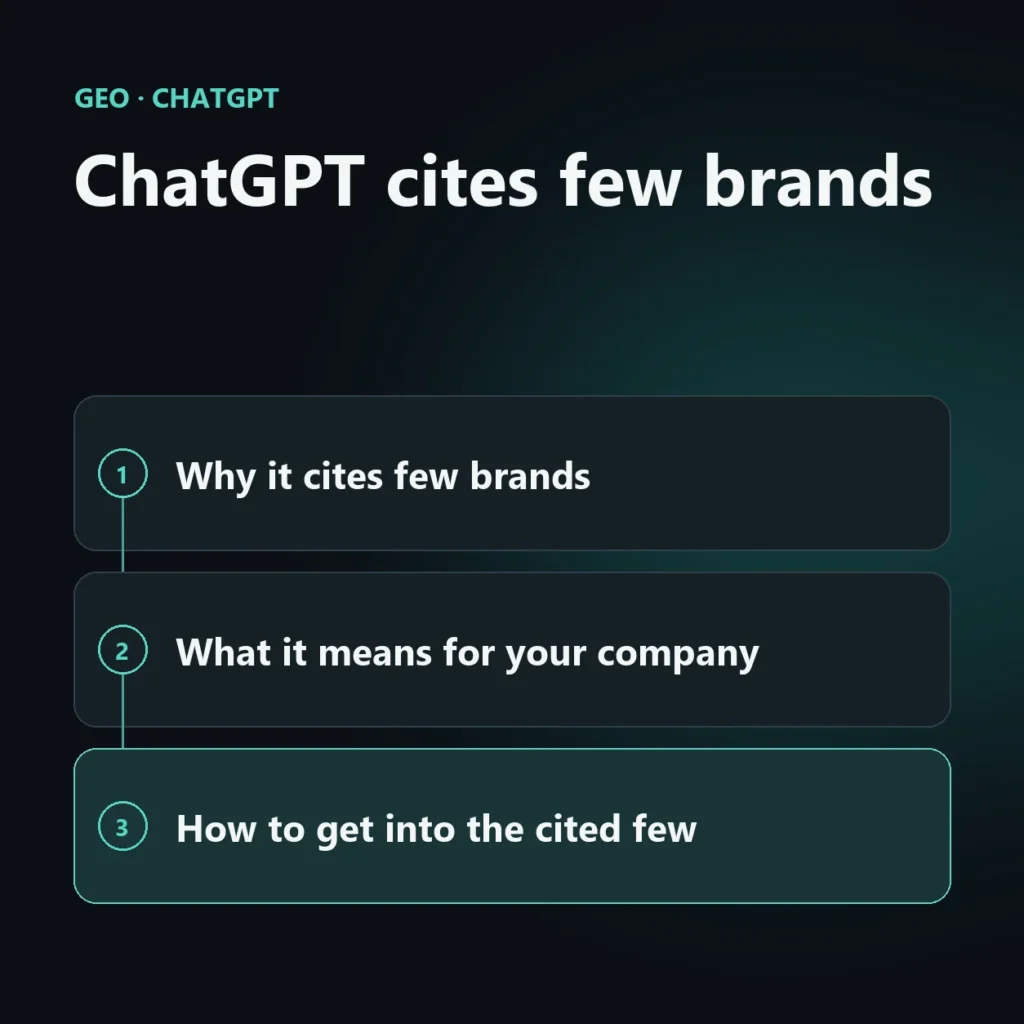
The brands cited by ChatGPT are a small minority: only a small share of companies appear in generated answers, while the majority remain invisible. This fact, observable in any test session with the main language models, is changing how companies need to think about their digital presence. It is no longer just about ranking on Google, but about making it into the set of sources that artificial intelligence selects, reworks and cites when a user asks a question. Understanding how this selection works is the first step to not being left out of the flow of information that generative assistants deliver every day.
Why ChatGPT cites so few brands
The mechanism behind ChatGPT’s answers is not a simple query to a search engine. The model generates text from patterns learned during training and, when it has access to external sources, integrates information retrieved in real time. In both cases, source selection follows criteria of perceived authority, consistency and frequency of mention, not a linear ranking like that of organic results.
This means that the brands cited by ChatGPT tend to be those that appear most regularly in third-party sources considered reliable: encyclopedias, news outlets, industry portals, technical documentation, high-reputation forums. A company that isn’t mentioned in these contexts, however well optimized its site, is unlikely to enter the generated answers. Visibility in the generative context is built elsewhere than on the classic results page.
A further narrowing factor is the synthetic nature of the answers. ChatGPT doesn’t list ten options the way a SERP would: it proposes two or three names, often just one. Competing to get into that narrow shortlist is therefore far more selective than the first page of Google, where the available space is still larger. That is why even companies with good traditional SEO performance can be absent from the assistant’s answers.
The role of third-party sources in selection
When the model retrieves information from the web, it favors pages that cover the topic in a structured, verifiable way. The citations in generative engines arise from this cross-checking: the model needs multiple confirmations to include a brand in an answer. A single isolated mention is rarely enough. You need consistent presence across several sources, with aligned information about what the company does and how it positions itself.
This creates a cumulative effect: those already cited tend to be cited again, because their past mentions feed the model’s perception of reliability. Those starting from zero have to build that presence from scratch, with methodical work on content, digital public relations and structured data.
What it means for your company’s visibility
The most immediate consequence is a redistribution of informational traffic. More and more users ask questions directly to an assistant instead of opening a web page, and receive a concise answer that often requires no further clicks. If your brand isn’t among those cited, that conversation happens without you: the user doesn’t know you exist, or worse receives information about a competitor as if it were the only relevant option.
This doesn’t concern only big companies. On the contrary, in vertical niches the chance of emerging as a reference is real, because the model has fewer candidates to choose from. A specialized company that publishes solid technical content and earns mentions in authoritative contexts of its sector has a good chance of entering the answers, even without a budget comparable to that of the major players. The game is played on the quality and consistency of sources, not on size.
The difference between SEO ranking and presence in AI answers
Ranking first on Google for a keyword doesn’t guarantee being cited by ChatGPT. The two systems optimize different goals: the search engine ranks pages, the model synthesizes knowledge. The first rewards the relevance and authority of the specific page; the second looks for consistency across multiple sources and the overall reliability of the entity. That is why the strategies must be integrated: SEO brings visibility and signals, but specific work on ChatGPT optimization is needed to turn that visibility into generative mentions.
A frequent mistake is treating GEO as a simple extension of on-page SEO. In reality it requires working on the brand’s identity as a recognizable entity, on presence in third-party sources and on the structure of content so that it can be easily extracted and reused by the model. These are different activities, with different metrics.
How to get into the shortlist of cited brands
The first step is understanding why your brand isn’t mentioned today. The causes can vary: no mentions in authoritative sources, content that doesn’t answer users’ questions directly, structured data that is incomplete or inconsistent across platforms. Analyzing these gaps helps define a targeted strategy instead of proceeding by trial and error.
If the problem is the absence of external signals, the priority becomes building presence in news outlets, industry directories, review platforms and relevant communities. If instead the problem is content quality, you need to review the structure of the pages to make them clearer, more factual and more citable. In many cases the two need to be tackled together, as I explain in the analysis on why ChatGPT doesn’t cite your site.
Content that models tend to reuse
The content that enters generated answers most easily shares a few characteristics: it answers a specific question in the first lines, uses clear, unambiguous language, contains verifiable data and precise definitions, and is organized in short, thematically consistent sections. Content written to be extracted and cited is more likely to be than a wordy text full of preambles.
Consistency across different pages of the same site also matters. If the model finds contradictory information, it tends to discard the entire source. Maintaining a uniform descriptive identity — name, sector, services, positioning — across the site, social profiles, directories and press releases is a basic requirement that many companies neglect.
Authority signals that really count
Not all mentions carry the same weight. A citation in a recognized trade publication is worth far more than dozens of appearances on low-quality sites. The quality of sources prevails over quantity, and this also applies to the links and references that lead to your brand. Better a few solid, consistent mentions than a widespread but superficial presence.
Structured signals count too: data organized in a machine-readable format, updated profiles, aligned contact details and descriptions. These are elements that help the model recognize the brand as a defined entity, not as a mere set of pages.
| Aspect | Traditional SEO | Presence in AI answers |
|---|---|---|
| Main goal | Ranking a page in the results | Being cited in a synthesized answer |
| Unit of analysis | The single page or keyword | The brand entity as a whole |
| Relevant sources | Site and backlinks | Mentions on authoritative third-party sources |
| Available space | Ten results per page | Two or three brands per answer |
| Key metric | Position and organic traffic | Frequency and context of citations |
Common mistakes that keep the brand out of citations
One of the most common mistakes is focusing exclusively on your own site, ignoring what is said about the brand elsewhere. Models rely largely on external sources, so a perfect but isolated site produces few signals. Without third-party mentions, the brand stays invisible to models, regardless of the technical quality of the pages.
A second mistake is writing generic content that talks about the sector without answering concrete questions. Models favor texts that contain clear answers to specific questions, because they are easier to reuse. An article that explains “what to do” in operational terms is more likely to be cited than one that tells the company’s story without useful informational elements.
Finally, the lack of consistency. Presence in generative answers isn’t built with an isolated intervention, but with a continuous flow of updated content and mentions that are consistent over time. The perceived authority of a model is the result of repeated, converging signals, not of a single peak of attention.
Frequently asked questions about brands cited by ChatGPT
Why does ChatGPT cite so few brands?
Because the answers are concise and the model selects only the sources it considers most reliable and consistent, reducing the available space to a few names per answer.
Does ranking first on Google guarantee being cited?
No. Organic ranking helps, but generative citation depends on mentions on third-party sources, entity consistency and content structure, not only on ranking.
How long does it take to get among the cited brands?
It depends on the starting point and the quality of existing signals. It takes ongoing work on content and mentions: there are no reliable shortcuts.
Do small companies have a chance of being cited?
Yes, especially in vertical niches, where the model has fewer candidates to choose from and specialization counts more than company size.
Is the content on your own site enough to be cited?
Rarely. Models rely largely on external sources: without authoritative mentions, a well-built site produces limited signals.
How do you measure presence in AI answers?
By regularly monitoring models’ answers to key questions in your sector and checking the frequency, context and tone of citations of the brand.
If ChatGPT doesn’t name you, it’s no accident
When you ask ChatGPT, Gemini or Perplexity which brands matter in your sector and your name doesn’t appear, the problem isn’t the visibility of the site: it’s the way generative models select and cite sources. I work on exactly this, building the conditions for generative engines to recognize you as a reference and include you in their answers. I analyze how you are perceived by AI and I intervene on content, entities and external signals to make you citable.
SEO, GEO and AEO specialist
Related articles
 GEOCompetitors in AI Answers: Who Gets CitedOctober 30, 2026
 GEOChatGPT and Bing: What We Actually KnowOctober 30, 2026
 GEOBing AI Performance Report: How to Read ItOctober 30, 2026
Explore by topic